Table of Contents
- Definition and Characteristics of the Baroque Style
- Combining Baroque Furniture with Modern Design: The Basic Principles
- The Role of Statement Pieces in the Modern Space
- Luxury Interior Design Ideas: Color Concepts and Contrasts
- Using Baroque Armchairs in a Modern Way: Upholstery and Textiles
- Vintage Solid Wood Furniture and Lighting as Baroque Style Elements
- Avoiding Cluttered Design and Practical Tips for Small Spaces
- Sustainability and Budget Options in the Style Mix
- Frequently Asked Questions
Last updated: August 31, 2026
Baroque Furniture in the Modern Living Room: A Guide to Mixing Styles
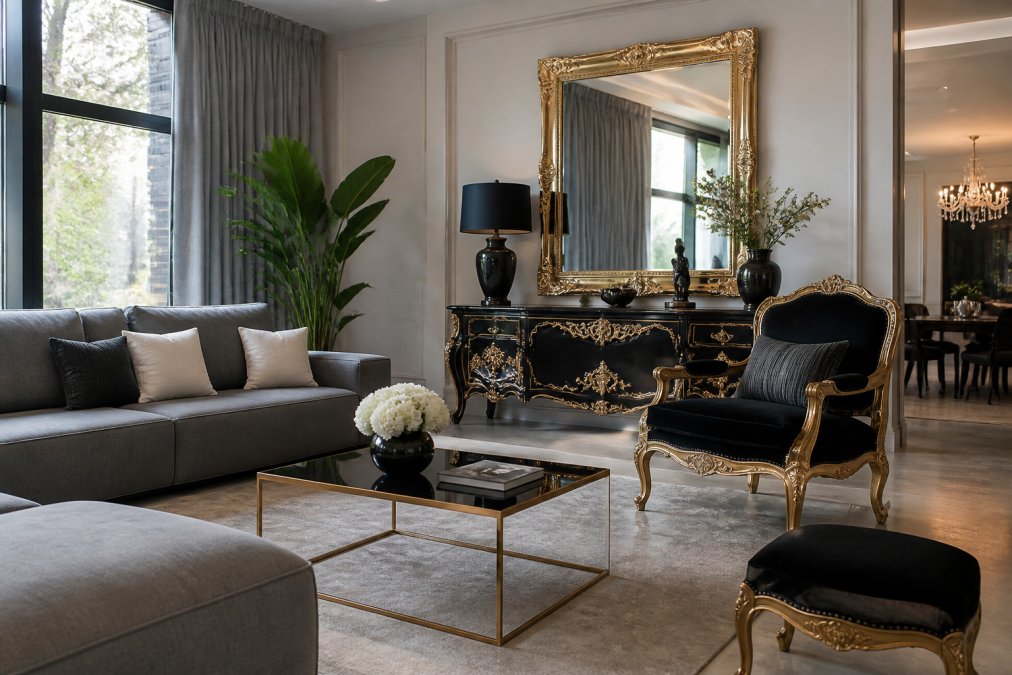
At first glance, the Baroque style and modern aesthetics seem irreconcilable. However, a carefully thought-out mix of styles creates spaces that feel both timeless and personal. Integrating Baroque furniture into a modern living room is an art that requires courage, understanding, and precise planning. At Casa Padrino, with two decades of experience in luxury projects, we know that this contrast does not just work – it tells a story of elegance and self-confidence.
The question is not whether Baroque fits into a modern living room. The question is: how do you do it right? This guide shows you the principles, techniques, and practical tips for elegantly integrating Baroque furniture into contemporary spaces without cluttering them.
Definition and Characteristics of the Baroque Style
The Baroque style is a design language of splendor and elegance. Originating in the 17th century, it is characterized by opulent ornamentation, curved shapes, bold colors, and rich materials. Baroque furniture is never subtle – and that is precisely its strength.
Typical characteristics of the Baroque style include:
- Elaborately carved wooden elements, often made of mahogany or walnut
- Gold accents, bronze or silver fittings
- Curved, organic lines instead of straight edges
- Upholstery in velvet, damask, or brocade
- Ornamental details such as shell motifs (rocaille), leaves, and floral patterns
- Chandeliers and candelabras as central design elements
What makes Baroque furniture still relevant today? This philosophy hits the nail on the head: Baroque pieces are statements. They communicate confidence and individuality in a world of mass production.
Baroque furniture differs fundamentally from modern furniture. While contemporary designs emphasize minimalism and functionality, Baroque celebrates ornamentation and visual richness. Nevertheless – or perhaps precisely because of this – they create an emotional depth in modern spaces that pure minimalist interiors often lack.
Combining Baroque Furniture with Modern Design: The Basic Principles
Combining Baroque furniture with modern design does not mean hiding or toning it down. It means using it strategically so that it shines. Casa Padrino has perfected this art through the design of luxury hotels and private residences.
The first principle is restraint. In most living spaces, one or two Baroque pieces should be sufficient as central elements. This ensures that the ornamentation is highlighted and the furniture does not dominate the room. A single Baroque armchair in an otherwise simple room looks elegant and confident without being overwhelming.
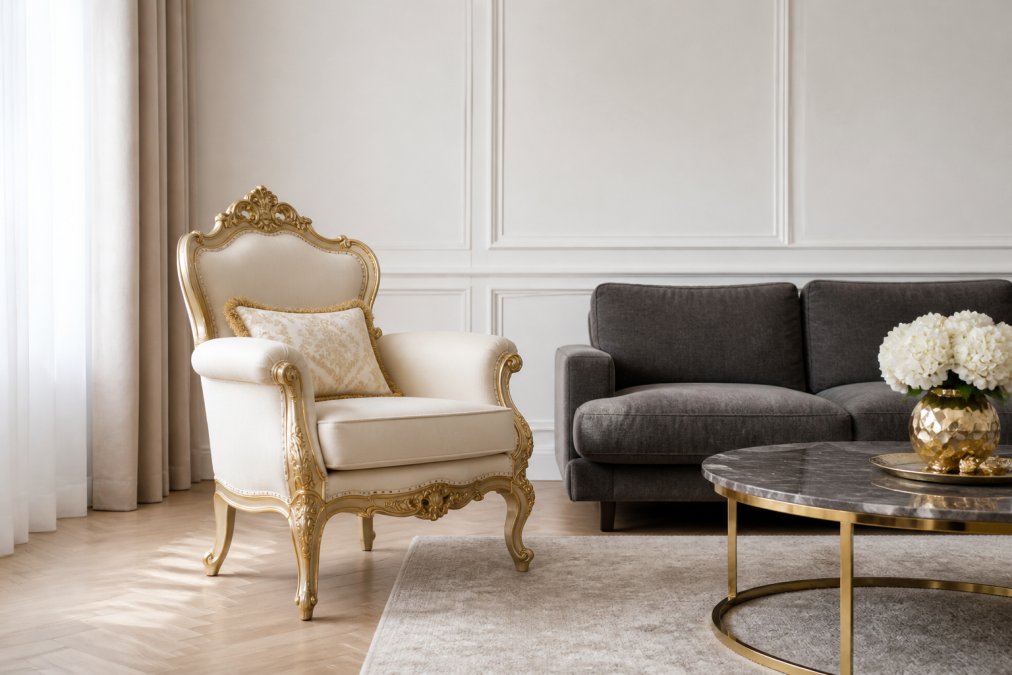
The second principle is contrast. Baroque furniture needs space around it – both physically and visually. Surround your Baroque piece with modern, simple elements. A dark mahogany cabinet with gold ornamentation looks powerful next to a minimalist, light gray sofa. The contrast sharpens both styles.
The third principle is harmony in diversity. When combining multiple Baroque pieces, they must support each other, not compete. This does not mean everything has to be identical – it means there must be a visual logic. A Baroque armchair and a Baroque table can stand together if they are linked by color or material.
For rooms under 20 square meters, Casa Padrino recommends limiting yourself to one large Baroque piece. Baroque furniture is often taller and more voluminous than modern pieces. In smaller rooms, a single large element like a cabinet or a chest of drawers creates the perfect balance. In larger rooms of 25 square meters or more with a ceiling height of at least 2.60 meters, you can combine several Baroque pieces without the room feeling cluttered.
The Role of Statement Pieces in the Modern Space
A statement piece is a single, independent furniture item that can speak for itself. In the context of Baroque furniture in the modern living room, the statement piece is your most important asset.
Why do statement pieces work so well? They create an anchor point. A Baroque armchair with curved legs and elaborate carvings becomes an eye-catcher. It guides the eye, creates interest, and prevents the room from looking sterile.
The best statement piece for a modern living room is often an armchair or a chest of drawers. Why? Because these pieces are functional and visually dominant at the same time. A Baroque armchair can actually be used – it is not just decorative. A chest of drawers offers storage space and becomes a statement piece.
When placing a statement piece, you should observe the following rules:
- Position it where it naturally draws attention – next to a window, on an accent wall, or as a counterweight to a large modern sofa
- Give it space. At least 60 centimeters of free space around the piece
- Illuminate it purposefully. A statement piece deserves dedicated lighting
- Keep the immediate surroundings minimalist to sharpen the focus
Casa Padrino offers an extensive collection of Baroque armchairs and chests of drawers that are perfect as statement pieces. Each piece is handcrafted and bears the signature of European luxury tradition.
Luxury Interior Design Ideas: Color Concepts and Contrasts
The choice of color is crucial when integrating Baroque furniture into a modern living room. This is often where the biggest mistake is made: people try to make everything harmonious. That is wrong. Baroque thrives on contrast.
If you combine several Baroque pieces in the same room, two to three harmonious color tones are ideal. An example: white and gold. Another: dark mahogany with bronze fittings. This color harmony ensures that the pieces fit together without looking monotonous.
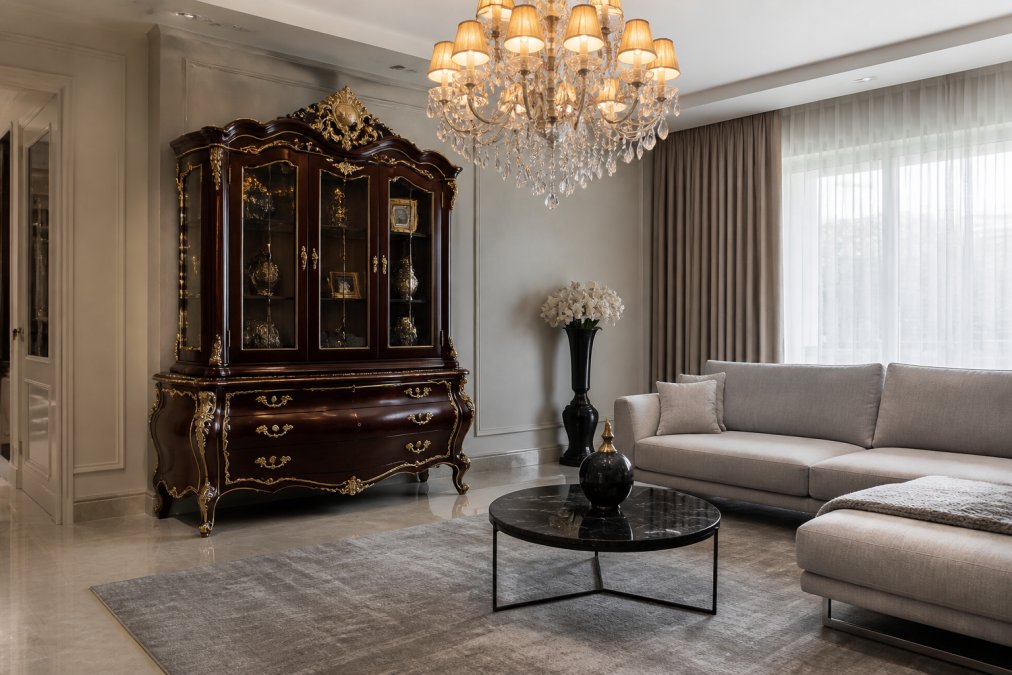
The modern spatial effect depends heavily on contrast. A cream-colored Baroque armchair looks completely different in front of a white wall than in front of a dark wall. In front of white, it looks classic and bright. In front of dark gray, it looks dramatic and contemporary. The wall becomes the canvas for your Baroque piece.
Gold accents are the heart of Baroque elegance. However, they must be used in moderation. In a modern living room, gold details should make up about 10-15% of the visible surfaces. This could be the fittings on the cabinet, the legs of the armchair, or the frames of mirrors. Too much gold looks cluttered. Too little, and the Baroque piece loses its power.
The color palette of a mixed-style living room should meet the following rule: a maximum of three primary colors plus neutral tones. Example: cream (neutral), dark brown (Baroque), light gray (modern), with gold as an accent color. This limitation creates coherence, even if the styles are different.
A common mistake is using too many colors at the same time. This leads to visual restlessness. Baroque furniture already has a lot of visual complexity due to its ornamentation. The surrounding colors should be calm.
Using Baroque Armchairs in a Modern Way: Upholstery and Textiles
The Baroque armchair is the flagship of Baroque elegance. Its upholstery and the choice of textiles determine whether it fits into a modern living room or feels out of place.
Traditional Baroque armchairs are upholstered in brocade, damask, or heavy velvet. These fabrics are opulent, but often too formal for a modern living room. A modern interpretation uses high-quality fabrics with subtler patterns or even solid-color upholstery in cream, gray, or black. The woodwork remains Baroque – curved legs, carvings, gilding – but the upholstery becomes more contemporary.
The best combination? A Baroque armchair with classic woodwork and modern, solid-color upholstery in a high-quality fabric like linen or a premium cotton blend. This creates a style mix that works. The armchair remains recognizably Baroque due to its shape, but does not look overwhelming due to the upholstery.
Textiles are more than just upholstery. They are accents. A Baroque armchair might need one or two cushions, but not too many. A single cushion in a contrasting color – perhaps gold or deep blue – can be enough. Too many cushions make the armchair look kitschy.
Casa Padrino offers Baroque armchairs in various upholstery options. The craftsmen understand the balance between authentic design and modern comfort. Each armchair is made according to individual wishes – you can choose the upholstery, color, and details exactly as they fit your space.
Vintage Solid Wood Furniture and Lighting as Baroque Style Elements
Solid wood furniture is the foundation of Baroque elegance. Unlike modern furniture made of plywood or veneer, genuine Baroque pieces are crafted from solid wood. Mahogany, walnut, and oak are the classic woods. They age beautifully and gain character over time.
Vintage Baroque pieces – genuine antiques – have an incomparable charm. But they are also expensive and not always practical. Modern reproductions that use traditional craftsmanship techniques offer a practical alternative. Casa Padrino manufactures furniture that looks like genuine antiques but is built with modern standards for durability and comfort.
Lighting is the second key element. A Baroque chandelier is not just a light source – it is a work of art. In a modern living room, a classic chandelier with crystal hangings or metal arms can be the perfect accent. It creates drama and elegance.
But here is the trick: the chandelier must match the ceiling height. In modern apartments with a ceiling height of 2.40 meters, a large traditional chandelier can feel overwhelming. A smaller chandelier or a pendant light with a Baroque design works better. Casa Padrino offers lighting solutions that combine Baroque aesthetics with modern functionality.
In addition to the main lighting, you should use accent lighting. A floor lamp with a Baroque base next to your statement armchair creates an intimate corner. Wall lights with crystals or metal arms can set accents without being dominant.
The right lighting makes the difference between a room that has Baroque furniture and a room that celebrates Baroque furniture. Warm, dimmable light emphasizes elegance. Harsh, bright light makes Baroque look kitschy.
Avoiding Cluttered Design and Practical Tips for Small Spaces
The biggest risk when mixing styles is clutter. A room with too many Baroque pieces, too many patterns, and too many details looks chaotic. That is not elegance – that is confusion.
The golden rule: less is more. A Baroque armchair, a modern sofa, minimal accessories, a clear color palette. That is elegance. Three Baroque chests of drawers, a Baroque cabinet, patterned wallpaper, and five different rugs – that is clutter.
For small rooms under 20 square meters, a strict rule applies: one large Baroque piece, everything else modern and minimalist. A Baroque cabinet in an otherwise modern, simple apartment looks luxurious. Two or three Baroque pieces in a small room feel suffocating.
Practical tips for small spaces:
- Choose Baroque pieces with slender legs, not massive bases. This makes them look less bulky
- Light colors make small rooms feel larger. A cream-colored or light gray Baroque armchair is better than a dark one
- Use mirrors to create depth. A large mirror with a Baroque frame can visually enlarge a small space
- Keep the floor clear. Too many accessories and decorations make small spaces chaotic
- Use wall space instead of floor space. A Baroque wall cabinet or shelf takes up less space than a chest of drawers
A single, well-chosen Baroque piece creates personality where minimalism alone might feel cold.
Sustainability and Budget Options in the Style Mix
Sustainability and luxury seem to contradict each other, but they do not have to. Genuine Baroque pieces – especially antiques – are sustainable. They are durable, timeless, and do not require frequent replacement. A genuine piece of Baroque furniture can last for generations.
The problem: genuine antiques are expensive and not always available. Here is a pragmatic solution: buy new pieces that are crafted using traditional artisanal methods but are constructed more modernly. They are more affordable than antiques, more sustainable than cheap mass production, and work better in modern homes.
Casa Padrino offers furniture made of high-quality materials produced with traditional techniques. This is a middle ground between genuine antiques and cheap mass-produced goods. The furniture lasts for decades, not just years.
Budget options in the style mix:
- Buy one large Baroque piece new and combine it with modern, affordable furniture. This saves money and creates contrast
- Use genuine antiques for accessories – mirrors, picture frames, small tables – rather than for large furniture pieces. This is more cost-effective
- Invest in good upholstery for armchairs and sofas. This is what you touch and use. Other pieces can be simpler
- Use DIY upcycling. A simple modern armchair can be transformed into a Baroque piece with new upholstery and legs
The psychology of spatial effect is important to understand. A room with one expensive Baroque piece and affordable modern furniture looks luxurious because the focus falls on the high-quality piece. A room with many cheap pieces looks cheap, no matter how much you spend. Quality beats quantity.
Casa Padrino understands this psychology. That is why the company focuses on a few high-quality pieces instead of mass production. Every piece of furniture is a statement.
Integrating Baroque furniture into a modern living room is not a compromise – it is a deliberate design statement. It requires courage, an understanding of both styles, and a clear vision. But when done right, it creates spaces that are timeless, elegant, and unmistakable.
Casa Padrino has the expertise and the collection to bring your vision to life. With over 20 years of experience in designing luxury spaces, the company offers not just furniture, but complete interior design solutions. From handcrafted Baroque armchairs to bespoke furnishing concepts – Casa Padrino combines traditional European craftsmanship with timeless design.
Visit Casa Padrino and discover how you can transform your living space into a masterpiece.
=== FAQ ANSWERS (audit these too, same rules) ===
[1] Q: How do I successfully combine Baroque furniture with a modern interior design style?
A: The key lies in restraint: in rooms under 20 square meters, a large Baroque piece should act as a statement piece. For larger rooms (from 25 square meters), two to three harmonious Baroque furniture items can be combined. Choose two to three coordinated color tones such as white and gold or dark mahogany with bronze. Casa Padrino offers bespoke solutions that combine traditional European craftsmanship with timeless design.
[2] Q: Which colors match Baroque furniture pieces in a modern living room?
A: Baroque furniture looks most elegant with classic combinations: white with gold accents, dark mahogany with bronze, or cream with silver ornamentation. The contrast with modern walls in gray, beige, or white creates harmony. Avoid too many competing color tones – two to three colors are enough for a balanced appearance. Casa Padrino uses high-quality materials such as gold leaf and bronze, which perfectly support these color concepts.
[3] Q: How do you prevent a room with Baroque furniture from looking cluttered?
A: Clutter is caused by too many ornamental pieces at the same time. Limit yourself to one or two statement pieces as eye-catchers and complement them with minimalist modern furniture. Use plenty of free space on the walls and choose simple, smooth textiles. Baroque furniture is already visually dominant – it needs calm surroundings. Casa Padrino provides targeted advice on selecting individual statement furniture pieces that create elegance without clutter.
[4] Q: Is the mix of Baroque and modern styles currently on trend?
A: Yes, mixing styles is an established design trend. Baroque furniture brings intimacy and human warmth to minimalist spaces. Designers specifically recommend Baroque when a room should look iconic and personal rather than just trendy. The contrast between splendor and simplicity creates confidence in interior design. This combination works particularly well for living spaces that are meant to exude character and individuality.
Frequently Asked Questions
How do I successfully combine Baroque furniture with a modern interior design style?
The key lies in restraint: in rooms under 20 square meters, a large Baroque piece should act as a statement piece. For larger rooms (from 25 square meters), two to three harmonious Baroque furniture items can be combined. Choose two to three coordinated color tones such as white and gold or dark mahogany with bronze. Casa Padrino offers bespoke solutions that combine traditional European craftsmanship with timeless design.
Which colors match Baroque furniture pieces in a modern living room?
Baroque furniture looks most elegant with classic combinations: white with gold accents, dark mahogany with bronze, or cream with silver ornamentation. The contrast with modern walls in gray, beige, or white creates harmony. Avoid too many competing color tones – two to three colors are enough for a balanced appearance. Casa Padrino uses high-quality materials such as gold leaf and bronze, which perfectly support these color concepts.
How do you prevent a room with Baroque furniture from looking cluttered?
Clutter is caused by too many ornamental pieces at the same time. Limit yourself to one or two statement pieces as eye-catchers and complement them with minimalist modern furniture. Use plenty of free space on the walls and choose simple, smooth textiles. Baroque furniture is already visually dominant – it needs calm surroundings. Casa Padrino provides targeted advice on selecting individual statement furniture pieces that create elegance without clutter.
Is the mix of Baroque and modern styles currently on trend?
Yes, mixing styles is an established design trend. Baroque furniture brings intimacy and human warmth to minimalist spaces. Designers specifically recommend Baroque when a room should look iconic and personal rather than just trendy. The contrast between splendor and simplicity creates confidence in interior design. This combination works particularly well for living spaces that are meant to exude character and individuality.