Baroque Designer Furniture for Upscale Living Spaces: 10 Classics

Table of Contents

Last updated: July 31, 2026

Baroque Designer Furniture for Upscale Living Spaces: 10 Classics

Baroque designer furniture for upscale living spaces embodies a design philosophy that has endured for over 400 years and is regaining significance in modern luxury interiors. Casa Padrino, as a renowned manufacturer of exclusive luxury furniture, specializes in creating these magnificent furnishing pieces, which are not only functional but also serve as emotional anchor points in upscale living spaces. This guide showcases the ten essential classics that transform any home into a palace.

What Makes Baroque Designer Furniture for Upscale Living Spaces So Timeless?

The Baroque style embodies opulence through solid wood, inlays, and carvings. These furniture pieces work equally well in classic historic buildings and modern lofts with classical accents. A handcrafted King Ludwig Baroque armchair by Casa Padrino becomes not just a piece of seating, but an investment in quality and style that endures for decades.

Pro Tip
Baroque furniture works particularly well when positioned as statement pieces – rather than as a complete room set. A single opulent armchair or a splendid display cabinet creates more impact than an overloaded room.

The Characteristics of the Baroque Style

The Baroque style is defined by characteristic features: solid wood such as walnut, mahogany, or oak, combined with elaborate carvings and gold embellishments. Upholstered chairs feature curved armrests and upholstered backrests, often with precious velvet covers. Display cabinets feature glass doors and multiple shelves, while marble columns and bronze ornaments underscore the luxurious finish.

In producing these features, Casa Padrino relies on traditional European craftsmanship combined with modern processing techniques. Each piece is individually crafted and undergoes multiple quality control stages.

Splendor and Opulence as Design Principles

Opulence is a philosophy of interior design. A majestic Louis XIV Baroque mirror with a gold frame reflects light and visually expands the space, while a Palazzo Baroque dining table with a marble top forms the centerpiece of an elegant dining room. People feel more significant and inspired in such spaces – that is the true value of Baroque designer furniture for upscale living spaces.

10 Essential Baroque Designer Furniture Pieces for Your Home
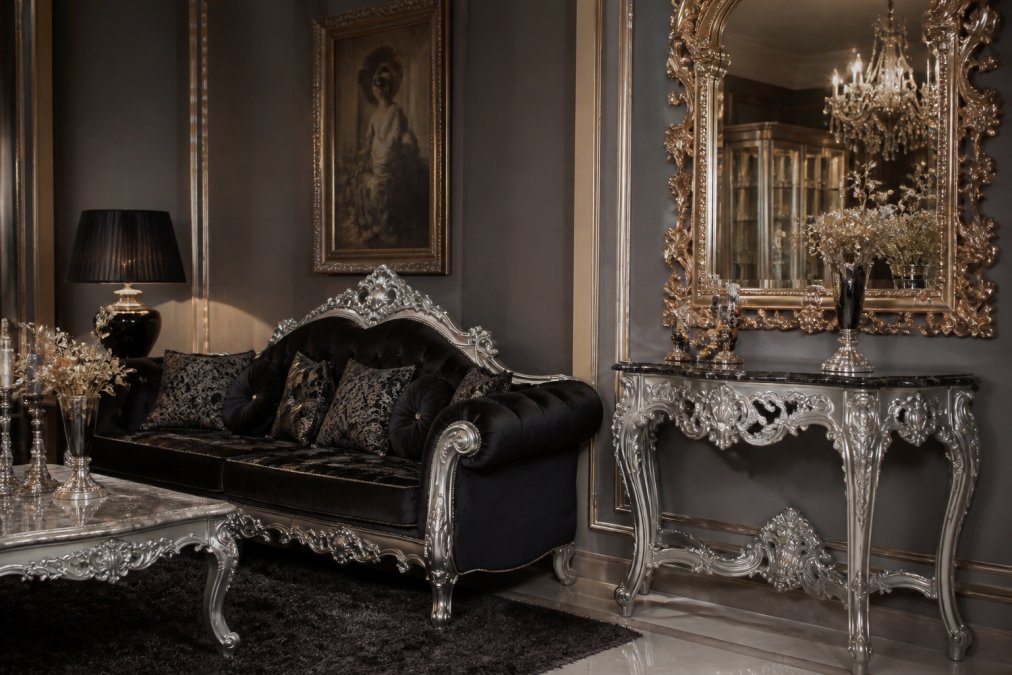
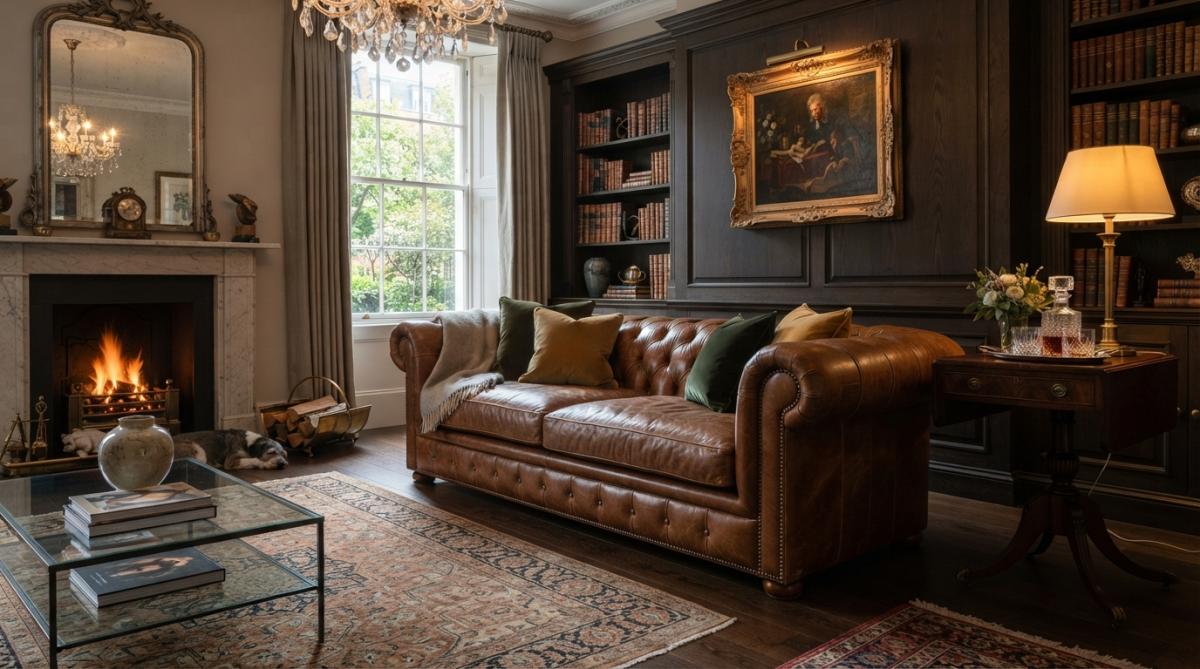
Elegant living room with an opulent black Baroque sofa featuring silver carvings, a gold-framed mirror, and a Baroque console table with a marble top in a classic luxury setting

1. The Palazzo Baroque Dining Table – Solid Wood with Marble Top

The Palazzo Baroque dining table by Casa Padrino is the centerpiece of any upscale dining room. Handcrafted from solid wood with genuine marble tops in various options – from classic white to deep black – this table offers unparalleled visual presence and functionality for eight to ten people. The construction features ornate carvings on the legs and a stable base built to last for generations.

Key Takeaway
A Baroque dining table is an investment in the moments created around it. Its durability means it will host tables full of conversations and celebrations for decades.

2. The Opulent Medusa Baroque Sofa – Velvet Upholstery and Carvings

The Medusa Baroque sofa places comfort and extravagance at the center. With high-quality velvet upholstery in black or silver and solid hand-carved wooden frames, this sofa creates a living environment that radiates luxury. The curved armrests and upholstered backrest offer visual appeal and genuine seating comfort. Casa Padrino offers this sofa in various sizes. Regular vacuuming and occasional professional cleaning keep the velvet upholstery in perfect condition.

3. The Majestic King Ludwig Baroque Armchair

The King Ludwig Baroque armchair by Casa Padrino is a statement piece that dominates any room. With a solid wood frame, gold embellishments, and an upholstered seat, this armchair offers both visual and physical comfort. The armchair is perfect as a reading nook or as a central element in a reception area. Each armchair is handcrafted, meaning every single piece has its own personality.

4. The Elegant Versailles Baroque Console Table

The Versailles Baroque console table is perfect for hallways, entryways, or as a decorative accent in the living room. Featuring a genuine marble top and hand-carved embellishments, this console table offers a way to display elegant decorations – whether an antique mirror, candlesticks, or art objects. Casa Padrino offers this console table in various sizes and color options.

5. The Imposing Louis XIV Baroque Mirror with Gold Frame

A large mirror with an elaborately decorated frame is a classic Baroque element for any upscale living space. The Louis XIV Baroque mirror by Casa Padrino features a solid wooden frame with a gold finish and hand-carved ornaments. This mirror visually expands the room and reflects natural light, creating a bright and welcoming atmosphere.

6. The Luxurious Royal Baroque Bed – Regal Sleeping Comfort

The Royal Baroque bed is for those who do not want to compromise on luxury even in the bedroom. With an elaborately carved headboard, gold embellishments, and upholstered elements, this bed creates a bedroom ambiance akin to a royal chamber. The construction is sturdy and built for durability. Casa Padrino offers this bed in various sizes.

7. The Stylish Château Baroque Nightstand

The Château Baroque nightstand is the perfect complement to a Baroque bed. Featuring a practical drawer and hand-carved embellishments, this nightstand offers functionality and aesthetics. The drawer is large enough for books and bedroom essentials while remaining discreet within the overall composition.

8. The Splendid Belle Époque Baroque Display Cabinet

A display cabinet is ideal for showcasing collectibles and fine porcelain. The Belle Époque Baroque display cabinet by Casa Padrino features glass doors and multiple shelves with hand-carved wooden frames and gold embellishments. Optional interior lighting showcases your collection to its best advantage. Its size and design make it a statement piece in any living or dining room.

9. The Elegant Madame de Pompadour Baroque Chest of Drawers

The Madame de Pompadour Baroque chest of drawers offers several spacious drawers with hand-carved details and practical storage space in an elegant design. It is perfect for bedrooms, hallways, or living rooms. Each drawer glides smoothly and is sturdy enough for daily use. The surface finish with gold accents and fine carvings turns each drawer into a work of art.

10. Baroque Accessories and Decoration for the Perfect Ambiance

Baroque accessories by Casa Padrino – from candlesticks and picture frames to wall decorations – complement large furniture pieces and create a cohesive design concept. A golden chandelier, antique mirrors, vases with classical patterns, or handcrafted wall panels contribute to the overall atmosphere.

Caution
Too many accessories can make a room look cluttered. The principle of ‘less is more’ also applies to the Baroque style – choose pieces you truly love.

Handcrafted Baroque Furniture: Materials and Craftsmanship

Quality in Baroque furniture begins with materials. Casa Padrino works exclusively with high-quality, sustainable materials that guarantee durability and beauty.

Solid Wood and Fine Timbers

Solid wood is the soul of every Baroque piece. Walnut, mahogany, oak, and cherry wood are preferred timbers, each with its own characteristics and tones. Woodworking is done by hand by experienced craftsmen who individually shape and refine each piece.

Inlays, Carvings, and Gold Embellishments

Inlays are fine wood marquetry where different types of wood are combined into complex patterns. Carvings are the visible sign of craftsmanship – every curve and ornamental detail is carved by hand. Gold embellishments, often gold leaf, are applied to highlight the carved details.

Marble, Bronze, and Surface Finishing

Marble tops on tables and consoles are both aesthetic and practical. Marble is heat-resistant and scratch-resistant, making it ideal for dining tables. Casa Padrino works with various types of marble, from classic Carrara to darker Nero Marquina. Bronze is used for fittings, handles, and decorative elements, and is often patinated to create an antique appearance.

Luxury Baroque Style Interior: From the Era to the Modern Living World

Baroque originated in the 17th century as a response to the Reformation. Today, the Baroque style has experienced a renaissance. People long for beauty, craftsmanship, and authenticity in a world of mass production. Casa Padrino understands this desire and is dedicated to preserving and developing this classic aesthetic.

The History of Baroque and Its Significance Today

Baroque first developed in Rome and spread throughout Europe. In France, it became the state style under Louis XIV. Every piece of furniture from Casa Padrino carries the history of the Baroque within it, combined with modern design and an understanding of contemporary lifestyles.

Baroque Furniture in Historic Buildings and Classical Spaces

Historic buildings with high ceilings and classical architectural elements are the natural habitat for Baroque furniture. However, Baroque furniture also works in modern spaces when positioned correctly. A single statement piece can give a minimalist loft depth and personality. The art lies in finding a balance between classic elegance and contemporary minimalism.

Interpreting Classical Furniture in a Modern Way – Baroque Meets Contemporary

Casa Padrino combines Baroque with modern design. A Baroque sofa can stand next to a minimalist glass table. A gold-framed mirror can hang above a modern sideboard. The secret lies in the balance. If you have many classical pieces, keep the wall colors neutral.

Pro Tip
Mix different eras, but keep a consistent color palette. If your Baroque armchair is black and gold, choose modern accents in similar shades.

Space Planning for Small Living Spaces with Baroque Furniture

Baroque furniture also works in small spaces. The key is scaling. A smaller Baroque armchair takes up less space than a large modern sofa. A narrow Baroque console table fits into any hallway. Casa Padrino offers furniture pieces in various sizes, specifically designed for smaller spaces.

Color Harmony and Living Room Ambiance

Classic Baroque colors are gold, black, white, cream, and deep greens or reds. If you have a black-and-gold Baroque sofa, choose wall colors in cream or light gray. Lighting is also critical. A traditional chandelier over a modern dining table creates drama and elegance.

Care and Value Retention of Baroque Furniture

A Baroque piece from Casa Padrino is an investment that lasts for generations. Proper care is crucial.

Care Instructions for Solid Wood Furniture

Solid wood furniture requires regular but uncomplicated care. Dust should be wiped off regularly with a soft cloth. Do not use harsh chemicals. Avoid direct sunlight and extreme heat. A stable indoor climate with moderate temperature and humidity is ideal. Scratches can be repaired by a professional – often invisibly.

Velvet covers should be brushed regularly with a soft brush. Stains should be treated immediately, ideally by a professional cleaner. With proper care, a velvet cover retains its beauty for years.

Sustainability and Origin as Investment Factors

The origin of a piece of furniture significantly influences its value. Furniture from Casa Padrino, handcrafted in European workshops with certified materials, retains its value better than mass-produced items. This transparency is a sign of quality and trust.

Custom-Made Designs and Personalization for Your Home

Casa Padrino also specializes in custom-made designs. If you need a Baroque armchair in a specific color or size, Casa Padrino can make it happen. Collaborating with the Casa Padrino design team means you get a tailored solution for your space.

Why Casa Padrino is the Premier Choice for Baroque Designer Furniture

Casa Padrino has established itself over two decades as a leading manufacturer of luxury furniture. The company has furnished grand hotels, restaurants, and private villas all over the world.

Craftsmanship Meets Luxury – Atelier Quality

Casa Padrino combines traditional European craftsmanship with modern design. Each piece of furniture is the result of master craftsmen who have refined their skills over years. Quality control is strict – only pieces that meet the highest standards leave the workshop. The use of materials such as solid wood, genuine marble, bronze, and gold leaf is standard.

Exclusive Collections and Bespoke Solutions

Casa Padrino does not just offer individual furniture pieces – the company creates complete interior design concepts. The collections for luxury hotel furniture, the specialization in Baroque furniture, and the services for custom-made furniture mean that Casa Padrino has a solution for every space. Collaboration with interior designers is central to Casa Padrino’s work. The luxury interior design and hotel furnishing solutions from Casa Padrino demonstrate this holistic philosophy.

Key Takeaway
Casa Padrino is not simply a furniture retailer – it is a partner in creating spaces that reflect your personality. The combination of craftsmanship, quality, and design expertise makes the company the premier choice for upscale living spaces.

Conclusion: Baroque Designer Furniture for Upscale Living Spaces

Baroque designer furniture for upscale living spaces is more than just furniture – it is an expression of elegance, quality, and timeless design. The ten classics represent the best that handcrafted tradition and modern design can achieve. Investing in such pieces pays off, not only aesthetically but also in terms of value retention and durability.

Casa Padrino understands these values and is dedicated to creating furniture that is not only beautiful but also sustainable and timeless. Whether you are looking for a single statement armchair or planning a complete room design – Casa Padrino offers the expertise, quality, and passion to turn your visions into reality.


Creating an upscale living space requires a philosophy, an aesthetic, and an understanding of timeless elegance. Casa Padrino offers exactly that: a combination of European craftsmanship, high-quality materials, and design expertise. From luxury furniture to bespoke furniture solutions – Casa Padrino transforms upscale living spaces into masterpieces. Discover the complete collection from Casa Padrino and find the perfect Baroque designer furniture for your home.

Frequently Asked Questions

What are the main characteristics of Baroque designer furniture for upscale living spaces?

Baroque designer furniture is characterized by its opulent aesthetic: hand-carved ornaments, gold embellishments, inlays, and the use of solid wood such as walnut. They define the Baroque style through splendor, extravagant carvings, and noble materials like marble and bronze. Casa Padrino offers authentic Baroque furniture that combines these classic features with modern craftsmanship, transforming upscale living spaces into luxurious living environments.

How can handcrafted Baroque furniture be integrated into modern interiors?

Interpreting classical furniture in a modern way is achieved through targeted combinations: choose a statement piece like a Baroque sofa or a gold-framed mirror and combine it with minimalist modern elements. Neutral colors, simple walls, and contemporary lighting create balance. Casa Padrino’s designer furniture can be placed in both historic buildings and modern spaces – the key is conscious space planning and color harmony.

Which materials are used for high-quality handcrafted Baroque furniture?

Authentic Baroque furniture consists of solid wood (especially walnut), combined with marble, bronze, and gold leaf. Surface finishing through inlays and hand-carved ornaments is characteristic. Casa Padrino utilizes traditional European craftsmanship: each piece of furniture is crafted in the workshop, using genuine materials and elaborate carvings that guarantee durability and timeless elegance.

How do I care for Baroque designer furniture to preserve its beauty?

Solid wood furniture requires regular care: use a soft, damp cloth for cleaning and special wood oils for surface maintenance. Marble surfaces should be cleaned with pH-neutral agents. Avoid direct sunlight and extreme temperature changes. Casa Padrino offers advice on correct care – ensuring you preserve the splendor of your Baroque furniture for generations to come.

Is Baroque designer furniture also available as custom-made designs?

Yes, Casa Padrino offers extensive custom-made designs and personalizations. Whether your spaces require specific geometries or you desire a unique color combination – the workshop manufactures exclusive Baroque furniture according to your specifications. This is particularly valuable for historic buildings and upscale living spaces, where individuality and value retention count as investment factors.
Exclusive Interior Design for Upscale Clubs: The Guide

Table of Contents

Last updated: July 30, 2026

Exclusive Interior Design for Upscale Clubs: The Guide

Designing an exclusive interior for upscale clubs requires more than just beautiful furniture. It is about creating a holistic atmosphere that enchants guests from the very first moment. At Casa Padrino, we understand that every detail – from lighting technology to the choice of materials – decisively influences the perception and well-being of your visitors. This guide shows how you can create a club that is both functional and emotionally moving through thoughtful design concepts, high-quality materials, and bespoke solutions.

Exclusive Interior Design for Upscale Clubs: Fundamentals and Requirements

Upscale clubs do not compete on price, but on experience – and this begins with the interior design. A luxurious ambience creates trust and a sense of belonging. When a guest enters a club with a well-thought-out, elegant interior, it immediately signals: high standards apply here.

Casa Padrino offers comprehensive solutions for luxury hotel furniture and contract furniture for the hospitality industry, specially developed for upscale clubs. These furniture pieces combine European craftsmanship with timeless design.

Why High-Quality Interior Design Makes the Difference

Investing in exclusive furniture, noble materials, and professional lighting concepts pays off directly in perception – and thus in the guests' willingness to return and recommend the club.

Psychology of Spatial Impact in Exclusive Clubs

Colors, lighting conditions, room proportions, and furniture arrangement work together to create a psychological environment. In upscale clubs, it is not about loudness, but about exclusivity, security, and sophistication. A well-designed VIP area with high-quality furniture signals to the guest: you are in a special place. This psychological dimension is crucial for customer loyalty and the willingness to accept premium prices.

:::pro-tip
Use room heights strategically: higher ceilings create a sense of spaciousness, while lower areas convey intimacy. Combine both for a varied experience.
:::

Luxury Club Design: Concepts for an Exclusive Atmosphere

A successful luxury club design is based on a clear conceptual framework that guides all design decisions and defines the guest's emotional journey through the space.

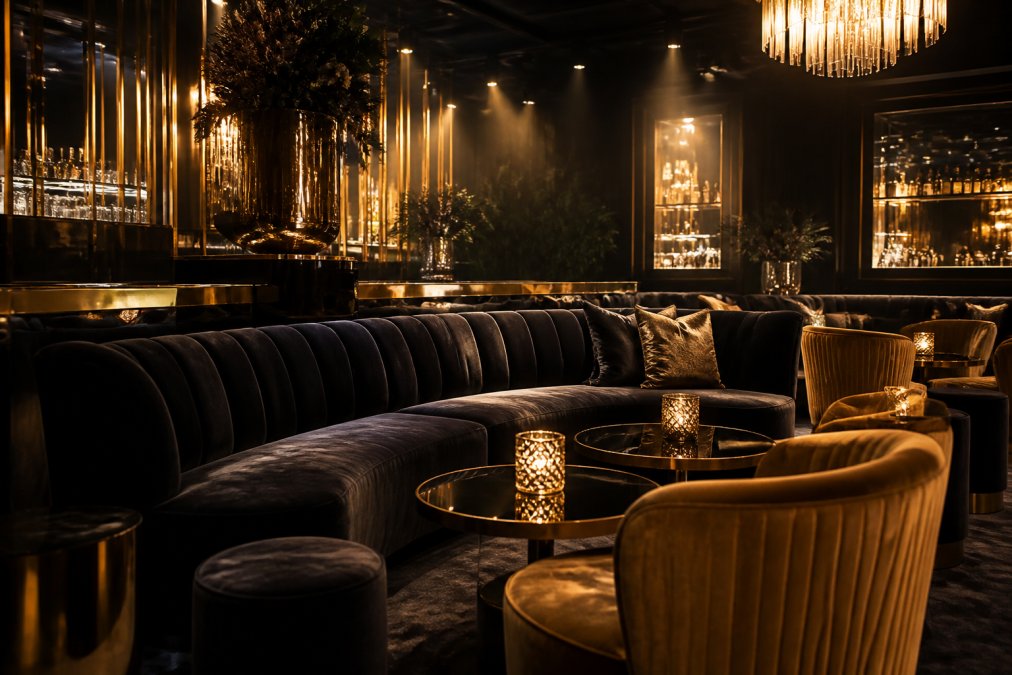
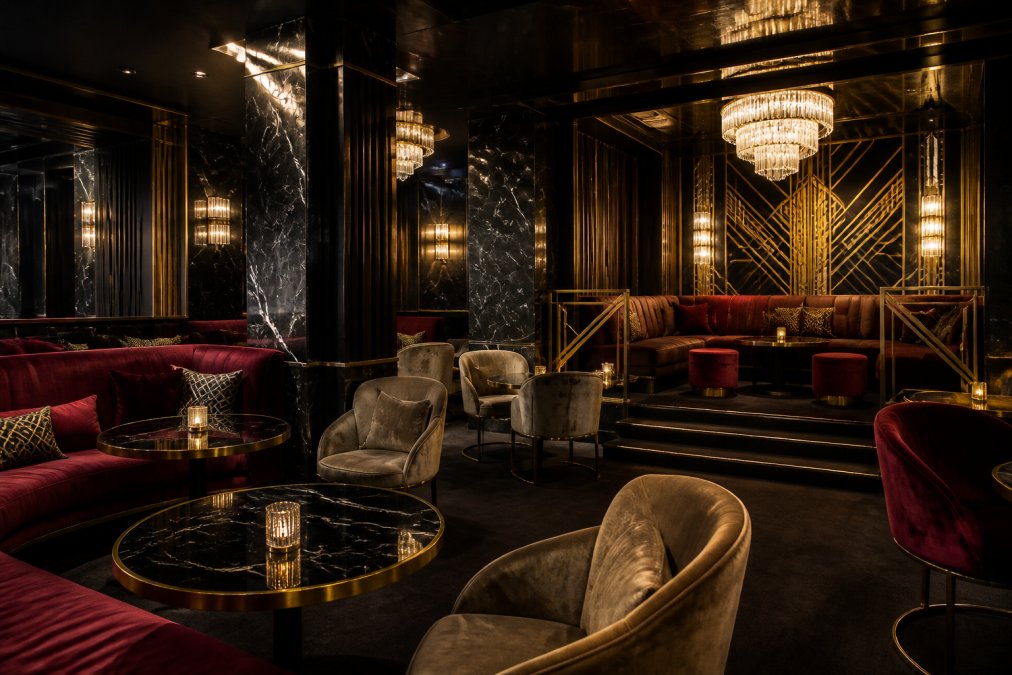
Elegant upscale club with Art Deco elements, geometric patterns, luxurious seating in marble and velvet, atmospheric lighting with gold accents, and an exclusive VIP lounge area with chandeliers

Art Deco Influences and Geometric Patterns

The Art Deco style remains timelessly relevant for upscale clubs. This style direction combines luxury with geometric precision – ideal for exclusive clubs. Characteristic features include symmetrical patterns, metallic surfaces, noble materials such as marble and mahogany, and geometric shapes.

Casa Padrino offers an extensive collection of Art Deco style furniture featuring gold leaf, bronze, and high-quality woods. These pieces automatically create an atmosphere of sophistication. Art Deco elements should be used sparingly as accents – such as through statement furniture or geometric wall patterns – while the rest of the interior design remains classic.

Spatial Layout and VIP Areas

Spatial layout is fundamental to functionality and well-being. A well-designed club features several zones: a public area, lounge zones for smaller groups, and exclusive VIP areas. The demarcation should be elegant – achieved through height differences, room dividers made of glass or wood, varying lighting, and high-quality furnishings in VIP zones.

:::key takeaway
VIP areas should make up 15-20% of the total area and be equipped with the best furniture and highest-quality lighting. This signals appreciation for premium clients.
:::

Club Lighting Concepts: Lighting Design and Acoustics

Lighting is the most important element for atmosphere in an upscale club. Properly applied lighting technology transforms a space into a work of art.

Modern Lighting Technology for Upscale Hospitality

The layered lighting concept combines ambient light, accent light, and task light. Ambient light should be warm and dimmed – typically 2700K to 3000K color temperature – for a relaxing atmosphere. Accent light highlights specific design elements. Task light is functional for areas where guests need to see clearly.

Luxurious materials such as marble, bronze, and gold leaf only look truly impressive with the right lighting.

Acoustic Design for High-End Clubs

Poor acoustics is a common problem. The goal is a balanced acoustic concept that allows for conversation and carries pleasant background music. Acoustic materials such as textiles, curtains, and special wall coverings absorb sound. The best solution is a mix: noble, hard materials for elegance, combined with strategically placed acoustic elements.

:::caution
Plan acoustics into your design concepts right from the start. Poor acoustics can ruin the best interior design.
:::

Material Selection and High-Quality Surfaces

High-quality materials are not only more beautiful – they are more durable, more resistant to aging, and convey quality and trustworthiness.

Noble Materials: Solid Wood, Marble, and Bronze

Solid wood is timelessly elegant. Unlike plywood, solid wood is robust, repairable, and ages beautifully. Mahogany, walnut, and oak are classic choices for upscale clubs. Casa Padrino processes exclusively high-quality woods, combined with bronze fittings and gold leaf details.

Marble is the material of kings. A large-format marble table or marble wall cladding automatically creates a luxurious atmosphere. Use real marble – each slab is unique with its own veining and color variations.

Bronze and precious metals are ideal accents. They look timelessly elegant and can be wonderfully combined with modern elements. Gold-plated bronze frames, bronze lights, or bronze fittings significantly elevate the overall effect.

Sustainability in Luxury Club Design

Sustainability and luxury are not a contradiction. True sustainability means choosing materials that last for decades instead of buying cheap furniture that needs to be replaced quickly. Casa Padrino focuses on timeless designs and robust materials. A sustainable approach supports local artisans and European manufacturers, reduces the ecological footprint, and ensures higher quality standards.

Material Durability Elegance Maintenance Sustainability
Solid wood 20-50 years Very high Regular High (renewable)
Marble 50+ years Extremely high Regular Medium (quarrying)
Bronze 50+ years Very high Minimal High (recyclable)
Velvet 5-10 years High Frequent Medium (synthetic)

Bespoke Furniture for Upscale Club Interior Design

Standard furniture can never meet the requirements of a truly upscale club. Every club has unique architecture, size, and vision. Bespoke furniture is therefore not just a luxury – it is a necessity.

Custom Adaptation to Room Geometries

Many clubs have unusual room geometries: sloped ceilings, niches, asymmetrical windows. Standard furniture does not adapt. Casa Padrino offers comprehensive custom-made furniture solutions. The advantages are enormous: optimal space utilization, perfect aesthetic integration, and a result that no one else has.

Bespoke Lounge Design and Bar Furnishings

Lounge areas are the heart of an upscale club. The design must be carefully thought out, taking into account seating comfort, arrangement, materials, and integration with tables and lighting. Casa Padrino manufactures lounge furniture that is not only beautiful but also ergonomically perfect.

Bar furnishings require special considerations: workspace for bartenders, storage space, lighting for spirits presentation, and aesthetic elements. A custom-made bar is often the highlight of a club.

:::ideal for
Bespoke furniture is ideal for clubs with high standards. The extra effort pays off through a unique atmosphere and durability.
:::

Contract Furniture Hospitality: Furnishing for Exclusive Clubs

Contract furniture for the hospitality industry is specially designed for professional use. It must be beautiful, robust, easy to clean, and designed for intensive use.

Color Concepts for a Luxurious Ambience

Colors influence moods and create visual identity. For upscale clubs, classic, noble colors work best: dark brown, cream, gold, black, and deep shades of green. These look timelessly elegant and create an atmosphere of seriousness and luxury.

The 60-30-10 rule has proven successful: 60% of the area in a neutral base color, 30% in a complementary color, and 10% in an accent color. This creates harmony without chaos. Casa Padrino offers furniture in various shades and can produce custom upholstery in your desired colors.

Budgeting and ROI of Interior Investments

A rule of thumb states that interior design should account for about 20-30% of the total investment in a club. This is an investment with a direct ROI. A beautiful, well-designed club attracts more guests, can command higher prices, and leads to greater customer loyalty.

The ROI is reflected in higher revenue per square meter, longer average length of stay, higher beverage consumption, and above all, recommendations and repeat visits.

Practical Implementation: From Planning to Realization

The implementation of an exclusive interior design is a complex project that requires careful planning and coordination.

Collaboration with Interior Architects and Designers

The first step is collaborating with an experienced interior architect with experience in upscale clubs, hotels, or similar properties. Casa Padrino offers comprehensive luxury interior design services and has 20+ years of experience in hotel projects and luxury hotel furniture solutions.

The collaboration should include several phases: concept development, design drafts with iterations, material selection, cost planning, and realization with quality control.

Quality Assurance and Delivery Management

Quality assurance is crucial for contract furniture. Every piece of furniture should be inspected before it leaves the manufacturer. Casa Padrino offers comprehensive hotel interior solutions that include delivery management and installation. Good delivery management takes timing into account: furniture should arrive in a logical order to minimize storage requirements.

Conclusion: Exclusive Interior Design as a Success Factor

Exclusive interior design for upscale clubs is far more than superficial aesthetics. It is a strategic element with a direct impact on economic success. A well-designed club with high-quality materials, sophisticated lighting technology, and bespoke furniture attracts the right guests, can command premium prices, and creates an atmosphere that generates loyalty and recommendations.

Investing in professional interior design is an investment in the future of your club – not as a cost factor, but as a revenue driver and differentiator.


Casa Padrino is the ideal partner for your vision. With comprehensive solutions for luxury furniture, custom-made furniture, and luxury villa furniture, the company has the expertise and craftsmanship to transform upscale clubs into spaces of the highest elegance. The combination of Italian-inspired design, European craftsmanship, and bespoke solutions makes Casa Padrino the preferred partner for demanding projects. Discover the extensive collection and let our experts advise you – visit Casa Padrino and realize your dream of a truly exclusive club.

Frequently Asked Questions

Which materials are best suited for the exclusive interior design of upscale clubs?

For exclusive clubs, high-quality materials such as solid wood, marble, bronze, and gold leaf are recommended. These materials offer not only visual elegance but also durability and hard-wearing properties for professional operations. Specialists like Casa Padrino work with such noble materials to create a luxurious ambience that looks timeless and withstands high demands.

How do I create a luxurious atmosphere in my club through lighting technology?

Lighting concepts are crucial for spatial impact. Modern lighting technology enables lighting design that dramatically showcases areas and defines different zones. Combine indirect lighting with targeted accents to create depth. Art Deco-inspired lights or geometrically designed light fixtures enhance exclusivity. Professional lighting concepts for clubs also take acoustics into account, creating a holistic sensory experience.

Why should I choose bespoke furniture instead of standard furniture for my club?

Bespoke furniture allows for a perfect fit to your specific room geometries and design concepts. It creates an exclusivity that standard furniture cannot offer and stands out visually. Contract furniture for the hospitality industry is also designed for professional use and offers better durability. Casa Padrino offers tailored solutions that transform your visions into unique spaces.

How do color concepts and design trends influence the perception of an upscale club?

Color concepts are central to the psychology of spatial impact. Deep tones such as anthracite, dark red, or navy blue convey exclusivity and elegance, while metallic accents in gold or bronze underscore luxury. Modern design trends often integrate geometric patterns and Art Deco influences. A consistent color scheme across all areas – from the VIP lounge to the bar – creates a coherent, high-quality ambience that impresses guests.

Luxury Furniture for Exclusive Penthouses: 10 Essentials

Table of Contents

Luxury Furniture for Exclusive Penthouses: 10 Essentials for Timeless Elegance

Penthouses represent the pinnacle of urban living, but furnishing them requires more than just expensive furniture. The right selection of luxury furniture for exclusive penthouses determines whether a space remains a mere collection of objects or transforms into a coherent oasis of elegance. Casa Padrino, a renowned manufacturer of exclusive luxury furniture, has gathered over 20 years of experience in furnishing grand hotels and private penthouse projects. This expertise is reflected in every handcrafted collection, from Baroque furniture to modern design pieces that combine functionality with timeless aesthetics.

This guide covers the ten essential elements that transform a penthouse from an ordinary apartment into a prestigious living space. We will show you how to create a distinctive ambiance with thoughtful material choices, bespoke solutions, and strategic lighting concepts.

Pro Tip
The best investment in penthouse furniture is a coherent interior design concept that harmoniously orchestrates space, light, and materials. Casa Padrino offers exactly this integrated consultation.

Luxury Furniture for Exclusive Penthouses: What Makes It Special

Not every expensive piece of furniture belongs in a penthouse. The difference between ordinary furniture and true luxury lies in three dimensions: material quality, craftsmanship, and timeless design. A velvet Chesterfield sofa is not just a place to sit; it is an investment in lasting value and visual impact.

Luxury furniture for penthouses is distinguished by being specifically designed for demanding spaces. It takes into account high ceilings, large windows, and the need to balance privacy with panoramic views. Casa Padrino understands these requirements from decades of working with high-end hospitality and private villas. The collection combines Italian-inspired elegance with European craftsmanship. Another aspect: exclusive penthouses require furniture that cannot be found in every showroom. Custom manufacturing is a practical necessity when your room geometry or design concept deviates from the standard.

:::fazit
True luxury furniture for penthouses combines handcrafted quality, timeless design, and individual customization.
:::

Exclusive Interior Design Concepts for Penthouses

A penthouse is not just a bedroom to be furnished, but a private universe to be curated. Every piece of furniture must be part of a larger visual and functional narrative. Casa Padrino does not work with isolated products, but with interior design concepts that take into account room geometry, lighting conditions, and personal style.

A coherent concept begins with a color palette. Many penthouse owners make the mistake of mixing too many styles. Instead, a penthouse should follow a clear aesthetic line: either classic-elegant with Baroque elements, modern-minimalist with design accents, or a deliberate fusion of both worlds.

Casa Padrino offers specialized collections for each of these directions. The Baroque furniture series, featuring handcrafted solid wood furniture, marble details, and gold accents, creates an atmosphere of royal elegance. The modern luxury furniture with mirrored glass and stainless steel brings lightness to spacious rooms.

Bespoke Built-in Furniture and Design Solutions

Penthouses rarely have standard layouts. Slopes, bay windows, and asymmetrical walls require furniture that adapts to the space. Bespoke built-in furniture is not a luxury here, but a necessity.

Casa Padrino has the expertise to develop complex spatial solutions. A sideboard can be built to your exact measurements to make use of a challenging wall area. A wardrobe can adapt to the ceiling height while looking aesthetically elegant. The process begins with precise room measurements and a clear definition of your design vision. The result is a piece of furniture that not only fits perfectly but also reflects your personal aesthetic.

Pro Tip
Bespoke furniture distributes costs over a longer lifespan and higher functionality. Well-planned built-in furniture utilizes space more efficiently and always looks elegant.

Harmonious Interior Design with Statement Furniture

A penthouse needs focal points—pieces of furniture that draw the eye and structure the space. A large crystal chandelier, an imposing Chesterfield sofa in dark blue, or a marble dining table with a stainless steel frame are not only functional but also visually dominant.

The art lies in placing these statement pieces so that they harmonize the space rather than overloading it. A large chandelier should hang centrally over a dining table or in a foyer. An imposing sofa should define the seating area. Casa Padrino advises you on achieving this balance. The collection is so diverse that you will not only find individual statement pieces but also the matching companion furniture to support the main piece.

Luxury Designer Furniture: Choice of Materials and Craftsmanship

The choice of materials is the foundation of quality and durability. A luxury sofa made from high-quality materials will still look elegant in ten years, perhaps even more beautiful as it develops a graceful patina over time.

Velvet, Marble, and Fine Woods

Velvet is the material of choice for luxury sofas and armchairs. It has a visual depth and tactile quality that leather or synthetic fabrics cannot match. A Chesterfield sofa in deep dark blue immediately looks prestigious. Casa Padrino upholsters its furniture with the finest velvet, which not only looks beautiful but is also durable enough for daily use.

Marble is the classic material for statement tables and consoles. A Carrara marble dining table with a stainless steel frame combines elegance with functionality. Marble is easy to care for, and its natural patina only makes the material more beautiful over time. Casa Padrino uses genuine marble slabs and combines them with high-quality stainless steel for a timeless aesthetic.

Fine woods such as beech, oak, walnut, and mahogany are the foundation for chests of drawers, sideboards, and beds. Solid wood guarantees durability over decades. Handcrafted carvings in the Baroque style give these pieces of furniture an unmistakable character. A Baroque bed with detailed carvings is not just a place to sleep, but a work of art.

Attention
Genuine velvet from Casa Padrino is denser and more resilient than cheap imitations. The same applies to marble: artificial marble imitations cannot match the durability and beauty of genuine natural stone.

Handcrafted Workmanship and Lasting Value

Handcrafted furniture differs from mass production through care in every detail. A craftsman building a Baroque sideboard cares about the quality of every drawer and every fitting.

Casa Padrino employs craftsmen with decades of experience. Every piece of furniture bears the signature of a master. This also means: if something needs to be repaired, it can be repaired. A drawer can be replaced, a fitting can be exchanged. Lasting value is a practical argument for luxury furniture. A Chesterfield sofa from Casa Padrino can still retain 70% of its original value in 20 years. For a penthouse that you might pass on or sell, this value retention is an important factor.

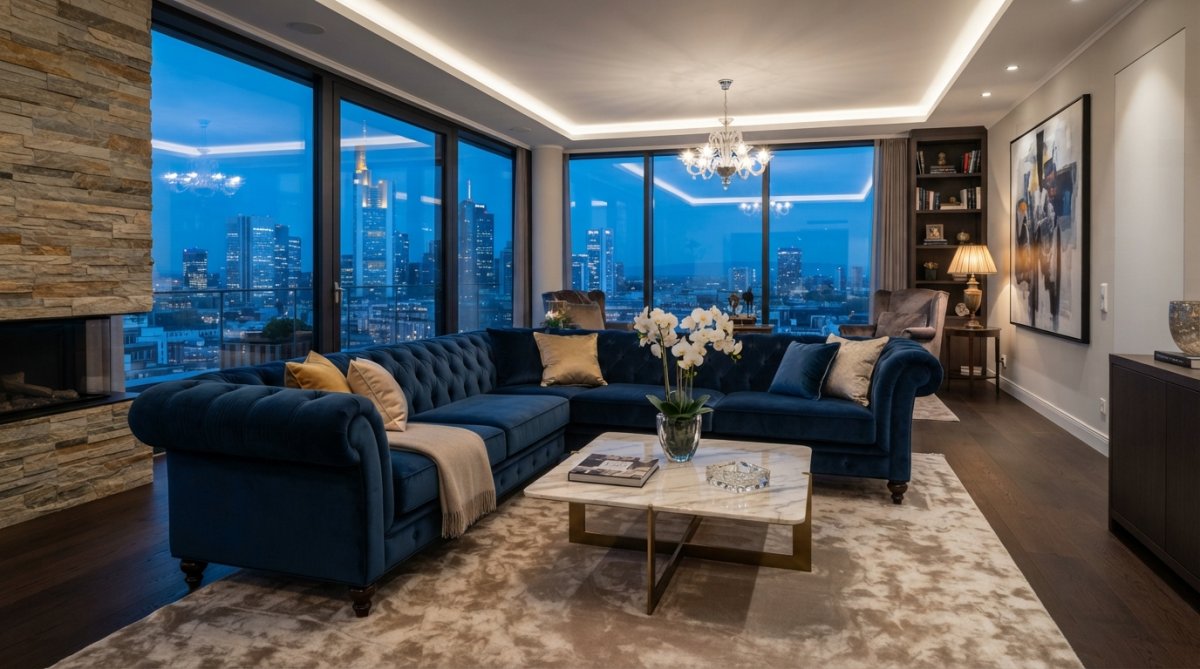
Elegant penthouse living room with handcrafted Chesterfield sofa in dark blue, marble dining table with stainless steel frame, large crystal chandelier, large windows with panoramic city views, warm evening light

Penthouse Living Room Design: Luxury Sofas and Sectionals

The living room is the heart of a penthouse. Here, luxury should not feel like a museum, but like a place to live. The right sofa is therefore crucial.

Chesterfield Sofas and Modern Sectionals

The Chesterfield sofa is an 18th-century classic and timeless. Its characteristic button tufting, rolled armrests, and upright backrest give it a formal elegance that works surprisingly well in modern penthouses. Casa Padrino offers Chesterfield sofas in various sizes and colors: dark blue, bordeaux, black, and classic leather.

Modern sectionals are the alternative for large, open spaces. An L-shaped or U-shaped sectional creates structure and offers ample seating for guests. Casa Padrino offers modular solutions that you can customize to your room dimensions. A sectional made of high-quality velvet or leather, combined with a coffee table made of marble or mirrored glass, creates a luxurious seating landscape.

Coffee Tables and Sideboards as Design Accents

A coffee table is more than just a surface. It is a visual anchor point in the seating area and often the first eye-catcher. A luxury coffee table should therefore be not only functional but also aesthetically impressive.

Casa Padrino offers coffee tables in various materials: marble with a stainless steel frame, mirrored glass with polished stainless steel, and solid wood with handcrafted details. A mirrored glass coffee table reflects light and makes a room look visually larger. A marble coffee table has a more formal effect. A wooden coffee table brings warmth to an otherwise cool room.

Sideboards are functional works of art. A Baroque sideboard with gold accents and handcrafted carvings is a statement piece of furniture that defines the entire room. A modern sideboard with mirrored glass doors looks contemporary and elegant. The combination of sofa, coffee table, and sideboard should be harmonious.

Modern Luxury Furniture: Minimalism Meets Elegance

Not all penthouses are furnished in the classic Baroque style. Many modern penthouse owners prefer a minimalist aesthetic that achieves elegance through simplicity. Casa Padrino understands this direction as well and offers a collection of modern luxury furniture.

Mirrored Glass and Stainless Steel in Contemporary Designs

Mirrored glass and stainless steel are the materials of modern luxury aesthetics. They are elegant, timeless, and functional. A coffee table made of mirrored glass with a polished stainless steel frame looks light and airy. A dining table made of marble and stainless steel combines the warmth of natural stone with the coolness of metal.

These materials have a practical advantage: they are easy to clean and do not show scratches like wood. Stainless steel develops a refined patina over time and becomes more beautiful with age. A modern penthouse with mirrored glass and stainless steel furniture looks contemporary without feeling cold.

Functionality Without Compromising on Aesthetics

A common mistake in modern penthouses is that functionality overshadows aesthetics. Casa Padrino offers solutions that conceal functionality without sacrificing it. A sideboard with closed doors stores everything you need out of sight. A large wardrobe can be built to your measurements and integrated into the wall architecture. A desk can be designed with an elegant marble or wood surface.

:::fazit
Modern luxury furniture should be functional without looking functional. This requires thoughtful planning and high-quality materials.
:::

Lighting Concepts for Exclusive Spaces: Chandeliers and Lighting

Light is not just functional; it is aesthetic. A well-lit room with the right fixtures looks elegant and inviting. A chandelier is a statement piece of furniture that is often overlooked. A large crystal chandelier, placed centrally over a dining table, instantly creates an atmosphere of luxury and elegance.

Casa Padrino offers chandeliers in various styles: classic multi-bulb crystal chandeliers, and modern chandeliers with minimalist designs. The choice depends on the ceiling height and the design concept. In a classic penthouse with Baroque accents, a large crystal chandelier is perfect. In a modern penthouse, a smaller, more linear chandelier may fit better.

In addition to the chandelier, a penthouse should also have wall lights, floor lamps, and possibly table lamps. The lighting should be built in layers: basic lighting with the chandelier, additional light in corners and reading nooks, and atmospheric light for evenings. Casa Padrino also offers lighting fixtures that match your furniture.

Pro Tip
When choosing lighting fixtures, make sure they are dimmable. Dimmers allow you to adjust the atmosphere depending on the time of day and the occasion.

Consultation and Interior Design Services for Penthouses

Furnishing a penthouse correctly is a complex task. It is not just about buying beautiful furniture, but about developing a coherent design concept. Casa Padrino offers comprehensive consultation and Interior Design Services.

Project Planning and Tailored Solutions

A good design project begins with a precise analysis. Casa Padrino sends experts to your home to understand the space: lighting conditions, architectural features, room usage, and personal aesthetics. Based on this analysis, a design concept is developed that defines the color palette, materials, and furniture pieces.

Casa Padrino works with craftsmen and specialists to ensure that the design concept is perfectly implemented. The result is a penthouse that not only looks beautiful but is also functional and timeless.

Sustainability and Lasting Value in the Luxury Segment

An important aspect of luxury furniture is its sustainability. A luxury sofa from Casa Padrino can last 30 years and still look elegant. This is more sustainable than constantly buying new furniture.

Casa Padrino uses high-quality, sustainable materials. Solid wood comes from responsible sources. Leather and velvet are of high quality and last a long time. Metal elements are made of genuine stainless steel or bronze. A luxury piece of furniture is an investment with lasting value. A Chesterfield sofa from Casa Padrino retains its value or even gains value if it is timeless and well-maintained.

:::ideal-für
Penthouse owners who think long-term and value timeless elegance, handcrafted quality, and lasting value.
:::

Structure and Order: Sideboards, Nightstands, and Chests of Drawers

An elegant penthouse is not only beautiful but also organized. Structure and order are the foundation of elegance. Everything has its place, nothing is lying around, everything is within reach but out of sight.

Sideboards are the primary solution. A large sideboard with several drawers can store dishes, cutlery, glasses, and table linen. A Baroque sideboard with gold accents is not only functional but also a visual anchor point.

Nightstands are important. An elegant nightstand next to the bed stores books, glasses, and personal items. Casa Padrino offers nightstands that match your bed, whether classic in Baroque style or modern and minimalist.

Chests of drawers are versatile. They can stand in bedrooms, hallways, living rooms, or offices. A Baroque chest of drawers with several drawers stores clothes or bed linen. A modern chest of drawers combines functionality with contemporary design.

Furniture Piece Best Use Material Recommendation Design Style
Sideboard Dining Room, Living Room Solid Wood, Marble Baroque, Modern
Nightstand Bedroom Solid Wood, Stainless Steel Classic, Contemporary
Chest of Drawers Bedroom, Hallway Solid Wood with Carvings Baroque, Rococo
Wardrobe Bedroom Solid Wood, Integrated into Wall Classic, Modern
Console Table Hallway, Entrance Marble, Wood Baroque, Neoclassicism

Furnishing an exclusive penthouse is the result of thoughtful planning, high-quality materials, and craftsmanship excellence. Casa Padrino offers exactly that: an extensive collection of luxury furniture for exclusive penthouses, combined with professional consultation and tailored solutions. Whether you want to furnish a classic penthouse with Baroque accents or a modern one with a minimalist aesthetic, Casa Padrino has the expertise and the products to bring your vision to life. Discover the world of Luxury Furniture, Bespoke Furniture, Luxury Villa Furniture, and professional Luxury Interior Design Services at Casa Padrino. Visit casa-padrino.de and turn your penthouse dream into reality.

Frequently Asked Questions

Which materials are typical for high-quality luxury furniture in penthouses?

High-quality luxury furniture for penthouses utilizes fine materials such as solid wood, genuine marble, polished stainless steel, the finest real leather, and velvet fabrics. Casa Padrino works with Carrara marble, handcrafted solid wood, and Swarovski crystals. These materials guarantee not only a luxurious look but also durability and lasting value over decades.

How do bespoke furniture pieces differ from standard designer furniture?

Bespoke furniture is specifically adapted to the room geometry and personal requirements. Casa Padrino offers custom manufacturing for built-in furniture, sectionals, and complete interior design concepts. This allows for a perfect fit, optimal space utilization, and a unique aesthetic harmony that standard furniture cannot achieve.

How do I create harmonious lighting concepts in my penthouse living room?

Professional lighting concepts combine various light sources: statement chandeliers for elegance, wall lights for accents, and indirect lighting for atmosphere. Casa Padrino offers luxurious crystal chandeliers that are not only functional but also serve as design objects and visually enlarge the space.

Why is sustainability important even in the luxury segment?

Sustainable luxury furniture combines exclusive aesthetics with responsible action. Handcrafted furniture from Casa Padrino made of high-quality materials has a long lifespan and retains its value, which is more sustainable in the long run than frequent replacement. Quality over quantity is the principle of true luxury.

What role do console tables and sideboards play in penthouse interior design?

Console tables and sideboards serve as functional design elements that create structure and order. Baroque console tables with marble tops or elegant sideboards offer storage space while acting as eye-catchers. They structure open spaces and create transition zones between different functional areas in the penthouse.

Planning Exclusive Interiors for Luxury Gastronomy: Step by Step

Table of Contents

Planning Exclusive Interiors for Luxury Gastronomy: Step by Step

Last updated: July 28, 2026

Planning an exclusive interior for luxury gastronomy requires far more than just selecting beautiful furniture. It is about creating a holistic feel-good atmosphere that enchants your guests from the moment they step through the door. At Casa Padrino, we understand that every detail – from room geometry and material selection to lighting design – has a decisive influence on the dining experience. In this comprehensive guide, we will show you how to plan an exclusive interior for luxury gastronomy that not only impresses aesthetically but is also functionally tailored perfectly to the needs of your business.

The hospitality industry in Germany is increasingly focusing on quality and individuality. Restaurants that stand out through custom-tailored interior designs achieve higher guest satisfaction and longer dwell times. This begins with strategic space planning that takes both the emotional and practical dimensions into account.

Custom Gastronomy Planning: The Foundation for Exclusive Interiors

Successful gastronomy planning starts with an honest analysis of your spatial conditions and operational requirements. Many restaurateurs make the mistake of being guided by aesthetic trends without considering the functional realities of their business. This leads to spaces that look impressive but are impractical in daily operations.

Space Analysis and Floor Plan Design

The first step in planning an exclusive interior for luxury gastronomy is to analyze the space holistically. Do not just measure the square footage, but also capture window placements, door openings, columns, ceiling heights, and angles of light. A 3D scan measurement allows you to create virtual layouts and test different furniture arrangements before placing orders.

The floor plan design must take the natural flow of traffic in the restaurant into account. Guests should find an intuitive path from the entrance to the cloakroom, to the table, and to the restrooms – without detours or confusion. At the same time, service staff must be able to circulate efficiently between the kitchen, bar, and guest area. Finding this balance is the art of contract furnishing.

A common mistake is overcrowding the space. Less is more – especially in luxury gastronomy. Generous spacing between tables creates intimacy and ensures that conversations cannot be overheard from the neighboring table. Casa Padrino offers tailor-made solutions that make optimal use of the available space without overloading it.

Optimizing Pathways and Functionality

Good pathways are invisible – but their absence is noticed immediately. Plan for service paths at least 1.2 meters wide between table groups. For upscale restaurants, it should rather be 1.5 meters. This allows staff to navigate with trays without obstructing guests.

Functionality also extends to accessibility. Accessibility is not only a legal requirement but also a sign of quality and respect. Ramps, wide door openings, and wheelchair-accessible tables should be seamlessly integrated into the design concept – not as an afterthought, but as a natural part of the interior design.

Pro Tip
Use floor plans with movable furniture elements (physical or digital) to play through different scenarios. This allows you to visualize the impact of spatial changes before making investments.

High-Quality Gastronomy Furniture: Material Selection and Surface Texture

The choice of furniture is the heart of an exclusive interior design. Gastronomy furniture must meet three requirements: it must look elegant, withstand intensive daily use, and remain timeless.

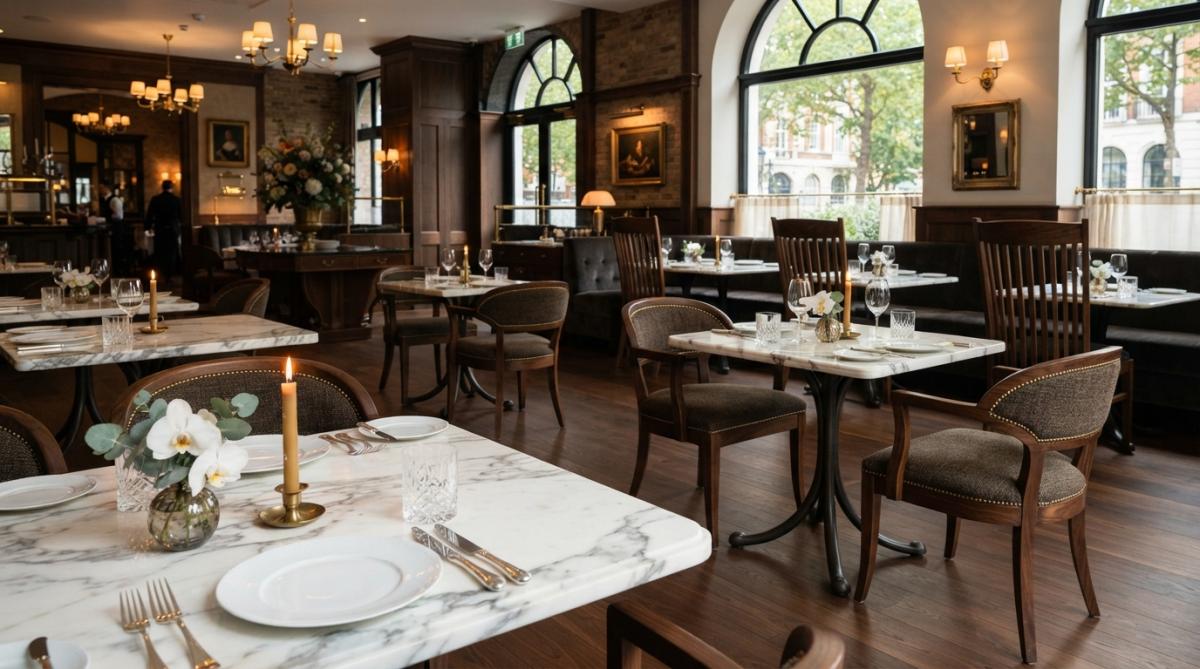
Elegant gastronomy room with noble marble tables, solid wood chairs in warm lighting and bronze-colored accessories

Solid Wood, Marble and Noble Materials

Solid wood is the first choice for upscale restaurants. Woods such as walnut, oak, or cherry develop a noble patina over time and become more beautiful with each passing year. Unlike veneered plywood, solid wood can be repaired, restored, and sanded down if necessary – an investment for decades.

Marble exudes luxury and is practical at the same time. Calacatta, Statuario, or Nero Marquina marble lends an elegant look to counters, buffets, and selected tables. The natural stone is easy to care for and develops a subtle surface change over time, which contributes to the character of the room.

Bronze and other noble metals are ideal accents. Bronze-colored handles, lights, and decorative elements combine elegantly with wood and stone. They are corrosion-resistant and develop a natural patina that radiates authenticity.

Textured fabrics for upholstery should be durable and easy to clean. High-quality linen, cotton, or wool blends in muted colors age better than smooth synthetic fibers. Avoid colors that are too light or too dark – gray-beige, taupe, and cream are timeless and practical.

Attention
Cheap plywood furniture with plastic surfaces quickly looks cheap and cannot be repaired. In luxury gastronomy, this is a breach of trust with your guests. Invest in quality that is visible.

Custom-Made Counters and Buffet Systems

One of the strongest opportunities for differentiation is custom manufacturing. Standard furniture rarely fits perfectly into an individual space. Counters and buffet systems should be precisely tailored to the room geometry, workflows, and design concept.

Casa Padrino offers comprehensive custom manufacturing solutions for counter construction and buffet systems. Each piece is manufactured to your exact specifications – from the height and materials to the smallest details such as handle strips or storage shelves. This allows you to create a completely coherent interior design where every element has its place.

Counters are more than functional elements – they are stages. They are the first point of contact between guest and staff. A well-designed counter with elegant proportions, high-quality materials, and thoughtful lighting immediately creates an impression of quality and professionalism.

Buffet systems must be ergonomically thought out. The height should allow guests to take food without bending or stretching. At the same time, the arrangement should offer a clear view of the food and whet the appetite. This is an art that requires experience.

Luxury Restaurant Design: Color Concepts and Emotional Impact

Colors are not decorative – they are psychologically active. They influence hunger, mood, dwell time, and even the perceived quality of the food.

Color Psychology in Premium Gastronomy

Warm colors such as beige, cream, gold, and terracotta stimulate the appetite and create an inviting, intimate atmosphere. They are ideal for upscale restaurants where guests want to relax and enjoy. These colors look timeless and classic – they are the safe choice for long-term investments.

Dark colors such as dark brown, anthracite, or dark gray create elegance and exclusivity. They look mature and sophisticated. However, dark colors require thoughtful lighting so as not to appear gloomy. In combination with light accents and good lighting technology, spaces of great sophistication are created.

Accent colors should be used sparingly. A deep blue, a warm red, or a rich green can be used as a wall accent or in textiles to create visual tension. However, these colors should never dominate – they are seasoning, not the main ingredient.

Avoid trends. Colors that look modern today will look outdated in two years. Focus on timeless combinations that remain elegant over decades. The emotional impact is more important than being trendy.

Lighting Concepts for Luxury Gastronomy: Atmosphere and Functionality

Lighting is the unsung hero of any gastronomy interior. It influences how food looks, how guests feel, and how long they stay.

A professional lighting concept for luxury gastronomy combines several levels: general lighting for safety, accent lighting for drama, table lighting for intimacy, and functional lighting for service areas.

Dimmable lighting is essential. The same light fixture should work brightly in the morning for preparation and dimmed in the evening for romance. LED technology makes this energy-efficient and without heat loss.

Color temperature is crucial. Warm white light (2700K) flatters skin and food. Cool white lighting (4000K+) looks uncomfortable in restaurants. High-quality fixtures with a high color rendering index (CRI 90+) show food and guests in their best light.

Indirect lighting creates atmosphere without glare. Light fixtures should be visibly elegant – they are part of the design. Casa Padrino offers exclusive lighting fixtures that function as art objects while creating perfect lighting conditions.

Key Takeaway
The best lighting is that which is not consciously perceived – it simply creates the right mood. This requires professional expertise and high-quality components.

Anchoring Corporate Identity and Branding in the Interior

Your interior design is your non-verbal brand. Before you buy even a single piece of furniture, you should know what message your restaurant is meant to convey.

A clear design concept that reflects your corporate identity creates coherence. This does not mean that everything has to look the same – it means it has to fit together. An upscale French restaurant has different design requirements than a modern Asian fusion restaurant.

Consistency is key. The colors, materials, furniture styles, and decorative elements should paint a coherent picture. If you combine elegant Baroque chairs with minimalist tables, it looks unintentional and unprofessional. If you do it deliberately to create a contrast, this contrast must be well-thought-out and elegant.

Signaling effect is important. High-quality materials, noble colors, and thoughtful details signal quality at first glance. Guests decide unconsciously in the first 30 seconds whether they are in a premium restaurant or not. Your interior design should support this decision.

Sustainability and Durability in Gastronomy Interiors

Sustainability is not just a trend – it is a responsibility. Durable furniture is more sustainable than cheap furniture that has to be replaced after a few years.

Solid wood from sustainable forestry, natural fabrics, and high-quality workmanship reduce the ecological footprint. A chair that lasts 20 years is more sustainable than ten chairs that last two years each.

Repairability is an underestimated aspect of sustainability. High-quality furniture can be repaired, restored, and modified if necessary. This allows it to grow with the requirements of your restaurant without constantly buying new furniture.

Casa Padrino works with materials and manufacturing processes that guarantee durability and beauty over decades. This is not only ecologically responsible – it is also economically sensible.

ROI of Interior Design: Profitability and Guest Experience

A common question is: How is the investment in an exclusive interior design justified? The answer lies in several measurable factors.

First: Guests pay for the experience. A restaurant with a well-thought-out, elegant interior design can justify higher prices. Guests are willing to pay more for an overall experience than for food alone.

Second: Dwell time. Guests who are in a pleasant environment stay longer. Longer dwell times mean more beverage sales, more desserts, and more tips. This directly impacts revenue.

Third: Repeat visits and recommendations. An impressive restaurant is recommended. Guests return and bring friends. This is free marketing that is priceless.

Fourth: Staff satisfaction. Staff working in a beautiful, well-thought-out space are happier and more productive. This reduces turnover and improves service.

Fifth: Durability. High-quality furniture lasts for decades. The investment is amortized over many years, not just a few.

Legal Requirements: Fire Safety and Accessibility

While aesthetics are important, they must never compromise safety. Fire protection is non-negotiable.

All materials in public spaces must meet certain fire protection classes. This applies to fabrics, upholstery, wall materials, and even decoration. High-quality materials naturally meet these requirements – cheap materials often do not.

Accessibility according to DIN 18040-1 is legally required. This means:

  • Wheelchair-accessible entrances without steps
  • Door openings of at least 90 cm width
  • Tables in different heights
  • Wheelchair-accessible restrooms
  • Clearly recognizable paths without obstacles

These requirements should be elegantly integrated into the design concept, not look like an afterthought. A well-designed restaurant is accessible to all guests.

Emergency exits must be clearly recognizable and easy to reach. The arrangement of furniture must not block escape routes. This is a matter of human dignity and responsibility.


Planning Phase Focus Timeframe Key Action
Analysis & Concept Space measurement, design concept 4-6 weeks Create 3D floor plan
Material Selection Colors, fabrics, wood types 2-3 weeks Order and test samples
Custom Manufacturing Counters, buffets, custom builds 8-12 weeks Place orders
Lighting Lighting technology, dimmers, fixtures 3-4 weeks Finalize lighting plan
Installation Assembly of all elements 2-4 weeks Coordinate contractors
Finishing Touches Decoration, final details 1-2 weeks Prepare for opening

Planning an exclusive interior for luxury gastronomy is a complex but rewarding task. It requires an understanding of aesthetics, functionality, psychology, and operational logistics. Every decision – from room geometry and material selection to lighting – impacts the overall experience.

Casa Padrino understands this complexity. With over 20 years of experience in furnishing grand hotels and upscale gastronomy establishments, Casa Padrino offers tailor-made solutions that turn your vision into reality. From custom space planning to high-quality gastronomy furniture to exclusive lighting – every element is manufactured with craftsmanship precision and aesthetic understanding.

Visit Casa Padrino and discover how to plan an exclusive interior for luxury gastronomy that enchants your guests and makes your business successful. With Luxury Furniture, custom contract furnishing, and Hotel Interior Solutions, Casa Padrino creates spaces of timeless elegance.

Frequently Asked Questions

What really defines an exclusive interior in luxury gastronomy?

An exclusive interior for luxury gastronomy is characterized by the combination of high-quality materials such as marble and solid wood, custom-tailored gastronomy concepts, and thoughtful space planning. Casa Padrino utilizes European craftsmanship and timeless design principles to create a feel-good atmosphere that immerses guests in a premium experience and highlights the restaurant’s corporate identity.

How important is lighting when planning exclusive gastronomy?

Lighting concepts are fundamental to the emotional impact of a luxury restaurant. They influence not only the atmosphere but also the perception of food and the quality of the stay. A well-thought-out lighting concept in luxury gastronomy considers accent lighting for statement furniture, indirect illumination for a feel-good atmosphere, and functional brightness in service areas. Casa Padrino integrates lighting as part of the overall design.

Which materials are particularly suitable for high-quality gastronomy furniture?

High-quality gastronomy furniture uses materials that combine elegance and durability: solid wood (oak, walnut), marble for tables and buffets, bronze and gold leaf for accessories, as well as textured fabrics for upholstery. These materials guarantee longevity in professional operations while creating the required luxury look. Casa Padrino selects materials that withstand years of intensive use.

How can individuality and corporate identity be achieved in the interior design of luxury gastronomy?

Individuality is created through custom manufacturing and a coherent color concept that reflects the brand identity. Custom-made counters, buffet systems, and furniture make it possible to implement specific room geometries and design specifications. Casa Padrino offers Bespoke Furniture and Luxury Interior Design that make every gastronomy interior unique and create an unmistakable feel-good atmosphere.

High-Quality Lighting for Upscale Gastronomy: The 2026 Lighting Concept Guide

Table of Contents

High-Quality Lighting for Upscale Gastronomy: The 2026 Lighting Concept Guide

Last updated: July 27, 2026

The right lighting defines the dining experience. High-quality lighting for upscale gastronomy creates atmosphere, directs attention, and influences how long guests stay and how much they spend. Casa Padrino, a renowned specialist in exclusive gastronomy furniture and lighting solutions, has learned through over 20 years of hotel projects that lighting design is just as important as the choice of furniture. The lighting concept determines the success or failure of a restaurant.

In this guide, we will show you how to systematically plan, implement, and optimize high-quality lighting for upscale gastronomy. We cover lighting design, zone lighting, LED technology, psychological effects, and practical maintenance tips. By the end, you will understand how professional restaurateurs light their spaces.


High-Quality Lighting for Upscale Gastronomy: Fundamentals of Lighting Design

Lighting design in gastronomy differs fundamentally from residential lighting. A restaurant must function consistently every day: clear structure, repeatable settings, and lighting elements that work reliably 365 days a year.

A good lighting concept begins with three questions: What should the space communicate? What functions does each zone require? How do I create flexibility for different times of day and occasions? Many restaurateurs light their spaces based on gut feeling and later wonder why guests do not stay long or why the food looks unappealing.

Pro Tip
The best lighting design does not start with luminaires, but with a floor plan drawing and color-coded markings for different functional areas. Only then do you select lights that optimally illuminate these zones.

High-quality lighting for upscale gastronomy follows proven principles: ambient lighting for safe navigation, accent lighting for focus and atmosphere, and flexible control for different operational phases.

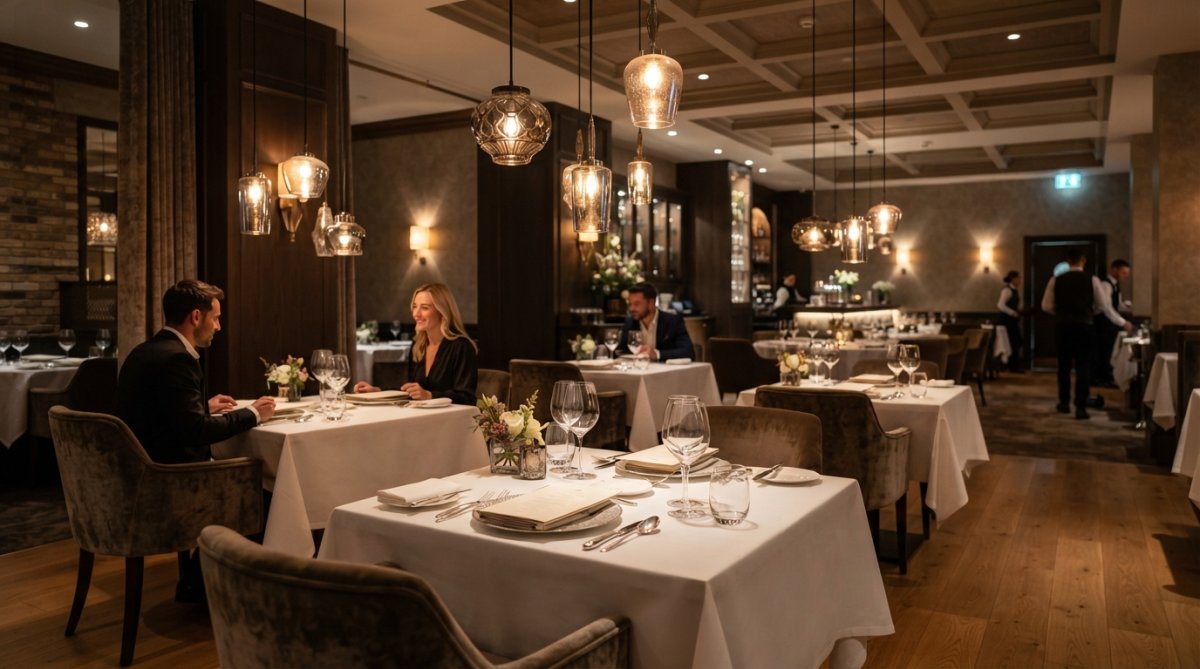
Elegant fine dining restaurant room with warm white pendant lighting over the tables, dimmed light, luxurious atmosphere, and visible guests dining

Why Lighting Design is Crucial in Gastronomy

Light influences three critical factors: safety, appetite, and length of stay. A space that is too dark feels unprofessional and unsafe. A space that is too bright feels uncomfortable. A room with poor color rendering makes high-quality dishes look unappealing.

Research shows that lighting mood directly influences the willingness to spend. Warm white light (2700-3000 Kelvin) promotes relaxation and longer stays. A restaurant that correctly utilizes high-quality lighting for upscale gastronomy earns measurably more.

Lighting Mood and Atmosphere as a Success Factor

The lighting mood is the first thing a guest perceives when entering a restaurant. It decides in milliseconds whether the space feels welcoming. A professional lighting mood is created by three elements: light color (Kelvin value), light intensity (Lux value), and light distribution (direct vs. indirect).

A restaurant with only direct light feels harsh and clinical. A restaurant with only indirect light feels dark. The balance between the two creates coziness without a lack of orientation.

Key Insight
Lighting mood follows measurable rules. Warm white light + indirect component + dimmability = luxury atmosphere. This combination works in any upscale restaurant.

Casa Padrino understands these principles and offers lighting solutions for gastronomy that combine mood and functionality. Their designer luminaires, from pendant lights to recessed spotlights, are specially calibrated for gastronomy projects.


Lighting Concepts for Upscale Gastronomy: Implementing Zone Lighting Correctly

Zone lighting is the backbone of any professional lighting concept. A restaurant is not a single space; it consists of several functional zones with different requirements. A table zone requires different lighting than the bar or the entrance area.

Each zone gets its own light layer. Tables need focused, soft light. The bar needs accent lighting for drama. The entrance needs orientation light. Together, these layers create a coherent concept that works and looks beautiful.

Combining Ambient and Accent Lighting

Ambient lighting ensures that guests can move safely and recognize food. Accent lighting creates drama and focus. Together, they tell a story.

For upscale gastronomy, the rule is: ambient lighting should be between 150-300 Lux. Accent lighting can then add an additional 50-100 Lux. A common mistake is sizing the accent lighting too weakly. Accent lighting should be at least 2-3 times brighter than the surrounding ambient lighting.

Differentiating Table Zones, Bar Areas, and Entrance Areas

Table zones need focused, soft light without glare. Pendant lights work perfectly; they illuminate the table without flooding the room. Dimmability is essential to adjust the mood.

The bar area is the most dramatic place in a restaurant. Accent lighting on bottles, shelves, or the work surface creates energy and focus. A bar without accent lighting feels like a storage room.

The entrance area must feel welcoming and guide guests. A mix of ambient lighting (for safety) and subtle accent lighting (for elegance) works optimally.

Zone Lux Range Light Color Type Effect
Tables 150-250 2700-3000K Pendant lights Cozy, appetizing
Bar 200-400 2700-3500K Accent + Ambient light Drama, energy
Entrance 200-300 3000K Ambient light + Accent Welcoming, clear
Restrooms 300-500 4000K Bright functional light Safe, functional

LED Lighting in Gastronomy: Technology and Light Quality

LED is the standard in gastronomy today. A good LED luminaire lasts 50,000 hours, which is 20 years at 8 hours a day. This means: LED not only saves electricity costs but also maintenance costs.

But not all LEDs are created equal. Quality depends on two critical factors: the CRI value (Color Rendering Index) and the color temperature (Kelvin). A restaurant with poor LEDs looks cheaper than one with good LEDs.

Understanding Color Rendering Index (CRI) and Ra Value

The Color Rendering Index (CRI or Ra value) measures how natural colors look under a light source. A CRI of 100 means: colors look just as natural as under daylight. A CRI of 70 means: colors look distorted and dull.

For upscale gastronomy, a CRI of at least 90 is non-negotiable. With CRI 90+, meat looks red, salad looks green, and wine looks vibrant. With CRI 70, everything looks gray and unappealing.

Attention
A CRI value below 85 is unacceptable for restaurants. With a poor CRI, high-quality dishes look cheap.

Color Temperature and Kelvin Values for Different Areas

The color temperature determines whether light feels warm or cold. 2700K is warm and cozy. 5000K is cold and activating.

For upscale gastronomy, the following applies:

  • 2700K: Ideal for tables, lounge areas, intimacy
  • 3000K: Universally applicable, warm but not too dark
  • 3500K: For bars and accent lighting, more energetic
  • 4000K: Only for functional areas (kitchen, restrooms)

A good lighting concept uses a maximum of two Kelvin values that differ by no more than 500K.


Gastronomy lighting is evolving rapidly. A restaurant operating with outdated lighting feels neglected. Current trends include: statement lights, flexible control, sustainable materials, and smart integration.

Casa Padrino offers an extensive collection of designer lights for gastronomy, specially developed for upscale restaurants. From classic pendant lights to modern recessed spotlights, every piece is crafted to high standards and atmospherically well-thought-out.

Pendant Lights as Statement Elements

Pendant lights are the queens of gastronomy lighting. They are functional and decorative. A good pendant light is a statement; it says: this restaurant takes quality seriously.

Modern pendant lights for upscale gastronomy have these characteristics:

  • Dimmable for lighting mood
  • CRI 90+ for color rendering
  • 2700-3000K for warmth
  • Glare-free design through diffusers or shades
  • High-quality materials (metal, glass, ceramics)

A single pendant light over a table creates focus. Multiple pendant lights in a row create rhythm. The placement is just as important as the luminaire itself.

Cordless Table Lamps for Flexible Room Design

Cordless table lamps enable flexibility that permanently installed lights cannot offer. They can stand on the table, on the bar, or even on a terrace, without power cables.

For upscale gastronomy, cordless table lamps are ideal for flexible event spaces, terraces without power supply, lounge areas with changing layouts, and special events. A good cordless table lamp lasts 8-12 hours and recharges in 2-3 hours.

Glare Protection and Lighting Comfort

Glare is an underestimated problem in gastronomy lighting. A guest who is glared at will not stay long. Glare protection is achieved through diffusers, shades, indirect light, and correct placement. A pendant light over a table should be positioned so that the light falls on the table, not into the guests’ eyes.


Restaurant Lighting Design: Psychological Impact and Guest Experience

Light affects the psyche. Warm white light activates different brain regions than cold white light. Bright light increases heart rate. Dimmed light lowers it. A restaurant that utilizes high-quality lighting for upscale gastronomy psychologically earns more and has more satisfied guests.

How Light Colors Influence Purchasing Behavior and Length of Stay

Warm white light (2700-3000K) increases the length of stay. Guests feel more relaxed and stay longer. This is ideal for fine dining restaurants. Warm white light also increases the willingness to spend; guests order more drinks and desserts.

Cold white light (above 4000K) shortens the length of stay. This is ideal for casual dining concepts where revenue is generated through table turnover. A restaurant can use these effects strategically.

Key Insight
The light color determines not only how a space looks, but also how long guests stay and how much they spend. This is measurable and reproducible.

Smart Home Integration and IoT in Gastronomy

Smart lighting is no longer a luxury; it is a necessity in modern restaurants. With smart home integration, lighting moods can be programmed and automated. A restaurant can automatically set the lighting mood to energetic at lunchtime and to cozy in the evening.

The benefits include automation based on the time of day, energy efficiency through automatic shut-off, scene management for different events, and remote control from a smartphone. For upscale gastronomy, smart lighting is a key differentiator.


Maintenance, Cleaning, and ROI Calculation of Gastronomy Lighting

High-quality lighting is an investment that requires maintenance to retain its value. The good news: LED lighting is low-maintenance. No bulb changes every few months. Just regular cleaning and occasional checks.

Energy Efficiency and Sustainability in Lighting

An LED light consumes 80% less electricity than a halogen light with the same brightness. For a restaurant with 50 lights, this means electricity savings of several thousand euros per year.

An LED light that lasts 50,000 hours is more sustainable than one that lasts 3,000 hours. The reason: less manufacturing, less transport, less waste. For an upscale restaurant, sustainability is also a selling point.

Practical Tips for Cleaning and Maintenance

LED lights are robust, but dirt and dust reduce brightness. Monthly cleaning is ideal:

  1. Switch off the power supply
  2. Dust with a dry brush or cloth
  3. For stubborn dirt: Slightly damp cloth with distilled water
  4. Dry
  5. Switch the power supply back on and test

A restaurant should keep a simple maintenance logbook. That is professionalism.


Lighting Concepts for Different Gastronomy Types: From Fine Dining to Casual Dining

Not every restaurant needs the same lighting. A fine dining restaurant needs a different lighting mood than a pizzeria. High-quality lighting for upscale gastronomy must match the restaurant.

Fine Dining Restaurants: Elegance and Intimacy

A fine dining restaurant is a place for slow enjoyment and intimacy. The lighting must support this: warm white, dimmed, focused on the tables, with subtle accent lighting for drama.

The ideal lighting values for fine dining:

  • Ambient lighting: 100-150 Lux (dim but safe)
  • Table lighting: 200-300 Lux (focused, warm)
  • Light color: 2700K (warm like candlelight)
  • Dimmability: 0-100% (full control over mood)
  • CRI: 95+ (colors must be perfect)

Pendant lights are ideal for fine dining. They create focus and intimacy. Indirect wall lighting creates depth. A fine dining restaurant with good lighting feels luxurious.

Casual Dining and Bars: Energy and Flexibility

A casual dining restaurant or a bar needs a brighter, more energetic lighting mood. The lighting should encourage guests to eat faster and drink more.

The ideal lighting values for casual dining:

  • Ambient lighting: 200-300 Lux (bright, clear)
  • Light color: 3000-3500K (neutral to warm)
  • Accent lighting: Strong and visible
  • CRI: 85+ (good enough)

For bars, several small lights work better than one large one. They create rhythm and allow accent lighting on different elements. Flexible lights are important because casual dining restaurants often host events or change their layout.


Implementing High-Quality Lighting with Casa Padrino

Casa Padrino is not just a furniture manufacturer; it is a specialist in complete gastronomy solutions. The company understands that lighting and furniture must work together. A beautiful light over a poor table feels out of place. A beautiful table under poor light looks cheap.

Casa Padrino offers integrated solutions: furniture, lights, and accessories that together form a coherent concept. Their designer lights for upscale gastronomy are specially developed with high CRI, warm light, and glare-free design.

The collection includes pendant lights, wall lights, recessed spotlights, and accent lighting. All lights are dimmable and available in various styles, from classic to modern. A restaurant can get a complete lighting solution from a single provider without compromising on quality or style.

Casa Padrino also offers consulting. The company has over 20 years of experience with hotel projects and knows the requirements of upscale gastronomy. With Casa Padrino, you get not only lights but also expertise in Luxury Hotel Furniture and Hotel Interior Solutions.


High-quality lighting for upscale gastronomy is not a luxury; it is a necessity. A restaurant without a good lighting concept loses guests and revenue. A restaurant with professional lighting wins both.

The investment in high-quality lighting pays off through longer stays, higher spending, and better reviews. With the right lights, the right CRI value, and the right lighting mood, a restaurant becomes not only more functional but unforgettable.

Casa Padrino has the expertise and the collection to transform your restaurant into a place guests love. With lighting solutions specially developed for upscale gastronomy, you create an atmosphere that perfectly showcases your food and service. Discover the lighting solutions and luxury furniture from Casa Padrino and learn how professional lighting design transforms your restaurant.

Frequently Asked Questions

What color temperature is ideal for high-quality lighting in upscale gastronomy?

For upscale gastronomy, a color temperature between 2,700 and 3,000 Kelvin (warm white) is recommended in the dining area to create an inviting, luxurious atmosphere. These Kelvin values promote relaxation and well-being. In the bar area, 3,000-3,500 K can be selected to convey more energy. A high CRI value (Ra ≥ 90) is crucial so that food, drinks, and guests appear in authentic colors.

What role does the Color Rendering Index (CRI) play in gastronomy lighting?

The CRI value (Ra value) determines how natural colors look under a light source. In upscale gastronomy, the CRI should be at least 90, ideally ≥ 95. A high Ra value ensures that food looks appetizing, drinks look vibrant, and guests’ skin is illuminated flatteringly – essential for the guest experience and the perception of quality.

How can I effectively implement zone lighting in my restaurant?

Divide your dining area into zones: ambient lighting (approx. 300-500 Lux) for general orientation, table lighting (400-800 Lux) for food and guests, accent lighting for artwork or design elements, and separate lighting for the bar and entrance area. Use dimmable LED lights to adjust the light intensity depending on the time of day and guest volume. This creates flexibility and an optimal lighting mood.

Which designer lights are particularly suitable for upscale gastronomy?

High-quality pendant lights with glare-free light, elegant chandeliers for reception areas, and modern recessed spotlights are ideal. Materials such as brass, polished aluminum, or glass add luxury. Designer lights should match the overall concept of your restaurant – from classic baroque to contemporary. Casa Padrino offers exclusive lighting solutions specially developed for luxurious gastronomy spaces that meet the highest quality standards.

How do light colors influence the purchasing behavior and length of stay of guests?

Warm white light (2,700-3,000 K) promotes relaxation and longer stays, ideal for fine dining. Cooler color temperatures (3,500+ K) have an energizing effect, suitable for bars and casual dining. Psychologically, warm light is welcoming and increases the willingness to spend more. A well-thought-out lighting mood with a high CRI value enhances the perception of quality and contributes to positive guest reviews.

Handcrafted Designer Furniture for Exclusive Living Spaces

Table of Contents

Handcrafted Designer Furniture for Exclusive Living Spaces

Last updated: July 26, 2026

Handcrafted designer furniture for exclusive living spaces is not just furniture – they are works of art that bring personality, history, and master craftsmanship into every room. At Casa Padrino, we have gathered over 20 years of experience in furnishing luxury living spaces and grand hotels with furniture that combines genuine craftsmanship with timeless design. In this guide, we will show you what truly sets handcrafted designer furniture apart and how it can transform your space.

Handcrafted Designer Furniture: Craftsmanship Meets Exclusivity

What Makes Handcrafted Furniture Unique

Handcrafted furniture differs fundamentally from mass-produced items. Each piece is created under the personal supervision of experienced artisans who have spent decades perfecting how to shape wood, stretch fabrics, and finish details. No two pieces are identical – each has its own character and history.

The decisive difference is structural: a handcrafted armchair lasts 30 years or more, whereas a mass-produced product begins to wear out after 5 to 8 years. This is due to the materials – genuine solid wood, high-quality upholstery materials, natural leather instead of synthetic imitations – and the construction. Handcrafted joints last longer than industrial pressing processes.

Casa Padrino offers a wide range of handcrafted designer furniture, from classic Baroque pieces to modern interpretations of European design traditions. The manufacturing philosophy is always the same: quality over quantity, durability over trends, individuality over mass production.

Pro Tip
A true indicator of craftsmanship quality is weight. Genuine solid wood furniture is significantly heavier than its industrial counterparts – a Baroque armchair can weigh 30–40 kg. The weight signals density, stability, and genuine material quality.

Craftsmanship as a Quality Feature

Craftsmanship is evident in the details: in the way a table leg is turned, how carvings are applied, and how a sofa’s upholstery is constructed. These details determine aesthetics, functionality, and durability.

A handcrafted Baroque armchair from Casa Padrino is constructed using classic techniques – the solid wood frame is not glued, but joined with mortise and tenon joints. Upholstery is done in multiple layers: suspension, natural fibers, and only then the padding material. Modern workshops combine traditional techniques with a modern understanding of ergonomics and design. The result: pieces that look classic but meet contemporary comfort requirements.

Luxury Furniture Germany: Tradition and Innovation

German Manufactories and Their Special Features

Germany has a long tradition of furniture manufacturing. German craftsmanship stands for precision and durability – a reputation that is the result of centuries of prioritizing quality over speed.

Casa Padrino embodies this tradition. The workshops we collaborate with follow strict standards: every piece of wood is carefully selected, every joint is checked, and every finished piece is inspected. This is time-consuming, but it also means that warranties are meaningful, not just marketing.

A special feature of German luxury furniture is the willingness to customize. While many international manufacturers work strictly from catalogs, German workshops offer to manufacture furniture to the exact millimeter according to the customer’s wishes. The choice of materials is another distinguishing feature – German manufacturers prefer to use European woods instead of cheap imports and work with established suppliers.

Key Insight
German luxury furniture manufacturers focus on the long term. This means higher initial investments, but significantly better value retention and a longer lifespan.

European Craftsmanship in Modern Design

European craftsmanship is diverse – Italian upholsterers, French cabinetmakers, Belgian glass cutters. Casa Padrino leverages this diversity and sources materials from the best specialists across the continent.

Modern designers re-interpret traditional techniques. A Baroque armchair does not have to look like a historical artifact – it can be upholstered with modern fabrics and integrated into a minimalist living room. The craftsmanship remains, but the aesthetic is updated.

The Baroque armchairs from Casa Padrino combine classic carvings and upholstery methods with modern cover fabrics and contemporary colors. The result is a piece of furniture that is both classic and modern at the same time.

Bespoke Luxury Furniture: Individual Interior Design

Tailored to the Millimeter According to Customer Wishes

Bespoke furniture is more investment-heavy because each piece is unique. A custom sofa is not assembled from existing stock, but is constructed specifically for your space.

This begins with measurements – not just room dimensions, but also windows, radiators, and door openings. A sofa that fits perfectly makes the room feel larger and more usable. Then comes the design phase: you can choose the size, seat depths, armrest height, padding, and upholstery materials. These decisions influence how the sofa feels, how long it lasts, and how it complements other furniture.

Please Note
Bespoke furniture has longer delivery times – often 8 to 12 weeks. This is normal and not a sign of poor quality, but quite the opposite: the time is dedicated to craftsmanship.

Planning Office and Interior Design Integration

For larger projects, Casa Padrino offers planning office services. You do not work with a salesperson, but with an interior designer who accompanies your project from start to finish.

The planning office creates 3D visualizations so you can see how the furniture looks in your space before it is manufactured. It coordinates with craftsmen, suppliers, and installers, ensuring that all elements form a coherent concept. This is particularly important for commercial contract furnishings – a hotel with 50 rooms needs a well-thought-out concept that translates across all rooms while still allowing for variation and individuality.

Unique Furniture Pieces: Material Selection and Craftsmanship

Exquisite Materials: Solid Wood, Marble, Bronze and More

The choice of materials is the foundation of luxury furniture. Casa Padrino works with genuine materials:

  • Solid Wood: Beech, oak, walnut, mahogany – carefully selected European and tropical woods. Each wood has different properties: oak is hard and durable, walnut is elegant and dark, mahogany is warm and precious.
  • Natural Stone: Marble, granite, limestone – for tabletops and surface finishes. Marble is elegant but sensitive. Granite is more robust.
  • Genuine Leather: For upholstered furniture. Genuine leather develops a patina and becomes more beautiful over time.
  • Precious Metals: Bronze, brass, stainless steel – for fittings, handles, and embellishments. These materials are durable and timeless.

For example, a luxury dining table from Casa Padrino combines a marble top with a stainless steel or wooden base – beautiful and functional.

Material Durability Maintenance Effort Best Application
Solid Wood 30+ Years Medium Frames, tabletops, structures
Marble Unlimited High Tabletops, surface finishes
Genuine Leather 20+ Years Medium Upholstered furniture, covers
Bronze/Brass Unlimited Low Fittings, embellishments

Care Instructions for Exclusive Designer Furniture

Luxury furniture requires care – that is part of the experience of owning a work of art.

Solid Wood: Treat regularly with wood oil or beeswax. This protects against drying out and stains. Avoid direct sunlight.

Marble: Sealing is essential. Acid can damage marble. Liquids should be wiped away quickly.

Genuine Leather: Treat regularly with special leather cream. This maintains suppleness and protects against cracking. Over time, genuine leather develops a natural patina – which is highly desirable.

Upholstered Furniture in General: Vacuum regularly, turn and reposition cushions. Professional cleaning every 2 to 3 years is recommended.

Handcrafted Designer Sofas: Upholstered Furniture as a Statement

Chesterfield and Baroque Armchairs: Classics with Comfort

A Chesterfield sofa is more than just a piece of furniture – it is a statement. The characteristic tufting, rolled armrests, and deep upholstery date back to the 18th century and have stood the test of time because they work.

The Chesterfield sofa from Casa Padrino combines these classic proportions with modern comfort. The upholstery is deeper than in historical originals, and the seat height is ergonomically optimized.

Luxurious living room with a handcrafted Chesterfield sofa in cognac-colored genuine leather, an elegant Baroque armchair next to it, a classic floor lamp with a crystal shade, warm light filtering through heavy drapes, and a marble side table with a bouquet of flowers

Baroque armchairs are more ornamental and dramatic – clearly a work of art. A handcrafted Baroque armchair with a carved solid wood frame and velvet upholstery is a true eye-catcher. What makes these armchairs comfortable? Not just the padding, but also the geometry – a slight backrest tilt, armrests at the right height, and a seat height that allows your feet to comfortably reach the floor.

Sectionals and Contract Furnishings

For larger spaces, Casa Padrino offers bespoke sectionals. A sectional is not just a large sofa – it is a well-thought-out system that adapts to the room’s geometry.

The planning office works with you to find the right configuration. For contract furnishings – hotels, restaurants, commercial spaces – consistency is crucial. All sofas must look identical, be equally durable, and feel equally comfortable. Casa Padrino has the experience to handle complex projects – from 80-room hotels to restaurant chains.

Baroque, Rococo and Neoclassicism

These styles are timeless. A Baroque armchair today looks no different from one from 1750, but it functions better.

Baroque (17th–18th century) is dramatic, opulent, and curved. Baroque furniture features elaborate carvings, bold colors, and often gold leaf gilding. They look best in rooms with high ceilings.

Rococo is a refinement of Baroque – less dramatic, more elegant, with more white and pastel tones.

Neoclassicism is the reaction to Baroque – straighter, more symmetrical, inspired by antique forms.

Casa Padrino offers all three styles. The choice depends on your space, your taste, and the effect you wish to achieve.

Pro Tip
The trick is to combine classic styles with modern colors and materials. [A Baroque armchair in gray or cream looks more contemporary](https://www.casa-padrino.de/stuehle/barock-stuehle/salon-stuehle-mod2) – but it remains a Baroque armchair.

Integration of Smart Home into Designer Furniture

Modern manufacturers, including Casa Padrino, are working to subtly integrate smart home elements into furniture – USB ports in side tables, wireless charging stations in sofa armrests, integrated lighting in display cabinets. The technology does not dominate the aesthetics – it is an additional feature.

For contract furnishings, especially in hotels, this is highly relevant. Modern guests expect to be able to charge their devices. A luxury hotel that does not offer this feels outdated. But the technology should be seamlessly integrated.

Contract Furnishing and Hotel Furniture: Professional Solutions

Consistent Furnishing Concepts for Large-Scale Projects

A luxury hotel is not just a collection of rooms – it is a coherent design concept. Every room should feature the same quality, style, and atmosphere.

The planning office works with hotel managers and designers to develop a concept. Which color palette? Which materials? Which style? Then all furniture – beds, wardrobes, sofas, tables, mirrors – is coordinated.

Casa Padrino has manufactured Luxury Hotel Furniture for international brands. This means: we understand what a luxury hotel needs – not just beauty, but also functionality, durability, and consistency.

Durability and Resilience for Commercial Use

Furniture in a hotel or restaurant is used differently than in a private home. It must be used daily, often by many different people, and yet still look like new.

This requires reinforced constructions, more robust materials, and special surface treatments. A hotel bed must be strong enough to be made thousands of times a year. A restaurant chair must withstand stains and scratches.

Casa Padrino works with reinforced wooden frames, high-quality mattresses with protective covers, and upholstery made of highly abrasion-resistant materials. This is more of an investment, but it also means that the furniture lasts 15 to 20 years, not 5 to 8 years. This makes perfect economic sense for hoteliers.

Sustainability and Material Origin in Handcrafted Furniture

Responsible Material Sources

Sustainability is a responsibility. Casa Padrino works with suppliers who practice responsible forestry. The woods come from sustainably managed forests, not from illegal or destructive sources.

For European woods, this is relatively simple – the EU has strict laws. For tropical woods, it is more complicated but entirely possible. Casa Padrino only works with suppliers who hold certificates (FSC, PEFC) or other proof of responsible origin.

The same applies to other materials – leather from ethical suppliers, fabrics without harmful chemicals, and recycled or responsibly mined metals. This increases costs, but it is the right thing to do.

Durability as a Sustainability Factor

The most important sustainability factor is durability. A piece of furniture that lasts 30 years is more sustainable than one that lasts 5 years – even if the former consumed more material and energy.

A cheap sofa that ends up in a landfill after 5 years is more harmful to the environment than an expensive sofa that lasts 25 years. Casa Padrino manufactures furniture that lasts, can be repaired, and retains its value. A handcrafted Baroque armchair is not thrown away after 5 years – it is passed down or resold.


Anyone who chooses handcrafted designer furniture for exclusive living spaces is investing in quality, durability, and value retention. Casa Padrino combines traditional European craftsmanship with modern design, offering bespoke solutions for private living spaces, luxury villas, and commercial properties. With over 20 years of experience in furnishing international hotels, we understand what exclusive spaces need: materials that are timeless, constructions that last, and designs that inspire.

Discover the complete collection from Casa Padrino and let our planning office advise you on designing your personal luxury living space. From classic Baroque pieces to neoclassical elegance and modern interpretations – we have the expertise to transform your vision into high-quality, handcrafted furniture art.

Frequently Asked Questions

What are the characteristics of high-quality handcrafted designer furniture?

High-quality handcrafted designer furniture is characterized by solid wood frames, exquisite materials such as marble and bronze, precise craftsmanship, and elaborate carvings. Casa Padrino combines traditional European craftsmanship with timeless design. Each piece is individually manufactured, guaranteeing uniqueness and quality. The use of premium materials and attention to artisanal detail ensure durability and aesthetic excellence.

What advantages does bespoke luxury furniture offer over mass-produced items?

Bespoke luxury furniture is made to the exact millimeter according to your room dimensions and personal ideas. It fits perfectly into your exclusive living spaces and can be precisely adapted in color and style to your design concept. Through custom manufacturing, Casa Padrino offers absolute individuality, the highest quality, and unique furniture pieces that do not exist a second time – a real difference compared to standardized mass-produced items.

How do you properly care for exclusive handcrafted designer furniture?

Care depends on the material: genuine leather furniture requires regular leather care with special products, marble tops require pH-neutral cleaners and protection from acids, and solid wood should be maintained with wood oil. Avoid direct sunlight and extreme fluctuations in humidity. Casa Padrino furniture is crafted with high-quality materials and lasts for decades with proper care. Detailed care instructions are provided with each piece of furniture.

Where can I find handcrafted designer furniture for exclusive living spaces in Germany?

Casa Padrino is a renowned manufacturer and wholesaler of exclusive handcrafted luxury furniture in Germany. The company offers extensive collections in Baroque, Rococo, and Neoclassicism styles, as well as customized solutions according to customer requirements. With over 20 years of experience in hotel projects and international references, Casa Padrino guarantees the highest quality and exclusive designer furniture for private and commercial projects.

Can handcrafted designer furniture be combined with modern interior design concepts?

Yes, handcrafted designer furniture can be excellently combined with modern elements. The timeless elegance of classic pieces forms an appealing contrast to minimalist or contemporary designs. Casa Padrino supports interior designers and private clients in integrating classics with modern technologies such as smart home systems. This blend creates unique, personal spaces that combine tradition and innovation.

Luxury Furniture for Prestigious Business Premises: 10 Design Classics

Table of Contents

Luxury Furniture for Prestigious Business Premises: 10 Design Classics

Last updated: July 25, 2026

Prestigious business premises require a conscious choice of furniture that exudes authority while offering comfort. The right furnishing with luxury furniture for prestigious business premises not only creates a visual statement but also leaves a lasting impression on clients, business partners, and employees. The collection by Casa Padrino offers exactly this combination of craftsmanship excellence, timeless design, and functional ergonomics that defines prestigious spaces.

Below, we showcase the ten most important design classics and contract furniture pieces that transform professional business premises into symbols of corporate identity.

Why Luxury Furniture is Essential for Prestigious Business Premises

First impressions are crucial. When a business partner enters your office, the furniture speaks a language long before you say a word. High-quality designer furniture signals stability, success, and diligence – qualities that potential clients and investors look for. Luxury furniture for prestigious business premises is not just an aesthetic choice; it is a strategic investment in your company’s credibility.

Choosing contract furniture made from high-quality materials such as solid wood, genuine leather, and marble creates a durability that low-cost alternatives cannot offer. A piece of Baroque furniture made of solid beech wood develops a patina over the years that increases its value rather than diminishing it.

Pro Tip
Prestigious office spaces should reflect your company’s values. A law firm or an insurance agency benefits from classic, timeless pieces, while creative agencies can certainly integrate more modern elements, as long as they are of high quality.

Casa Padrino specializes in creating exactly these atmospheres. With over 20 years of experience in furnishing luxury hotels, boutiques, and exclusive business premises, the company combines Italian-inspired elegance with European craftsmanship. The choice of materials and craftsmanship in luxury furniture for prestigious business premises differs fundamentally from mass-produced goods: each piece is crafted with care, not mass-produced.

Design Classics for the Executive Level: Baroque and Neoclassicism

Timeless styles such as Baroque and Neoclassicism have proven themselves in prestigious offices because they embody continuity and tradition. The Baroque style, with its curved shapes, ornamental details, and noble materials, exudes opulence without appearing exaggerated. A Baroque desk made of solid wood with gold accents becomes the centerpiece of an executive office. Neoclassicism reduces Baroque elements to their essential forms – more linear, but still elegant and prestigious.

Both styles work particularly well in industries that need to convey trust and continuity: notary offices, law firms, wealth management consultancies, and traditional craft businesses. Casa Padrino offers extensive collections in both styles, from classic display cabinets and magnificent sofas to solid conference tables.

Key Takeaway
Baroque and Neoclassicism are not old-fashioned; they are timeless. A well-crafted piece of Baroque furniture will look just as elegant in 50 years as it does today.

Exclusive Office Furniture: Executive Chairs and Desks as Statement Pieces

The executive chair is far more than just a piece of furniture – it is a symbol of position and authority. A luxurious executive chair made of the finest genuine leather with ergonomic properties and flawless craftsmanship underlines the authority of the owner. The desk is the workspace where important decisions are made. A solid desk made of mahogany or walnut wood offers ample space and the right acoustics for focused work.

An exclusive office design harmoniously combines these statement pieces. The executive chair should match the desk in color and material without being identical. Casa Padrino offers tailor-made solutions that meet the specific requirements of any executive office.

Ergonomics must not be neglected. A beautiful chair that causes pain after four hours is not an investment. The best executive chairs from Casa Padrino combine ergonomic functions (height adjustment, backrest tilt, armrests) with craftsmanship quality and a noble appearance.

Designing Prestigious Office Spaces: Conference Tables and Reception Areas

A conference table is where business is done. A large, solid conference table made of high-quality wood creates an atmosphere of professionalism. A conference table measuring 240 x 120 cm offers space for up to ten people and looks impressive without being constricting.

The material is crucial. Solid mahogany or walnut wood develops a warm patina and signals stability. Casa Padrino offers conference tables in various materials, from solid wood to combined solutions with glass tops on wooden frames.

The reception area is the first point of arrival for visitors. A prestigious reception desk in white and gold, handcrafted from solid wood, immediately creates a luxurious first impression. The reception desk should be large enough to store work materials, but also elegant enough not to look like a piece of furniture from a warehouse.

Attention
Make sure that conference tables and reception desks are not too dark. A table that is too dark in a room with little natural light can feel oppressive. Light materials or indirect lighting can help.

The Perfect Luxury Executive Chair: Ergonomics Meets Elegance

An executive chair must look elegant and be comfortable. The backrest should support the natural curvature of the spine. An executive chair with an adjustable backrest allows the user to adapt the backrest to their individual anatomy. The armrests should be positionable at the height of the desk so that the arms are properly supported when typing.

The material plays a major role in comfort. Genuine leather is not only more refined than synthetic leather, it is also more breathable and durable. An executive chair made of the finest genuine leather with a solid wood frame will not only be comfortable today but will still look like new in ten years. Casa Padrino offers executive chairs that meet these requirements, featuring height adjustment, swivel function, and ergonomic details.

Ideal for
Executive chairs are particularly suitable for managing directors, lawyers, doctors, and other professionals who sit in their offices for several hours a day. The investment in a high-quality chair quickly pays off through improved productivity and health.

Reception Area Design: Shaping First Impressions with Luxury Furniture

The reception area is the first point of contact with your company. An elegantly designed reception area with high-quality furniture immediately sets a professional tone. The combination of a prestigious reception desk, elegant seating, and thoughtful lighting creates an atmosphere that builds trust.

Elegant reception area with white and gold luxury reception desk, modern designer furniture, and professional lighting in a bright, spacious room

A good reception area should include a reception desk, seating for waiting guests, a coat rack, and appropriate lighting. The reception desk should be made of high-quality materials – solid wood, marble, or high-quality lacquers. The seating should be comfortable and elegant. A Baroque velvet sofa or a modern designer sofa with leather upholstery signals that your guests are valued.

Lighting is often underestimated. Indirect lighting with warm light creates the right atmosphere. Casa Padrino offers complete furnishing concepts for reception areas that harmoniously combine all these elements.

Choice of Materials and Craftsmanship: What Defines Luxury Furniture

The difference between ordinary furniture and luxury furniture for prestigious business premises lies in the materials and craftsmanship. A piece of solid wood furniture is crafted differently than a plywood piece with veneer. A genuine leather cover ages differently than synthetic leather.

Solid wood is the foundation of good furniture. A chair made of solid beech wood is heavier, more stable, and more durable than a plywood chair. Solid wood can be repaired; a scratch can be sanded down and repainted. For contract furniture in prestigious spaces, solid wood is the only sensible choice.

The finish is another quality indicator. A high-quality lacquer is applied in several coats, with sanding between layers. The result is a smooth, durable surface that resists scratches and stains.

Genuine leather differs fundamentally from synthetic leather. Genuine leather breathes, adapts to temperature, and develops a beautiful patina. For an executive chair that is used daily, genuine leather is indispensable. Casa Padrino uses only high-quality materials: solid wood, genuine leather, marble, bronze, and gold leaf.

Pro Tip
Look out for certificates and warranties. High-quality manufacturers like Casa Padrino offer warranties on their furniture because they trust in their quality.

Custom-Made and Individual Solutions for Your Business

Every business is different. Custom manufacturing allows the furniture to be tailored precisely to your company’s needs. Perhaps your office is unusually shaped, with sloped ceilings or alcoves. A custom-made desk would work perfectly. Customization can also mean that the color and material are precisely matched to the corporate identity.

Casa Padrino offers extensive custom-made solutions. The company works directly with clients to develop the perfect solution. Whether it is furnishing a single executive office or an entire hotel, Casa Padrino has the experience and craftsmanship to meet complex requirements.

A custom-made desk that fits perfectly into the space and reflects the corporate identity is an asset that lasts for decades. For prestigious business premises, custom manufacturing is often the best solution.

The 10 Must-Have Design Classics for Prestigious Spaces

Furniture Piece Best Application Style Materials
Baroque Executive Chair Managing Director’s Office, Law Firm Baroque, Neoclassicism Genuine Leather, Solid Wood
Imperial Conference Table Meeting Room, Boardrooms Classic, Neoclassicism Solid Wood (Mahogany, Walnut)
Royal Desk Executive Office, Notary Office Baroque Solid Wood with Gold Accents
Prestige Reception Desk Hotel Reception, Law Firm, Boutique Classic, Modern Solid Wood, Lacquer Finish
Versailles Baroque Display Cabinet Office, Gallery, Museum Baroque Solid Wood, Glass, Gold Lacquer
Elegance Luxury Sideboard Conference Room, Office Modern-Classic Solid Wood, High-Gloss Lacquer
Majestic Baroque Sofa Lounge, Waiting Room Baroque Solid Wood, Velvet Fabric
Glamour Designer Coffee Table Reception Area, Lounge Modern Stainless Steel, Glass
Medusa Baroque Armchair Reception, Private Office Baroque Genuine Leather, Solid Wood
Classic Bookshelf Library, Office Classic Solid Wood, Adjustable Shelves

These ten classics form the foundation for any prestigious business premises.

Contract Furniture for Prestigious Spaces: From Planning to Implementation

Contract furniture refers to furniture specifically developed for commercial or institutional spaces. It differs from residential furniture in its robustness, size, and functionality. A piece of contract furniture for a conference room must not only look beautiful but also withstand intensive daily use.

The planning of contract furniture requires a precise analysis of the room’s geometry, the intended use, and the corporate identity. A good contract furniture planner will ask questions: How many people will use the room at the same time? What technology needs to be integrated? Which colors and materials match the corporate identity?

Casa Padrino offers a comprehensive planning service for contract furniture. With over 20 years of experience in furnishing luxury hotels, restaurants, and exclusive business premises, Casa Padrino has a deep understanding of what works.

Luxury Brands and Designer Collections: Exclusivity in the Details

Some furniture manufacturers collaborate with well-known designers to create exclusive collections. These designer collections bring an additional layer of exclusivity and creativity to the space. Casa Padrino offers exclusive collections developed in collaboration with renowned designers. These collections combine traditional craftsmanship with modern design.

Exclusivity also lies in the details. A chair with hand-stitched decorative seams is more exclusive than a chair with a machine-made seam. A table with a hand-sanded surface is more exclusive than a table with an industrially polished surface. These details make the difference between good furniture and great furniture.

Consulting and Planning Service: Your Path to Prestigious Spaces

Selecting the right furniture for prestigious business premises requires an understanding of design, functionality, materials, and the specific requirements of the company. A professional consulting service can significantly simplify this process. An experienced consultant will ask questions, analyze the space, understand the corporate identity, and then make recommendations that take all these factors into account.

Casa Padrino offers a comprehensive consulting service. The company has a team of experts trained in spatial planning, design, and material selection. These experts can work with you to develop a solution that meets your requirements and realizes your vision. The service includes spatial analysis, design concepts, material selection, custom manufacturing, and installation.


Designing prestigious business premises is an investment in the future of your company. The right choice of luxury furniture for prestigious business premises creates an atmosphere that builds trust, promotes productivity, and strengthens corporate identity. Casa Padrino has the experience, craftsmanship, and materials to turn this vision into reality. Visit casa-padrino.de and discover how we can transform your prestigious space into a masterpiece of elegance and functionality. With tailor-made solutions, high-quality materials, and personalized advice, Casa Padrino offers the complete solution for your furnishing needs.

Frequently Asked Questions

Which furniture is particularly suitable for an exclusive office design?

For an exclusive office design, designer furniture such as handcrafted genuine leather executive chairs, solid mahogany conference tables, and prestigious sideboards are ideal. These pieces combine functionality with aesthetic elegance, creating an atmosphere of professionalism and prestige. Casa Padrino offers specialized contract furniture that is both ergonomic and visually impressive.

How do I design prestigious office spaces stylishly and functionally?

Prestigious office spaces require a thoughtful combination of design classics, high-quality materials, and individual planning. Choose conference tables made of solid wood, ergonomic executive chairs, and elegant reception areas that reflect your corporate identity. Professional interior design consulting helps develop spatial concepts that are both aesthetically pleasing and practical.

Why are luxury executive chairs an important investment?

A high-quality luxury executive chair combines optimal ergonomics with a prestigious appearance. For long working days, it offers seating comfort through high-quality materials such as genuine leather and solid wood. At the same time, an elegant executive chair underlines the status of the leadership level and shapes the impression of visitors. Casa Padrino crafts executive chairs by hand, combining durability and style.

What role do material selection and craftsmanship play in luxury furniture?

Material selection and craftsmanship are the foundation of true luxury furniture. Solid wood such as mahogany, genuine leather, velvet, and fine fittings in bronze or gold guarantee durability and timeless elegance. Handcrafted furniture shows individual quality and care that mass production cannot achieve. Casa Padrino utilizes European craft traditions to create contract furniture that lasts for generations.

Can I customize luxury furniture for my business premises?

Yes, custom manufacturing is a core service for prestigious business premises. Specialized providers like Casa Padrino adapt designer furniture to specific room geometries, color concepts, and corporate identity. From custom-made conference tables to individual reception areas, custom solutions enable perfect integration into your office furnishings.

Repairing Luxury Hotel Furniture: A Guide

Table of Contents

Last updated: July 21, 2026

Repairing Luxury Hotel Furniture: A Guide to Value Preservation and Longevity

The repair of high-quality luxury hotel furniture is a strategic investment that is often underestimated. Professional restoration saves significant costs and preserves the authenticity of the interior. Demotex GmbH and companies like Casa Padrino know from decades of experience that timely maintenance makes the difference between short-term expenses and long-term value preservation.

This guide shows you how to optimally maintain luxury furniture in hotel operations, which repair methods are available, and why prevention is more cost-effective than constant replacement.

Repairing High-Quality Luxury Hotel Furniture: Why Prevention and Maintenance Matter

Daily use by guests leaves its mark: scratches on wooden surfaces, wear and tear on upholstery, stains on textiles. The problem arises when these signs of wear are not systematically addressed. Minor damage grows into major issues. Torn upholstery becomes a safety hazard. A neglected wooden surface begins to turn gray.

Structured maintenance with regular inspections and quick repairs not only extends the life of your furniture but also keeps it in a condition that conveys luxury to your guests. A hotel with well-maintained furniture looks high-end; one with visible damage looks neglected.

Typical Damage Patterns in the Hospitality Industry

Upholstered furniture suffers from intensive use: seats sag, seams rip open, and upholstery fabrics wear unevenly. Wooden furniture shows scratches, dents, and signs of wear on edges and corners. Leather surfaces crack without proper care. Metal fittings oxidize, especially in damp bathrooms.

Damage that compromises hygiene and safety is critical: a tear in upholstery can become a breeding ground for pests. A loose leg is a tripping hazard. A damaged cover can no longer be thoroughly cleaned.

Value Preservation Through Timely Intervention

A baroque armchair from Casa Padrino costs several thousand euros to purchase new. After five years of intensive hotel use with torn upholstery and a scratched wooden frame, it loses its value. Timely restoration costs a fraction of the price of a new purchase and restores it to its original condition.

This also preserves design continuity. If you have to replace individual pieces of furniture, your room concept becomes fragmented. New pieces may not match the remaining furniture perfectly. With professional restoration, the overall concept remains intact. High-quality furniture is often unique or part of a limited series and cannot be easily replaced.

Range of Services in High-End Hotel Furniture Restoration

Professional furniture restoration is a specialized craft that requires deep material knowledge, technical skills, and artistic understanding. Demotex GmbH and similar specialist companies offer a wide range of services that go far beyond simple repairs.

Upholstery Work and Reupholstering of Contract Furniture

Upholstered furniture is the heart of the hotel industry. When the upholstery is damaged, a simple patch is no longer enough.

Professional upholstery work begins with disassembly. The old upholstery material is removed, and the wooden frame is inspected. Damaged parts are repaired or replaced. The spring core is checked and renewed if necessary.

Then comes the reupholstering. The craftsman selects a fabric that matches the original, or a better one if the original material is no longer available. High-quality upholstered furniture requires craftsmanship in cutting and sewing. The final result should not look like a repair, but like a restored original piece.

For hotel furniture, the choice of material is critical. The fabric must be durable, easy to clean, and meet fire protection requirements.

Surface Treatment and Wood Restoration

Wooden furniture is the backbone of luxury hotels. Scratches, dents, and stains are inevitable. The question is: how are they removed?

Surface treatment begins with an accurate diagnosis. Are they superficial scratches or deep dents? Is the surface lacquered, waxed, or oiled? Different materials require different treatments.

For light scratches, a touch-up solution may suffice. For deeper dents, the surface must be sanded down – with sensitivity, so as not to destroy the surface structure. Sanding is followed by surface refinement with multiple coats of finish for durability and shine.

The restoration of marquetry, ornaments, and carvings is particularly demanding, requiring specialized craftsmanship and artistic understanding.

Leather Repair and Textile Cleaning

Leather requires special care. Superficial scratches can be treated with special creams. Deeper cracks require cleaning, preparation, and treatment with special adhesives and color pigments so that the repair becomes invisible.

When it comes to stains, it depends on the type. A specialized craftsman will first test on inconspicuous areas to ensure that the cleaning does not damage the leather.

Textile cleaning is equally specialized. High-quality fabrics cannot simply be put in the washing machine. Professional textile cleaning uses special solutions and processes to remove dirt without damaging the material.

Costs and Cost-Effectiveness of Hotel Furniture Repair

Repairs are an investment in value preservation and longevity, not just a cost factor.

Repair vs. New Purchase: Cost-Benefit Analysis

The central question: When is a repair worth it, and when is a new purchase more economical?

Rule of thumb: If the repair costs are below 40-50 percent of a new purchase, a repair is almost always more economical. You gain the remaining lifespan of the furniture piece. A restored armchair will last another five to ten years.

Scenario Repair Costs New Price Decision
Minor upholstery damage 15-25% 100% Repair
Surface scratches 5-10% 100% Repair
Comprehensive reupholstering 30-45% 100% Repair
Structural damage 60%+ 100% Evaluate

An often overlooked factor is availability. A damaged baroque armchair from Casa Padrino cannot simply be replaced by another model. Restoration solves this problem immediately.

Key Takeaway
Repairs are more economical than new purchases as long as the costs are below 50 percent of the price of a new item. For high-quality designer furniture, the decision is even clearer.

ROI Through Longevity and Value Preservation

The return on investment of professional furniture repair is often underestimated. A luxury hotel thrives on its ambiance. Guests pay premium prices because they expect everything to be flawless. A room with damaged furniture looks cheap. Restoration restores the premium ambiance and thus justifies higher room rates.

Over ten years: An armchair is damaged. Option A: Replacement (full price of a new item). Option B: Restoration (35-40% of the price of a new item). With Option B, you not only save on repair costs but also gain another five to ten years of use.

A consistently maintained, restored room retains its value. A room where individual pieces of furniture are gradually replaced looks incoherent and loses value.

Sustainability and Value Preservation Through Professional Furniture Repair

The repair of high-quality luxury hotel furniture is an act of sustainability.

Environmental Responsibility in the Hospitality Industry

Every new piece of furniture has an ecological footprint: raw material extraction, production, transport. If you restore existing furniture instead, you save these environmental costs.

This is highly relevant for hotels with sustainability certifications. A hotel that restores its furniture instead of constantly replacing it can communicate this as a sustainability feature and attract eco-conscious guests.

A replaced piece of furniture ends up in a landfill. A restored piece of furniture remains in the cycle. This is ecologically sensible and economically advantageous.

Craftsmanship and Longevity as a Sustainability Factor

True craftsmanship is sustainable. A chair restored by hand is treated with care. Such furniture lasts longer because it is better made.

Industrially manufactured mass products are often not designed for longevity. Luxury furniture is different. A baroque armchair from Casa Padrino can last a hundred years – if it is cared for.

Professional restoration says: this piece of furniture is valuable enough to be preserved. It is not a disposable item, but a piece of culture and craftsmanship.

Pro Tip
Communicate your restoration efforts to your guests. A sign in the room explaining that the furniture was restored by hand reinforces the impression of quality and sustainability.

Professional Hotel Furniture Care: On-Site Service and Workshop Repair

There are two fundamentally different approaches: On-site service and workshop repair.

On-Site Service for Minimal Business Disruption

Some damage can be repaired directly in the hotel. A craftsman comes to the room, repairs the furniture, and is gone. The advantage: the room is quickly usable again.

On-site service is suitable for surface treatments, leather repairs, textile cleaning, minor upholstery corrections, and metal part repairs.

The disadvantage: not all work can be carried out on-site. Comprehensive reupholstering requires specialized tools and materials.

Workshop Repair for Complex Restorations

For extensive restorations, the workshop is the right place. The craftsman has the time, tools, and materials to work thoroughly.

Workshop repairs are suitable for comprehensive upholstery work with reupholstering, wood restoration, structural repairs to the frame, and restoration of carvings.

The disadvantage: the room is blocked during the repair. Ideally, several pieces of furniture are sent for repair at the same time. Some hotels work with temporary replacement stock to continue renting out the room.

Step-by-Step Guide: Repair Process for Hotel Room Furniture

Craft restoration of an elegant baroque chair in a professional workshop, with visible tools, upholstery material, and wooden surfaces under warm light, gloves and expertise recognizable

Step 1: Damage Assessment and Material Analysis

It all begins with a precise analysis. The specialist systematically inspects the piece of furniture: What damage is visible? How severe is it? Is there hidden damage?

At the same time, the material is analyzed: Which wood? Which fabric? Which leather? Which surface treatment? This information is crucial because the restoration must be matched to the original.

The result is a detailed report with all damage and a repair plan – your basis for the decision.

Step 2: Cleaning and Surface Preparation

Before the actual repair begins, the piece of furniture is thoroughly cleaned. Dust, dirt, and old surface treatments must be removed.

For wooden furniture, this is done by sanding with different grits. For upholstered furniture, the old upholstery is removed and the frame is inspected. For leather and textiles, a special cleaning is carried out.

Step 3: Repair and Refinement

The craftsman works according to the repair plan. For wooden furniture: repair dents, fill scratches, repair or replace damaged parts, then apply surface refinement. For upholstered furniture: check the spring core, apply new upholstery, cut and sew new fabric. For leather: fill and dye cracks, treat scratches, preserve the surface.

Step 4: Quality Control and Acceptance

Before the piece of furniture goes back to the hotel, it is thoroughly checked. A professional company does this systematically – the inspection is carried out by a person other than the craftsman who repaired it.

Only after passing quality control is the piece of furniture returned to the hotel.

Attention
Inspect the piece of furniture yourself. Check whether the repair was carried out cleanly. If something is not right, report it immediately. Good craftsmen stand by their work.

Avoiding Common Mistakes in Hotel Furniture Repair

Lack of Specialization and Material Knowledge

The biggest mistake: working with a craftsman who has no experience with luxury furniture. High-quality furniture requires specialized knowledge. An unqualified craftsman will make mistakes – and these are often irreversible.

Solution: Only work with specialist companies that have experience with luxury furniture. Ask for references and look at completed projects.

Excessive Business Disruptions

If you block a room for three weeks because the furniture is being repaired, you lose revenue. This must be factored into the cost-benefit calculation.

Solution: Plan repairs during quiet periods. Use temporary replacement stock if possible. Prioritize repairs by urgency.

Insufficient Documentation of Damage Causes

When a piece of furniture is damaged, it is important to understand why. Was it wear and tear? Misuse by a guest? A design flaw? This information helps you avoid similar damage in the future.

Solution: Document every damage with photos and a description.

Specialization in Gastronomy and Hospitality: Why Expertise Matters

Not all restoration companies are the same. Some specialize in gastronomy and hospitality with additional requirements and certifications.

Fire Protection and Hygiene Certifications

Special requirements apply in hotels and gastronomy. Furniture must meet fire protection standards. Fabrics must be flame-retardant. Upholstery material must have specific certifications.

A specialized company knows these requirements and selects materials that meet the standards. They will provide the necessary certificates.

At the same time, hygiene standards apply. Furniture must be easy to clean. Materials must be hygienic.

Contract Furniture and Star-Hotel Standards

Contract furniture differs from residential furniture. It must be more durable, cleaned more frequently, and withstand higher loads.

A five-star hotel expects every piece of furniture to be flawless. A specialized restoration company understands these standards and carries out restorations that meet them.

Casa Padrino and similar providers of luxury furniture often work with such specialized companies.


The repair of high-quality luxury hotel furniture is a strategic investment in value preservation, aesthetics, and sustainability. By professionally maintaining your furniture, you save costs, preserve your design concept, and show your guests that quality is important to you.

Discover the exclusive collection from Casa Padrino and learn how high-quality luxury furniture is designed for the hotel industry. With over 20 years of experience in international hotel projects, Casa Padrino offers not only exceptional furniture pieces but also the expertise to preserve them in the long term. Visit Casa Padrino today and be inspired by the craftsmanship of European luxury furniture.

Frequently Asked Questions

Why should hotels repair luxury furniture instead of replacing it?

Repairing high-quality luxury hotel furniture offers several advantages over buying new. First, professional maintenance preserves the value and aesthetics of the interior, which is often part of the overall ambiance. Second, in many cases, repair is more economical, especially for solid contract furniture made of fine materials such as solid wood or genuine leather. Third, repair contributes to sustainability and reduces waste. High-quality furniture is designed for longevity and can be preserved for decades through professional restoration.

What types of damage to hotel furniture can be professionally repaired?

The range of services for hotel furniture restoration is extensive: upholstery work and reupholstering of armchairs and sofas, surface treatment and wood restoration for wear and tear, leather repair for scratches and cracks, textile cleaning for stains, as well as the repair of damage to veneer, marquetry, and ornaments. Spring core renewals and the renovation of hotel room furniture with signs of wear are also possible. The craftsmanship makes it possible to professionally repair even complex damage to baroque or rococo furniture.

How long does a professional repair of luxury hotel furniture take?

The duration depends on the scope and complexity of the damage. Simple cleaning and minor surface treatments can be done within a few days. Extensive upholstery work, wood restoration, or specialization in historical styles require several weeks. On-site service minimizes business disruptions, while workshop repairs may be necessary for more complex restorations. A professional service provider will create a realistic schedule after the damage assessment and inform you transparently about the duration of the maintenance.

What role do fire protection and hygiene certifications play in furniture repair?

In the hotel industry, fire protection and hygiene certifications are essential. For upholstery work and textile repairs, it must be ensured that the materials used comply with the applicable fire protection regulations. Specialized service providers for gastronomy and hotels know these standards and use certified materials. Professional furniture care and textile cleaning also contribute to compliance with hygiene standards. These certifications are not optional, but necessary for the safe and compliant operation of upscale establishments.

Hotel Interior Design Costs: Calculation Guide

Table of Contents

Last updated: July 20, 2026

Hotel Interior Design Costs: Calculation Guide

Hoteliers and investors regularly face a critical question: How can you realistically and reliably calculate hotel interior design costs? The answer is more complex than a simple rule of thumb, as costs depend on numerous factors—from the hotel category and quality standards to regional differences. At Demotex GmbH, we have been supporting hoteliers for over 20 years in precise cost planning for luxury hotel interiors, and we have learned that a structured calculation makes the difference between a blown budget and solid investment planning.

This guide shows you how to systematically approach calculating hotel costs—from distinguishing between fixed and variable costs and budgeting by hotel category to strategic depreciation models that optimize your financial planning.

Calculating Hotel Interior Design Costs: Fundamentals of Investment Planning

Investment planning for hotel interiors requires a deep understanding of the two types of costs that shape every hotel project. Fixed costs arise independently of room occupancy and remain constant over a longer period, while variable costs are directly linked to the use and wear and tear of the furnishings.

An average 4-star hotel with 100 rooms requires initial furnishing, the total budget for which depends heavily on the chosen quality class. The hotel category determines not only the furniture quality and choice of materials, but also guest expectations and ultimately the room rates you can charge.

Pro Tip
Many hoteliers forget that initial furnishing is only the beginning. Allocate funds for replacement investments right from the initial calculation—on average 10-15% of the initial furnishing budget per year for renovations and wear-and-tear parts.

Understanding Fixed vs. Variable Costs

Fixed costs in hotel furnishing include furniture, lighting systems, flooring, and structural interior elements that remain in place for years. These costs are incurred as one-offs or at longer intervals and are typically distributed over depreciation models (AfA—depreciation for wear and tear).

Variable costs arise from maintenance, repairs, and the replacement of wear-and-tear parts. A damaged chair, replaced bed linen, or a repaired fixture are typical variable costs that change with occupancy and guest frequency. A hotel with 80% occupancy has different maintenance costs than one with 50% occupancy.

Separating these two types of costs is crucial for room rate calculation. Your room rates must not only cover variable operating costs but also offer sufficient margin for the amortization of fixed costs.

Hotel Category as a Cost Factor

The hotel category—whether a 3-star, 4-star, or 5-star hotel—is the main driver of the total interior design costs. A budget hotel requires functional, durable furniture with a minimalist design, while a 5-star hotel requires exclusive, high-quality handcrafted pieces that convey a sense of luxury and exclusivity to guests.

When renovating or initially furnishing an upscale hotel, you must consider not only furniture but also lighting concepts, color schemes, and room acoustics. Casa Padrino specializes precisely in these requirements, offering hoteliers an extensive collection of luxury hotel furniture in Baroque, Rococo, and Neoclassical styles that meet the standards of international grand hotels.

Hotel Room Furnishing Costs: Step-by-Step Calculation

A precise calculation of hotel room furnishings begins with a detailed list of all elements. Every room requires a bed, nightstands, desk, chairs, wardrobe, bathroom fixtures, and lighting. Multiply this list by the number of your rooms, taking into account different levels of furnishing for various room categories (Standard, Superior, Suite).

Key Insight
Most hoteliers underestimate the costs of public areas. The lobby, restaurant, bar, and conference rooms can account for 20-30% of the total furnishing budget—often more than the rooms themselves.

Room Rate Calculation by Level of Furnishing

Room rate calculation is directly linked to the level of furnishing. A room with high-quality Baroque-style furniture, marble washbasins, and exclusive accessories justifies significantly higher room rates than a functional standard room.

Many hoteliers use the following rule of thumb: daily room rates should be around 1-2% of the total investment budget per room. So if you invest 50,000 euros per room, you should calculate with daily rates of 500-1,000 euros to amortize the investment within a reasonable timeframe.

Room occupancy is a critical factor. With an average occupancy of 70%, your rates must be higher than at 85% occupancy to achieve the same contribution margin. Also consider seasonal fluctuations: holiday regions have different occupancy patterns than business hotels.

Budgeting Public Areas and Ancillary Rooms

The hotel lobby is often the first thing guests see—and it leaves a lasting impression of the entire hotel. An elegant lobby with high-quality furniture, art objects, and sophisticated lighting signals quality and exclusivity.

Public areas require a different cost logic than rooms. They are used more intensively, must be more robust, and should convey a consistent design statement. The restaurant, bar, conference rooms, wellness areas, and corridors need special attention when budgeting.

A structured breakdown for public areas could look like this:

Area Priority Estimated Cost Share
Lobby & Reception High 15-20%
Restaurant & Bar High 12-18%
Conference Rooms Medium 8-12%
Wellness & Spa Variable 5-15%
Corridors & Ancillary Rooms Medium 8-10%
Rooms (total) High 40-50%

Hotel Renovation Budget Planning: First Steps in Cost Analysis

A hotel renovation differs fundamentally from initial furnishing. During a renovation, you work with existing structures, must minimize business interruptions, and often cannot take all rooms out of service at the same time.

The cost analysis for a renovation begins with an honest inventory: Which furniture and furnishing elements are still functional and aesthetically acceptable? Which urgently need to be replaced? Are there design elements that should be modernized or updated?

Initial Furnishing vs. Replacement Investment

Initial furnishing is a one-off investment that equips the entire hotel or new rooms. Replacement investment, on the other hand, is a regular task—typically, you have to expect a comprehensive renovation every 7-10 years, depending on the intensity of use and material quality.

The distinction is crucial for financial planning. Initial furnishings are often financed through loans, while replacement investments should be paid for from ongoing operating resources or reserves. For example, a 100-room hotel could renovate 10-15 rooms annually to continuously maintain a fresh standard without jeopardizing operations.

When planning replacement investments, you should think in terms of wear-and-tear groups: mattresses and bed linen have a shorter lifespan than furniture, and furniture has a shorter lifespan than flooring. Staggered replacement planning prevents you from suddenly being confronted with enormous costs.

Attention
Many hoteliers delay renovations for too long to save costs. The result: guests book elsewhere, room rates drop, and the hotel loses competitiveness. Regular, planned renovation is cheaper than an emergency complete overhaul.

Renovation Costs for Public Areas

Public areas age visually faster than rooms because they are used more intensively. A lobby that was elegant 5 years ago can look outdated today. Restaurants and bars are also subject to stronger design trends than rooms.

Renovation costs for public areas are often higher per square meter than for rooms because higher quality standards and more specialized craftsmanship are required here. A restaurant redesign could include new flooring, wall design, lighting concepts, and of course, new furniture and decoration.

Plan for longer renovation cycles for public areas—typically a complete renovation every 8-12 years, with minor updates every 3-4 years. This keeps the areas modern and appealing without affecting operations.

Hotel Furniture Prices and Hotel FF&E Costs: Quality and Cost-Effectiveness

FF&E stands for “Furniture, Fixtures & Equipment”—the category under which most hotel furnishing costs fall. FF&E costs are directly linked to the quality and durability of the furniture. A cheap bed lasts 3-4 years, a high-quality bed lasts 10+ years.

Calculating the true cost per year requires you to divide the purchase cost by the expected lifespan. A hotel bed that costs 5,000 euros and lasts 10 years costs you 500 euros per year—significantly cheaper than a cheap bed for 1,500 euros that needs to be replaced after 4 years (375 euros per year, plus replacement costs and business interruption).

Modularity vs. Custom Manufacturing: Cost-Effective Solutions

Modular furniture offers flexibility and often lower purchase costs. You can combine and adapt modules and replace individual components if necessary. This makes modular systems particularly economical for hotels that want to update their furnishings regularly.

Custom manufacturing, on the other hand, allows you to make optimal use of spaces and create a consistent, distinctive design. If your hotel has a special design concept—for example, Baroque-style elegance with modern accents—custom manufacturing is often the better choice, even if the initial costs are higher.

Casa Padrino offers both options: modular collections for quick, standardized solutions and extensive custom manufacturing options for hotels with specific design requirements. The combination of traditional European craftsmanship with timeless design makes it possible to create spaces that are not only economical but also look elegant years later.

Hotel FF&E Costs: Correctly Evaluating Furniture, Fixtures & Equipment

Evaluating FF&E costs requires you to think beyond the purchase price. Consider:

  • Supply Chain Reliability: Can you get replacement parts if something is damaged?
  • Maintenance Costs: How expensive is it to clean and repair the furniture?
  • Aesthetic Durability: Does the furniture still look modern and high-quality after 5 years?
  • Hospitality Compatibility: Does the furniture fit your concept and target group?

A high-priced designer piece that is difficult to repair and goes out of style in 3 years is economically unviable. A timeless, high-quality piece of furniture that can be repaired if necessary and still looks elegant after 10 years is a better investment.

The Sustainability Cost Factor and Supply Chain Risk Management

Sustainability is no longer just a cost factor—it is a strategic differentiator. Guests are increasingly paying attention to whether a hotel operates sustainably. Furniture made from sustainable materials, long-lasting quality, and responsible manufacturing can make your hotel more attractive to environmentally conscious guests.

Sustainable furniture often costs more initially but lasts longer and reduces your replacement costs over the years. A wooden armchair made of certified solid wood with handcrafted finishes costs more than a cheap armchair made of plywood and plastic—but after 5 years, it is still a gem, while the cheap armchair had to be replaced long ago.

Supply chain risk management is an often overlooked aspect of hotel furnishing planning. If your furniture supplier suddenly goes bankrupt or supply bottlenecks arise, you can quickly find yourself in trouble. Working with established, reliable suppliers like Casa Padrino, who have over 20 years of experience in international hotel projects, significantly reduces this risk.

Pro Tip
Diversify your suppliers, but work with at least one strategic partner you trust. A reliable partner can quickly deliver replacement parts in emergencies or offer short-term solutions.

Tax Depreciation (AfA) in Hotel Furnishing Calculations

Depreciation for wear and tear (AfA) is an important factor in cost planning. Furniture and furnishings can be depreciated over their useful life—typically over 10-13 years, depending on the depreciation class.

Depreciation reduces your taxable profit and thus your tax burden. A hotel that invests 500,000 euros in furniture can spread these costs over 10 years—50,000 euros of depreciation annually. This significantly reduces your tax burden, especially in the first few years after the investment.

Understand the tax regulations in your region. In Germany, there are different depreciation rates for different types of furnishings. Work with your tax advisor to ensure you take advantage of all available depreciation options.

Avoiding Common Mistakes in Cost Calculation

The most common mistake is underestimating ancillary costs. Many hoteliers only budget for furniture and forget transport, installation, on-site adjustments, and disposal of old furniture. These “hidden” costs can easily account for 15-20% of the total costs.

A second mistake is not considering buffer budgets. Projects rarely go exactly to plan. Unexpected damage during delivery, on-site adjustments, or short-term design changes occur regularly. A buffer budget of 10-15% is realistic.

A third mistake is focusing only on purchase costs without considering life-cycle costs. A cheap piece of furniture with high maintenance costs is ultimately more expensive than an expensive but robust piece.

Also avoid compromising too much on quality and design to save costs. A hotel thrives on its details and its ambiance. Guests notice cheap furniture and poor workmanship—and book elsewhere next time.

Hotel Furnishing with Casa Padrino: Luxury Furniture for High Standards

If you want to furnish or renovate a hotel with high standards, Casa Padrino is a strategic partner that supports your investment planning. The company specializes in exclusive luxury hotel furniture and extraordinary interior design concepts developed specifically for the upscale hotel industry.

Casa Padrino offers an extensive collection of high-quality furniture in Baroque, Rococo, Neoclassical, and Art Nouveau styles—styles that exude timeless elegance and do not “wear out” as quickly as trendy furniture. The use of materials such as solid wood, marble, bronze, and gold leaf guarantees not only durability but also aesthetic longevity over decades.

Elegant hotel room with exclusive Baroque-style furniture by Casa Padrino, marble washbasin with bronze fixture, gold leaf details on mirrors and chandeliers, warm lighting from chandeliers, luxurious bed linen and curtains

Customization to specific room geometries and design concepts is a core competence of Casa Padrino. If your hotel has a special design concept or you need to furnish rooms with unusual proportions, custom solutions from Casa Padrino can meet your requirements.

With over 20 years of experience in international hotel projects and references from luxury brands that demand the highest quality, Casa Padrino offers not just furniture, but a complete concept for luxury hotel interiors. The combination of traditional European craftsmanship and timeless design creates an ambiance of the highest elegance that delights your guests and justifies your investment over decades.

Investing in Casa Padrino furniture is an investment in the longevity and prestige of your hotel. This furniture will not be replaced in 5 years—it becomes a signature of your hotel that guests recognize and appreciate.


Calculating hotel furnishing costs is a complex task that requires strategic thinking, financial discipline, and a deep understanding of quality. By understanding these fundamentals and conducting a structured cost analysis, you can ensure that your investment is not only economically profitable but also creates a hotel that your guests love.

Discover the exclusive collection from Casa Padrino and let our experts support you in planning your hotel interior. Visit casa-padrino.de and find out how we can make your vision of a luxurious, economically optimal hotel interior a reality.

Frequently Asked Questions

What is the average cost of hotel room interior design per category?

The costs of hotel room furnishings vary greatly depending on the hotel category and level of furnishing. For a 4-star hotel, the investment budgets for furniture, lighting, and accessories are significantly higher than for budget hotels. Room rate calculations should take into account that luxury hotels work with high-quality materials such as solid wood, marble, and bronze, which reduces operating costs in the long term through durability.

How do fixed and variable costs differ in hotel furnishing calculations?

Fixed costs include initial furnishing, furniture, and structural elements that are one-off investments. Variable costs arise from maintenance, replacement investments, and regular renovation costs. A precise cost analysis separates these items to create realistic operating costs and ROI forecasts. Budget planning for hotel renovations should take both factors into account.

What role does tax depreciation (AfA) play in hotel interior design costs?

The depreciation of furniture and furnishings (AfA) significantly reduces taxable profits. Hoteliers should clarify with their tax advisor which hotel FF&E costs can be written off as operating resources. This affects the actual profitability of investment planning and should be included in the cost calculation.

How can you save on hotel furniture prices without losing quality?

Modularity instead of custom manufacturing reduces costs significantly without diminishing the impression of luxury. Long-term partnerships with suppliers like Casa Padrino enable better conditions with consistent hotel room furnishings. A well-thought-out replacement investment strategy and proactive maintenance prevent expensive emergency renovations and optimize operating costs over the years.

Handcrafted Furniture for Interior Designers: Bespoke Solutions

Table of Contents

Handcrafted Furniture for Interior Designers: Bespoke Solutions

Last updated: July 24, 2026

Interior designers who want to furnish their projects with timeless elegance and handcrafted precision know: handcrafted furniture for discerning interior designers is not just furniture. They are investments in quality, individuality, and the lasting impression a room leaves behind. Demotex GmbH has specialized in exactly this requirement for over two decades – combining European craftsmanship with timeless design for professionals who refuse to compromise. This guide shows you how bespoke solutions can transform your spatial concepts and why handcrafted quality makes all the difference.

Handcrafted Furniture for Discerning Interior Designers: Why Craftsmanship Matters

The distinction between industrial mass production and genuine manufacturing lies in the details that no one sees – until you sit in a room and feel the quality. Handcrafted furniture for discerning interior designers is not created on automated production lines, but by skilled artisans who inspect, adjust, and refine every single piece.

This process makes it possible to respond to specific spatial requirements that are impossible to meet with standard furniture. A Baroque armchair with bespoke proportions for a low-ceilinged penthouse living room. A Neoclassical chest of drawers that fits exactly into an unusually wide niche. A hotel headboard with integrated lighting according to precise CAD specifications.

Pro Tip
Many interior designers underestimate the time advantage of craftsmanship: while you often have to make compromises with standard solutions, an experienced workshop integrates your requirements directly into production – no redesign, no adjustments after delivery required.

Durability is another critical factor. Handcrafted furniture lasts for decades – sometimes generations. In professional hotel operations, where furniture is subjected to intensive daily use, the higher investment quickly pays off through reduced replacement cycles and consistent aesthetics over the years.

Bespoke Luxury Furniture: The Foundation of Individual Interior Design

Bespoke solutions are the foundation upon which genuine interior design is built. Every project has different requirements – varying room geometries, styles, functional demands, and budget frameworks. Bespoke luxury furniture responds to this variability instead of ignoring it.

Material Selection and Handcrafted Precision

The choice of materials determines not only the aesthetics but also the durability and character of a space. Handcrafted furniture for discerning interior designers traditionally uses high-quality materials: solid woods such as mahogany, walnut, and oak; marble slabs for table tops; bronze for fittings; gold leaf for embellishments.

Every material is carefully inspected before processing. A block of wood is not cut immediately – it is seasoned to dry optimally. Veneers are selected and arranged by grain to create visual harmony. Surface finishing is carried out in multiple layers: sanding, priming, lacquering, polishing – each step controlled by hand.

Key Insight
Handcrafted precision is shown in millimeters: a cabinet whose doors close absolutely flush, even though the room has settled by 2 cm. A table whose top is just as level after years as it was on the first day.

Casa Padrino works with the finest European materials and has access to rare wood species and finishing techniques that industrial manufacturers cannot offer. This material quality is not interchangeable – it is part of a project’s identity.

CAD Planning and Technical Interfaces for Professionals

Modern interior design demands precise technical interfaces. You need CAD data to refine your planning. You need BIM integration for complex hotel projects. You need exact dimensions to ensure coordination with other trades.

Professional workshops understand this requirement. Planning begins with your specifications – whether as a PDF, a room sketch, or a digital file. The workshop creates detailed working drawings that are not only used for production but also serve you in coordinating with architects, electricians, and other specialists.

CAD planning also allows variants to be thought through quickly. Should the chest of drawers be 85 or 92 cm wide? How does this affect the proportions? A good partner will show you several options – digitally, before a single screw is turned.

Close-up of artisan hands carefully carving ornate wooden furniture detail with traditional chisels and tools in a bright workshop, wood shavings visible on the workbench

Individual Interior Design through Unique Designer Furniture

Unique designer furniture pieces are not simply “more expensive furniture”. They are spatial solutions that respond to the specific situation – architecturally, functionally, and aesthetically.

From Baroque to Neoclassicism: Style Confidence in Contract Furnishing

Styles are more than decoration – they are a language that allows the space and the user to communicate with each other. A Baroque cabinet is not simply “playful”; it creates an atmosphere of elegance and history. A Neoclassical table communicates order, proportion, and timeless sophistication.

For interior designers, style confidence is crucial. You cannot improvise. A Baroque armchair that looks too “cheap” undermines the entire project. A Neoclassical shelf that is not perfectly proportioned is noticed immediately – negatively.

Casa Padrino offers comprehensive experience in classic European styles. Baroque with elaborate carvings and gilding. Rococo with playful shapes and fine details. Neoclassicism with stricter proportions and elegant restraint. Art Nouveau with flowing lines and organic shapes. These styles are not “trends” – they are proven design languages that work because they are based on decades or centuries of tested aesthetics.

For high-end hotel projects, this means: guests immediately recognize that they are in a space of quality. Not because of a price tag, but because of the craftsmanship, the choice of materials, and the stylistic coherence.

Spatial Concepts Combining Functionality and Aesthetics

A unique piece of designer furniture must function. A hotel bedside table that looks beautiful but has no power outlet is a failure. A desk whose proportions are elegant but whose work surface is too small is not usable.

True contract furnishing combines both. The bedside table has hidden power lines and magnetic holders for tablets. The desk has an optimal working height and integrated cable routing. Beauty arises through intelligent design, not despite functionality.

Attention
A common mistake: interior designers order furniture based on photos without clarifying the functional details. Later, it turns out that the cabinet is too deep to open the door fully, or that the drawers block each other. Clarify all functional requirements in writing before production begins.

Unique Designer Furniture for High-End Projects

A unique piece of designer furniture is a conscious decision against standard solutions. It is the recognition that a project deserves something special – and that this distinctiveness has a price that is worth it.

Handcrafted Precision versus Mass Production

The difference lies in control. In mass production, thousands of identical parts are manufactured. Quality control is done on a random basis. Defects are accepted as long as they are within the tolerance range. A cabinet with 2 mm of play in the hinges is “fine”.

In handcrafted production, every piece is inspected individually. The hinges are adjusted so that the doors close absolutely flush. Scratches on the surface are reworked. Proportions are checked with a trained eye – not just with measuring tools.

This takes time. A handcrafted cabinet takes longer than an industrially manufactured one. But the quality is incomparable. After years, the handcrafted cabinet is still as good as on day one. The industrially manufactured one shows wear and tear.

Surface Finishing and Material Quality as a Differentiating Feature

The surface is what you see and touch. It is therefore the primary signal of quality. A high-quality surface finish not only looks better – it also protects the material underneath.

Handcrafted finishing is done in layers. For a stained solid wood cabinet, this means: sanding the wood, applying stain, intermediate sanding, priming, first coat of lacquer, second sanding, second coat of lacquer, polishing. Every step is manually controlled.

The result is a surface that is not only smooth and glossy but also feels premium to the touch. Some surface finishes use traditional techniques such as a wax finish or shellac – materials that gain character over the years instead of fading.

For high-end hotel projects, this means: a chest of drawers cleaned daily by housekeeping retains its beauty. The surface finish is strong enough for intensive use, yet fine enough to exude elegance.

Hotel Interior Design Furniture: Professional Solutions for B2B Projects

Hotels have specific requirements that residential furniture does not have to meet. Guests use furniture more intensively, unpredictably, and sometimes more carelessly than private individuals. A hotel bed is made and unmade daily. A hotel armchair is used by hundreds of different people. A hotel cabinet must conceal household appliances while looking elegant at the same time.

Durability and Functionality in Hotel Operations

Durability in hotel operations is not optional – it is an economic necessity. A hotel bed that has to be replaced after 3 years is a financial disaster. An armchair whose upholstery is worn out after 2 years not only looks bad but also signals a lack of quality.

Professional hotel interior design furniture is therefore constructed differently than residential furniture. The frame construction is more solid. The upholstery uses more robust materials. The covers are made of fabrics that can withstand frequent washing. The wooden parts are protected with surface finishes that withstand cleaning agents.

Casa Padrino has over 20 years of experience in furnishing luxury hotels. This experience is reflected in every design decision. A hotel headboard is not only beautifully designed – it is constructed to be easy to clean, to prevent damage by guests, and to withstand years of intensive use.

Ideal for
Luxury hotels with high standards of aesthetics and durability, boutique hotels that differentiate themselves through design quality, and spa and wellness resorts where tranquility and elegance are central.

Sustainability Certifications and Compliance for Large-Scale Projects

Large-scale projects – whether hotel chains or commercial properties – increasingly have sustainability and compliance requirements. Furniture must be made from certified materials. Finishes must be environmentally friendly. Supply chains must be traceable.

A professional partner for hotel interior design furniture understands these requirements and can document them. FSC certification for wood. Environmentally friendly lacquers and stains. Transparent production processes that you can justify to your clients.

For large-scale projects, this is not only ethically important – it is also a marketing advantage. A hotel furnished with sustainable materials can communicate this. Guests who value sustainability will appreciate it.

Collaboration with Interior Designers: Project Support from Start to Finish

Planning Services and Architect Support

True planning services begin early. Not just when the furniture is ordered, but when the spatial concept is still in development. A good partner asks questions: What function should this space fulfill? Which style fits the project? Which materials make sense? Which colors harmonize with the rest?

These questions lead to better results. A cabinet that is not only beautiful but also fits perfectly with the architecture of the room. A table whose size and height are optimally coordinated with the room geometry. An armchair whose color enhances the project’s color palette.

Casa Padrino offers comprehensive advice. Your requirements are combined with craftsmanship knowledge. The result is furniture that is not only high-quality individually but also works as an ensemble.

Cost-Benefit Analysis for Bespoke Furnishing Projects

A common question: Is the investment in bespoke furniture really worth it? The answer is: It depends on how you measure the costs.

If you only compare the initial purchase costs, bespoke items are more expensive. A handcrafted cabinet costs more than an industrially manufactured one.

But if you calculate over the life cycle – purchase, maintenance, replacement, disposal – it looks different. A handcrafted cabinet lasts 20 years. An industrially manufactured one lasts 5-7 years. This means you have to replace the industrial cabinet 3-4 times, while the handcrafted one still looks good.

In addition: a cabinet that fits your project perfectly requires no adjustments. You save costs on reorders, modifications, and repairs.

For hotel projects, the calculation is even clearer. A hotel headboard that lasts 10 years is cheaper than one that has to be replaced after 3 years – even if the first one is more expensive.

Aspect Industrial Production Handcrafted Production
Acquisition Costs Low Higher
Durability 5-7 years 15-20+ years
Adjustments needed Frequent Rare
Repairs Regular Minimal
Total costs over 20 years Higher Lower
Aesthetic consistency Deteriorates Maintained

Why Handcrafted Furniture is Indispensable for Demanding Projects

Handcrafted furniture for discerning interior designers is not a luxury you can afford – it is a necessity for professionals who want to build their reputation. A project furnished with standard furniture looks like a project with standard furniture. A project with handcrafted furniture looks like a project where every detail has been thought through.

That is the difference between “beautiful” and “extraordinary”. Between “good” and “unforgettable”. Between a room that guests forget and a room they remember years later.

The investment in quality pays off – not only economically, but also in terms of customer satisfaction, project reputation, and personal satisfaction as an interior designer. You haven’t just furnished a room – you have created a masterpiece.


The reality of many design projects is a challenge: standard furniture never fits perfectly, compromises arise, and the original vision is diluted. Casa Padrino solves this problem with bespoke solutions developed specifically for your requirements. With over 20 years of experience in furnishing luxury hotels, villas, and high-end commercial spaces, Casa Padrino offers comprehensive expertise in craftsmanship, material selection, and timeless design. Every piece of furniture is manufactured with handcrafted precision, uses European quality materials, and integrates perfectly into your spatial concepts. Discover how Casa Padrino brings your next interior design vision to life.

Frequently Asked Questions

What advantages does handcrafted furniture offer interior designers compared to mass-produced goods?

Handcrafted furniture allows interior designers absolute creative freedom and individuality. Unlike mass production, bespoke solutions can be tailored precisely to room geometries, design concepts, and client specifications. Handcrafted precision guarantees the highest material quality and durability – essential for prestigious spaces and professional hotel projects. In addition, unique pieces create a distinctive ambiance that exudes prestige and exclusivity.

How does the collaboration between interior designers and manufacturers of handcrafted furniture work?

Project support begins with detailed planning services: interior designers develop their spatial concepts, and the manufacturer supports them with CAD planning and technical interfaces. Modern workshops offer architect services with BIM data and professional advice on material selection and surface finishing. Regular exchange during production ensures that every piece meets exact specifications – from design classics to innovative custom solutions.

Which materials and surface finishes are standard for high-end interior design projects?

Bespoke luxury furniture uses high-quality materials such as solid wood from sustainable sources, marble, bronze, and gold leaf. Surface finishes range from hand-polished lacquers to patinated metal surfaces. For hotel interior design furniture, robust, easy-to-maintain surface treatments are essential to guarantee durability in professional operations. Sustainability certifications and compliance standards are increasingly a prerequisite for B2B projects.

How do bespoke furniture pieces differ from standard solutions in their cost-benefit analysis?

While unique handcrafted designer furniture requires higher initial investments, it pays off over decades through durability and functionality. Unlike mass-produced goods, bespoke solutions retain their aesthetics and technical performance. For interior designers, this means: fewer replacement purchases, higher customer satisfaction, and a portfolio with lasting references. The individuality justifies the investment through unique spatial design.