Table of Contents
- Tip 1: Material Quality as the Foundation of Durable Restaurant Furniture
- Tip 2: Check Edge Impact Resistance and Surface Quality
- Tip 3: Stability and Commercial Suitability According to DIN Standards
- The Benefits of Custom-Made Hotel Furniture for the Dining Room
- Tip 4: Caring for Solid Wood Furniture in Restaurants
- Tip 5: Buying Robust Hotel Furniture: Checklist for Second-Hand Purchases
- Tip 6: Ergonomics and Seating Comfort for Guests
- Tip 7: Room Climate, Humidity and Value Retention
- Frequently Asked Questions
Last updated: September 23, 2026
Tip 1: Material Quality as the Foundation of Durable Restaurant Furniture
Anyone looking for durable restaurant furniture quickly comes across a simple principle: the material determines the service life, not the price alone. Investing in professional, durable seating reduces the need for annual replacement purchases, as an industry guide by MityLite on avoiding annual furniture replacement costs shows. At Casa Padrino, every project therefore starts with the question of materials, before a design is even defined.
Solid Wood versus Chipboard: The Decisive Difference
Solid wood is a naturally grown material whose structure lasts for decades. Chipboard, on the other hand, consists of glued chips whose edges swell under constant stress. For a dining room with guests changing every day, this is no minor detail. Solid wood is rated as one of the most durable materials for dining room furnishings, as Tradis Design explains in its recommendations for opening a restaurant.
What matters is not just “solid wood” but the type of wood. Oak and ash are among the hardest European woods and withstand knocks from chair legs and fluctuations in humidity far better than soft conifers. Beech is very pressure-resistant but reacts more sensitively to moisture and should only be used with a sealed surface in busy dining rooms. Pine and spruce are better suited to decorative surfaces than to load-bearing frames.
Why Density Determines Service Life
A practical indicator is the density of the wood: the higher it is, the more resistant the surface is to dents and scratches. A simple test before buying: press your fingernail into an inconspicuous spot. If a visible notch remains, the wood is too soft for continuous commercial use.
Multi-Layer Construction as an Alternative to Solid Panels
For table tops and bar counters, multi-layer construction (also known as veneered core board with a solid wood edge) has proven itself: a stable core of cross-glued wood layers is finished with a high-quality top layer. This considerably reduces the movement of the wood when the climate changes and is often the technically better choice for large surfaces than a solid panel. It is important that the visible edges are also made of solid wood, as only then will they withstand knocks.
Metal, Marble and Stone as a Complement
For heavily used areas such as bar feet, table frames or buffet surfaces, stainless steel, bronze and marble are a sensible complement to wood. Stainless steel is hygienic and easy to clean, bronze develops a patina over the years and gains character, marble is scratch-resistant but sensitive to acids and needs regular sealing. Casa Padrino combines these materials in its Casa Padrino luxury restaurant chairs and table series so that appearance and commercial durability go together.
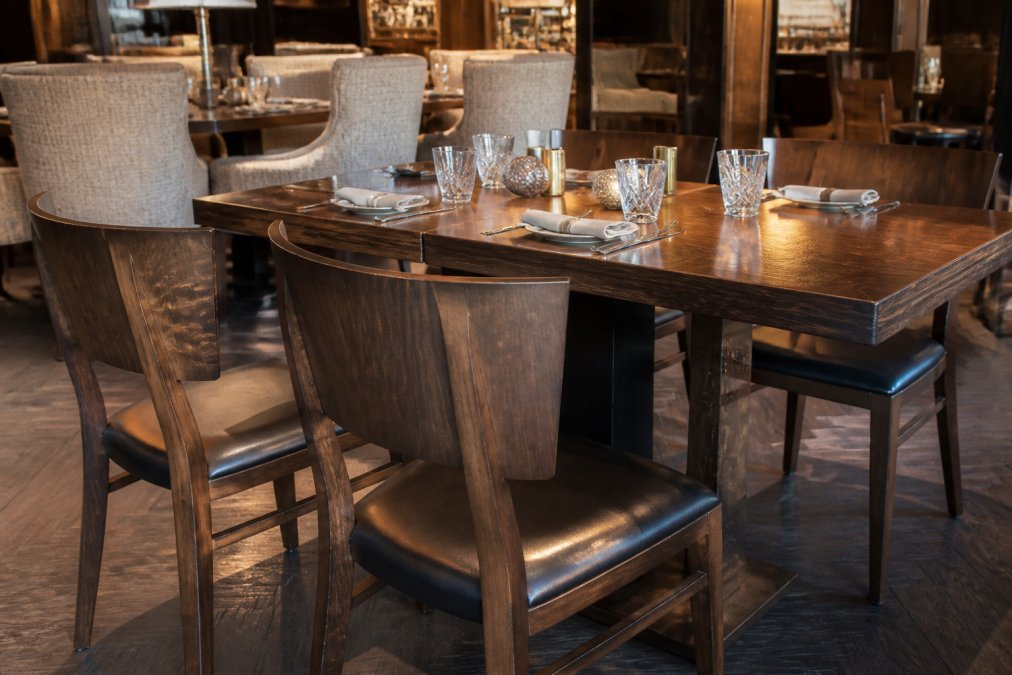
Solid wood is not all the same: oak and ash are the first choice for busy dining rooms, beech only with a sealed surface, softwoods rather for decorative surfaces. Check the density with the fingernail test before ordering a series.
Tip 2: Check Edge Impact Resistance and Surface Quality
Edge impact resistance describes how well a furniture edge copes with knocks from chair legs, serving trolleys or cleaning equipment. In the restaurant trade it matters more than any showroom look. Test the edge with your fingernail: if it can be dented, it is too soft for everyday commercial use.
The surface quality also determines how well the furniture retains its value.
Tip 3: Stability and Commercial Suitability According to DIN Standards
Stability is not a matter of taste for restaurant furniture but a safety requirement. Tested contract furniture meets the relevant DIN standards for commercial use and withstands loads that would overwhelm private home furniture. Look for screwed frames instead of push-fit joints.
Which Standards Are Actually Relevant for Restaurant Furniture
Unlike in the private sphere, several sets of standards apply in parallel in the dining room. For seating, EN 16139 (non-domestic seating, safety, strength and durability requirements) is the central basis. It defines test methods for loads that go far beyond private use, such as repeated seat loads, front edge tests and drop tests. For tables, EN 15372 (non-domestic tables) applies, which tests stability, horizontal load and impact resistance of the table top, among other things.
Fire Protection: What Is Really Required in the Dining Room
Special fire protection requirements apply to upholstery fabrics and textile surfaces in the dining room. The classifications according to DIN 4102-1 (building material classes, including B1 “flame-retardant”) and the European EN 13501-1 with classes A to F are particularly relevant. Many contract upholstery products are additionally tested according to DIN 66084 (behaviour of upholstery when exposed to a small ignition source); this test simulates, for example, a discarded cigarette and is particularly relevant for dining rooms with a bar or lounge.
Checking Stability in Everyday Use
- Tilt test: push the chair forward with your hand on the front edge of the seat; if it tips over, the base is too narrow.
- Joint test: shake the frame. Push-fit joints give audibly, screwed or mortised joints remain stable.
- Load test: place a weight on the seat and watch whether the legs deform.
- Edge test: run your fingernail over the edge. If it can be dented, it is too soft for everyday commercial use.
| Checkpoint | What to look for | Why it matters |
|---|---|---|
| Edge impact resistance | Test the edge with a fingernail | Prevents swelling and chipping |
| Stability | Screwed frames, wide base | Protection against tipping when busy |
| Seating standard | Ask for proof of EN 16139 | Commercial durability |
| Table standard | Ask for proof of EN 15372 | Stability and impact resistance |
| Fire protection | DIN 4102-1 / EN 13501-1 / DIN 66084 | Official requirement and insurance cover |
| Surface | Oil or lacquer, can be refinished | Value retention over years |
| Spare parts | Floor glides and covers available to reorder | Repair instead of replacement |
A missing fire protection certificate is not a formality but a liability risk. Always have test certificates for upholstery fabrics handed over in writing and keep them together with the order; in the event of an official inspection or an insurance claim, they are your proof.
Casa Padrino supplies tested contract furniture for hotel interior solutions and advises you on the right standards for your type of dining room, from the bar to the fine dining restaurant to the hotel lobby.
The Benefits of Custom-Made Hotel Furniture for the Dining Room
The benefits of custom-made hotel furniture lie in the precise fit: each piece is tailored to the actual room geometry rather than the other way round. This avoids dead space, awkward walkways and makeshift solutions. Through the Casa Padrino bespoke furniture service, Casa Padrino produces one-off pieces in solid wood, marble, bronze and gold leaf that match the room plan exactly.
Tip 4: Caring for Solid Wood Furniture in Restaurants
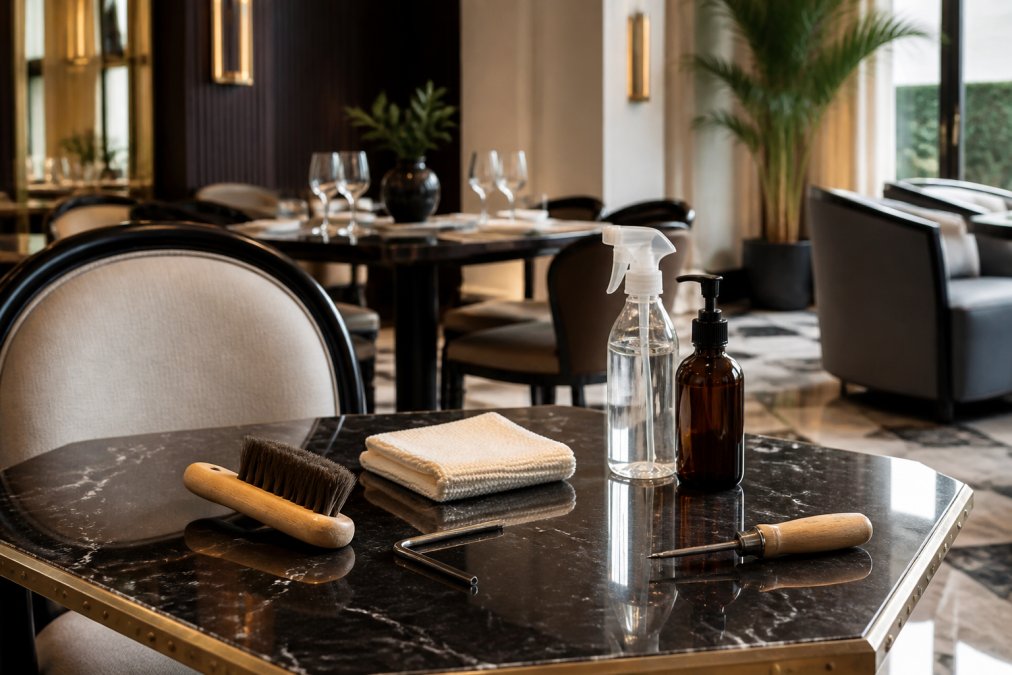
Caring for solid wood furniture in restaurants follows a fixed rhythm. Wet wiping too often does more harm than good because moisture penetrates the wood fibres. A maintenance interval of one oil treatment per quarter has proven itself in practice.
The Right Cleaning Agents for Upholstery Fabrics and Surfaces
For oiled surfaces, use only pH-neutral cleaning agents without abrasives. For upholstery fabrics, the Martindale rub count determines durability: the higher the value, the longer the cover withstands daily use. Chenille, velvet and bouclé are increasingly finding their way into restaurants in 2026, with durable substructures providing the necessary robustness, as MityLite describes in its current furniture design trends.
When buying, have the Martindale rub count of the upholstery fabrics confirmed in writing. Covers below 30,000 rubs are rarely a good choice for dining rooms with high guest turnover.
Tip 5: Buying Robust Hotel Furniture: Checklist for Second-Hand Purchases
Anyone who wants to buy robust hotel furniture can also save money on the second-hand market, provided the inspection is right. This checklist helps before buying:
- Check frames for cracks and signs of moisture
- Test joints for play and tighten all screws
- Check the edge impact resistance of all visible edges
- Check upholstery for sagging and odours
- Clarify availability of spare parts for floor glides and covers
- Request fire protection certificates for textile surfaces
- Have origin and year of manufacture documented
Tip 6: Ergonomics and Seating Comfort for Guests
Ergonomics in the dining room means that guests should be able to stay seated longer without compromising seating comfort and functionality. Ergonomic problems in commercial environments can be minimised through targeted design strategies and choice of materials, as a study in the International Journal of Design on ergonomic problems shows. Seat height, seat depth and backrest angle are the three levers with the greatest effect.
Tip 7: Room Climate, Humidity and Value Retention
Humidity permanently below 35 percent causes solid wood furniture to crack, usually at the joints. Replacing individual components later is considerably more expensive than a simple hygrometer for monitoring.
The trend is moving away from short-lived purchases towards high-quality materials such as solid wood, as Falstaff reports on sustainability in the restaurant trade. Sustainability and long-term investment are therefore no longer opposites but the same decision.
Frequently Asked Questions
What should you pay particular attention to when choosing restaurant furniture?
Look for solid wood, high edge impact resistance and a stable construction. Check the surface for scratch resistance and ease of cleaning. For commercial use, DIN standards and fire protection requirements are decisive. Custom-made hotel furniture from Casa Padrino offers exceptional durability and value retention thanks to individual adaptation and high-quality materials such as solid wood, marble and bronze.
Which materials are best suited for heavily used restaurant furniture?
Solid wood is considered one of the most durable materials for dining room furnishings. It is robust, repairable and retains its structure for years. For upholstery, hard-wearing fabrics with a high Martindale rub count are recommended, such as chenille, velvet or bouclé combined with stable substructures. For its collections, Casa Padrino uses only high-quality materials such as solid wood, marble and bronze, designed for intensive daily use.
How can care extend the service life of hotel and restaurant furniture?
Regular care is crucial. For solid wood furniture in restaurants, use mild cleaning agents and re-oil regularly to protect the surface. Upholstery fabrics need regular vacuuming and, depending on the material, professional deep cleaning. A fixed maintenance interval, for example every six months, helps to detect wear early. Casa Padrino provides specific care instructions for each collection that secure long-term value retention.
Why is investing in high-quality luxury furniture for restaurants economically sensible?
Professional, durable seating considerably reduces the need for annual replacement purchases. Solid wood and high-quality upholstery fabrics last for years, which lowers operating costs and optimises depreciation. Exclusive furniture also increases the prestige of the dining room and guest satisfaction. Casa Padrino offers robust hotel furniture designed for durability and value retention. The investment pays for itself through lower maintenance and replacement costs over its service life.
What role does design play in the durability of restaurant interiors?
Timeless design is a decisive durability factor. Trends change, but classic shapes and high-quality materials remain attractive for years. Rounded benches and curved tables, which are on trend in 2026, create an inviting atmosphere and can be flexibly integrated into room concepts. Casa Padrino relies on traditional European craftsmanship and timeless elegance, so your interior remains stylish and functional even after many years.