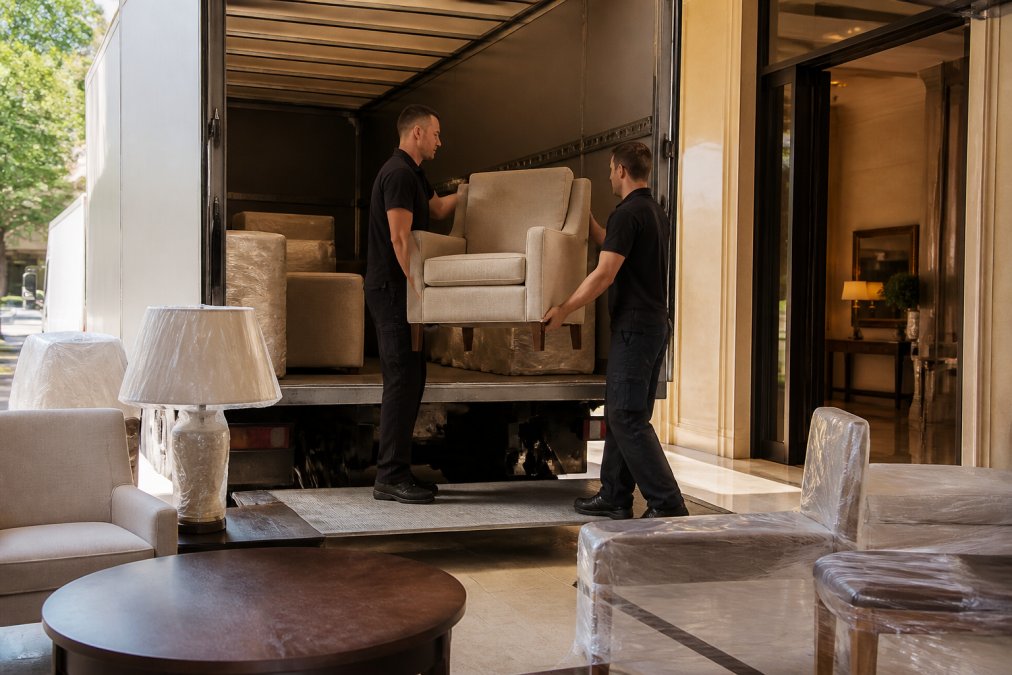
Optimizing Hotel Furniture Delivery Times: Tips for 2026

Table of Contents

Last updated: September 16, 2026

Why Hotel Furniture Delivery Times So Often Become a Project Risk

The market for hotel furniture and equipment is set to reach a volume of USD 52.8 billion in 2026, with an annual growth rate of 4.8 percent (Future Market Insights on hotel furniture market development). Anyone looking to optimize hotel furniture delivery times in this environment encounters a persistent problem: delivery time is almost always treated as a static value in procurement. This is precisely one of the most common reasons for project delays when it is not factored into planning as a dynamic variable (PM Furniture on delivery time risks in hotel projects).

At Casa Padrino, we have been supporting hotel projects for over 20 years and see the same root cause time and again: deadlines are calculated backwards from the opening date without factoring in production, transport, and customs as moving variables. The consequences are backorders, partial furnishings, and compromises on design.

This guide shows you how to systematically manage hotel furniture delivery times instead of just hoping for them.

Contract Furnishing and Hotel Planning: The Schedule as a Management Tool

Reliable hotel contract furnishing planning does not begin with the floor plan, but with the schedule. It is the actual management tool, not just an appendix to the design concept.

Milestones Instead of Wish Dates

Work with verifiable milestones: design drawing approval, order confirmation, production start, quality control, loading, arrival at the construction site. Every milestone needs a responsible person and a date.

Calculating Buffers Realistically

Buffers are not a weakness, but part of the calculation. Plan reserves for customs clearance, adjustments, and installation windows. A buffer that is visible in the schedule can be defended. An invisible buffer is used up at the very first delay.

The Advantages of Custom-Made Hotel Furniture for On-Time Delivery

The advantages of custom-made hotel furniture are rarely where you expect them. The obvious benefit is the fit: furniture is tailored to room geometries instead of filling gaps with makeshift solutions. The less obvious benefit is on-time delivery.

With mass-produced goods, the delivery date depends on stock levels that you cannot control. With custom-manufactured goods, it depends on a production schedule that you can define together with the manufacturer. This shifts control back to the planner.

Pro Tip
In every tender, ask for the production start date, not just the delivery time. A manufacturer who cannot name a start date does not have a binding end date either.

Hotel Furniture Procurement Strategies: Delivery Time as a Dynamic Variable

Hotel furniture procurement strategies fail most frequently because delivery time is written into the tender as a constant. However, it is the result of several moving factors.

Correctly Evaluating Delivery Time Factors

Evaluate each factor individually: material availability, manufacturing capacity, transport route, customs clearance, and installation lead time. Only the sum of these yields a realistic range. Sustainability plays a growing role here, as European guests increasingly demand sustainable furniture concepts, which favors local manufacturing with shorter delivery routes (HIT Preless on sustainability in the hotel industry).

Checklist for Evaluating Delivery Performance

Use this checklist before awarding a contract:

Get Started Today →

  • Does the provider state a binding production start date?
  • Is there a reference from a comparable project scope?
  • Are the transport route and customs clearance documented?
  • Is there a dedicated contact person for logistics?
  • Are spare parts and follow-up deliveries contractually regulated?
  • Is on-site installation included in the schedule?

Hotel Interior Solutions: Interfaces Between Design and Logistics

Hotel Interior Solutions only work when design and logistics speak the same language. In practice, both processes often run in parallel without coordination: the design team issues approvals while logistics should have triggered orders long ago.

Digital tools for process automation help optimize sales and procurement cycles before guests arrive (HotelNetSolutions on procurement automation). However, a clear interface remains crucial: who issues which approval, and which order may only be triggered afterwards?

Attention
The most common mistake is late design approval. Every week of delay in approval shifts the production start, without the opening date shifting accordingly. In the end, furniture is missing on the move-in date.

Optimizing Hotel Furniture Delivery Times: Step by Step

How to optimize hotel furniture delivery times in practice, from the tender to installation.
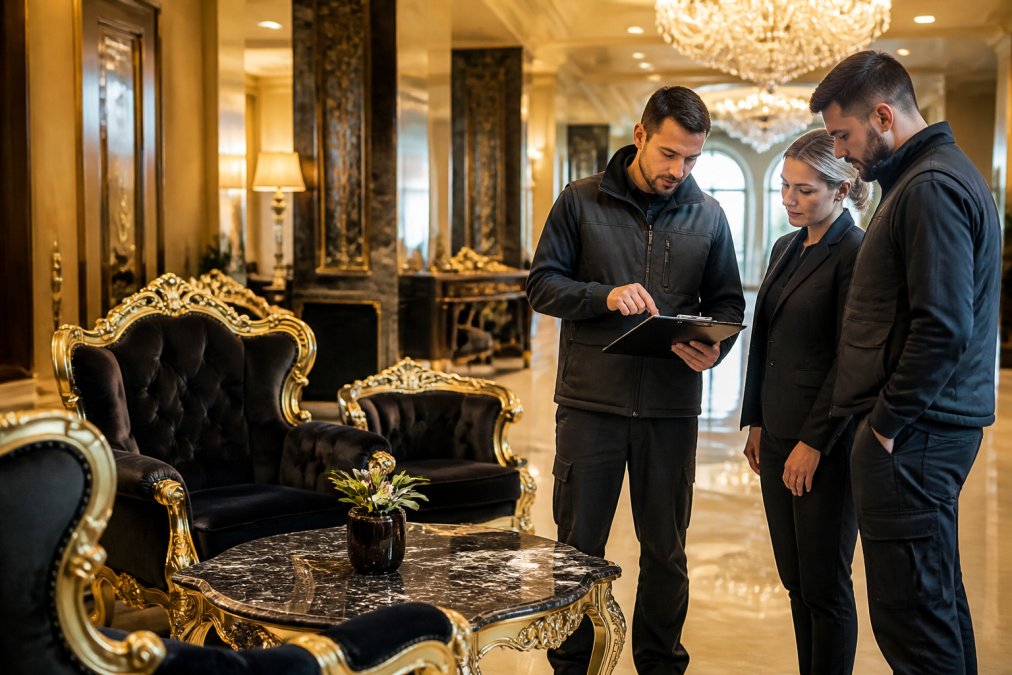
Elegant hotel lobby with baroque armchairs and marble tables, next to it a logistics team checks a delivery plan on a tablet, warm light, luxurious atmosphere
  1. Build the schedule backwards. Start with the opening date and work your way back through installation, transport, and production.
  2. Tender delivery time as a range. Request a realistic range instead of a single desired date.
  3. Contractually fix the production start. The start date is the most reliable variable in the entire process.
  4. Review milestones weekly. A brief weekly status report prevents surprises in week twelve.
  5. Plan installation windows. Installation requires time, access, and personnel, not just a delivery date.

Avoiding Common Mistakes in Delivery Planning

The most expensive mistake is assuming that delivery time is a matter of negotiation. It is a result of production and logistics. Anyone who squeezes it without changing the underlying factors merely shifts the risk to the installation phase.

Mistake Cause Impact
Desired date instead of range Delivery time planned as a constant Delay in installation
Late design approval Missing design/logistics interface Production start is delayed
No production start date Unclear order clarification No reliable end date
Installation not planned Focus only on delivery Furniture remains unassembled

Conclusion: On-Time Delivery Begins with Choosing the Right Partner

The 2026 Global Hospitality Furniture Market Analysis cites resurgent tourism as the main driver of demand, both for refurbishments and new builds (Global Hospitality Furniture Market Report 2026). At the same time, guest expectations regarding the quality and durability of interior furnishings are rising.

On-time delivery therefore does not originate in logistics, but in the choice of partner. A manufacturer who commits to a binding production start and milestones removes the greatest project risk for you.


The greatest challenge with hotel furniture remains the coordination between design, manufacturing, and scheduling. As a manufacturer and wholesaler, Casa Padrino combines exclusive luxury hotel furniture with custom interior solutions, ranging from baroque furniture to complete hotel interior solutions. With over 20 years of experience in international hotel projects, high-quality materials such as solid wood, marble, and gold leaf, as well as custom adaptation to your room geometries, Casa Padrino accompanies your project from planning to installation. Start your project with Casa Padrino and secure on-time furnishing at the highest level: Discover Casa Padrino luxury hotel furniture.

Frequently Asked Questions

Why are delivery times for high-quality hotel furniture often long?

High-quality hotel furniture is often handcrafted using materials such as solid wood, marble, or gold leaf. This manufacturing process takes time, and delivery time is not a static figure but a dynamic variable that depends on material availability, factory capacity, and transport routes. If it is not treated as a variable in planning, delays occur. Early ordering and clear milestones in hotel contract furnishing planning significantly reduce this risk.

How can hotel furniture planning be made more efficient?

Efficient planning begins with a binding schedule that separately details manufacturing, transport, and installation. Digital process automation tools help shorten procurement cycles and secure delivery dates before guests arrive. Utilizing the advantages of custom-made hotel furniture—meaning perfectly fitting pieces instead of standard items—reduces on-site adjustments and subsequent delays. A dedicated contact person at the manufacturer further accelerates coordination.

What role does early ordering play in contract furnishing?

The earlier an order is placed, the more flexibility remains for material procurement and manufacturing. Early ordering secures capacity and prevents a project from falling into a bottleneck phase. Casa Padrino therefore plans delivery dates together with the client.

How can delivery delays be avoided during hotel renovations?

Delays rarely occur during transport, but rather during preparation. Clear hotel furniture procurement strategies, a checklist for evaluating delivery performance, and defined buffer times prevent the most common mistakes. It is also important not to treat delivery time as a fixed value, but to review it regularly. Working with a specialized manufacturer who manages both production and logistics from a single source keeps the schedule intact.
Sustainable Luxury Furniture for the Hotel Industry: The 2026 Guide

Table of Contents

Last updated: September 15, 2026

Sustainable Luxury Furniture for the Hotel Industry: What Makes the Difference

The global market for hotel furniture is growing from USD 4.72 billion in 2025 to a projected USD 6.01 billion by 2031, as shown by Hospitality Furniture Trends 2026. Sustainable luxury furniture for the hotel industry is far more than a passing trend: it combines prestigious craftsmanship with ecological responsibility and is becoming a decisive competitive factor for hotel operators. Casa Padrino has been manufacturing custom luxury hotel furniture for over 20 years, supporting hotels, restaurants, and prestigious business premises from the initial sketch to complete contract furnishing. This guide shows how you can combine sustainability and prestige in one furnishing concept.

Definition: Sustainability Without Loss of Prestige

Sustainable luxury furniture for the hotel industry refers to pieces that combine the highest aesthetic standards with resource-saving materials, a long service life, and a transparent supply chain. The apparent contradiction between luxury demands and the circular economy dissolves as soon as durability becomes the central design principle. This is precisely where the difference lies compared to short-lived interior solutions: a solid Baroque table made of certified wood lasts for decades, whereas cheap alternatives have to be replaced after just a few seasons.

Benefits for Hotel Operators and Guests

The benefits range from lower replacement investments to a measurably better guest experience. Sustainable products that are free of harmful chemicals improve indoor air quality and increase the well-being of guests and staff, according to Jording. For hotel operators, this means fewer complaints, higher guest satisfaction, and a strong selling point for sustainable travel. At the same time, ongoing costs decrease because high-quality contract furniture needs to be replaced less frequently.

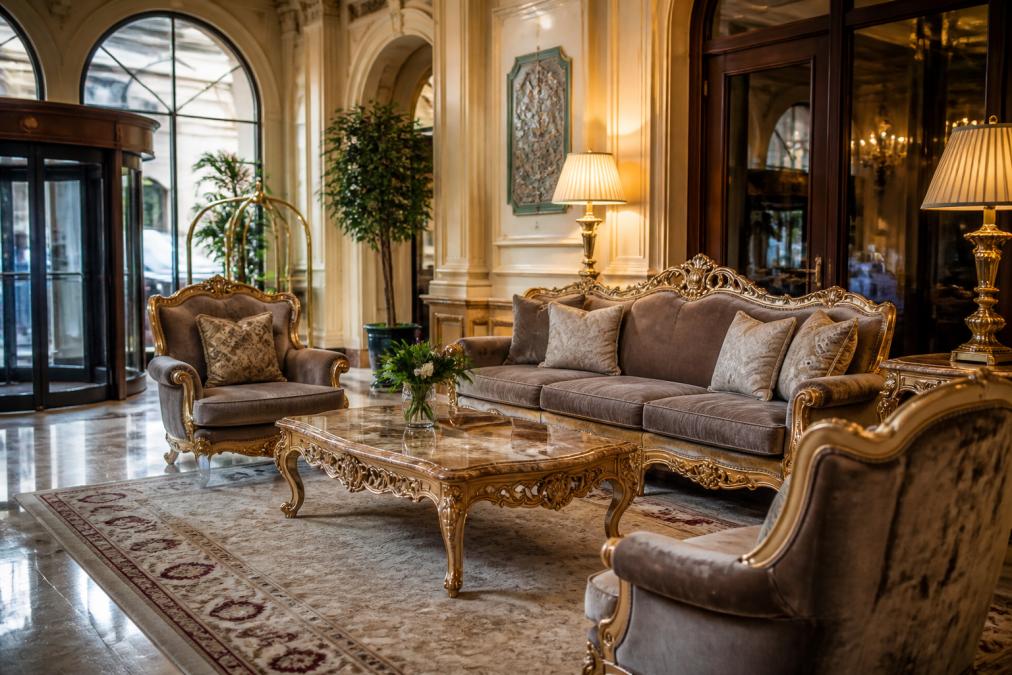
Elegant hotel lobby with solid Baroque furniture made of certified wood, fine fabric upholstery, and warm lighting that highlights the craftsmanship and sustainable luxury of the interior

Material Science: Certified Woods, Natural Fibers, and Recycled Materials

The choice of material determines the ecological balance and durability. Certified woods from sustainable forestry, natural fibers, and recycled materials form the basis of any responsible procurement. Casa Padrino processes solid wood, marble, bronze, and gold leaf using traditional European craftsmanship, ensuring that each piece of furniture remains usable for decades.

Certified Woods: FSC and PEFC as Standard

For hotel furniture, woods from certified forestry are ideal, such as those certified by the FSC (Forest Stewardship Council) or PEFC (Programme for the Endorsement of Forest Certification). These seals guarantee that the wood comes from sustainably managed forests where ecological and social standards are met. Casa Padrino exclusively uses woods with the corresponding certification for its luxury hotel furniture, keeping the supply chain transparent and traceable. Solid oak, beech, or walnut wood is not only durable but also repairable and recyclable at the end of its service life.

Natural Fibers and Recycled Materials

In addition to wood, natural fibers such as linen, wool, cotton, or silk are suitable for upholstery and covers. These materials are biodegradable, skin-friendly, and free from synthetic pollutants. Recycled materials such as recycled aluminum, glass, or plastics can be used in modern hotel concepts, provided they meet aesthetic and functional requirements. Casa Padrino combines traditional materials with innovative recycling solutions for its Baroque and custom furniture to unite sustainability and luxury.

Pollutant-Free and Indoor Air Quality

Pollutant-free materials are not a luxury, but a health precaution. Eco-friendly materials without harmful chemicals improve indoor air quality and thus the well-being of all users. Hotels that plan consistently in this area also meet growing ESG criteria and strengthen their sustainability strategy. Casa Padrino ensures that all materials are pollutant-free and uses only tested, low-emission materials for its luxury interior design projects.

Regional Sourcing and Short Transport Routes

An often underestimated sustainability factor is regional sourcing. Short transport routes significantly reduce CO2 emissions and increase supply chain transparency. Casa Padrino sources a large portion of its materials from European sources, keeping transport routes short and the supply chain traceable. This not only benefits the environment but also quality assurance, as regional suppliers often meet stricter standards.

Pro Tip
When sourcing hotel furniture, look for certificates such as FSC or PEFC and ask specifically about the origin of the materials. Casa Padrino provides the appropriate verification for every project.

Custom Hotel Furniture: Longevity as a Sustainability Factor

Custom hotel furniture is the most effective form of resource conservation. Instead of standard items that are replaced after a few years, pieces are created that fit the room geometry and design concept perfectly and last for decades. The selection of regional materials and the durability of the furniture are considered key factors for responsible hotel development, according to Ferrocom-Sitwell. For commercial use, wear resistance is what matters most: contract furniture must withstand daily wear and tear.

Sustainability Factor Impact Relevance for Operators
Longevity Replacement cycles are extended Lower investment costs
Custom Manufacturing Perfect fit, no waste Higher investment security
Certified Woods Transparent supply chain Meets ESG criteria
Absence of pollutants Better indoor air quality Enhanced guest experience

Sustainable Hotel Interior Design: Regional Supply Chains and Circular Economy

Sustainable hotel interior design begins with short transport routes. Regional supply chains significantly reduce the carbon footprint and increase supply chain transparency. Circular economy and upcycling concepts go even further: furniture is repaired, refurbished, or reused in new projects instead of being disposed of. This material ecology makes sustainability a measurable part of the furnishing concept.

Luxury Hotel Furniture Manufacturers: Certifications, Life Cycle Assessment, and LCA

Luxury hotel furniture manufacturers differ primarily in terms of verifiability. Certifications and quality seals prove that materials and processes meet standards. A Life Cycle Assessment (LCA) evaluates the environmental impact over the entire life cycle, from raw material extraction to disposal. Casa Padrino provides the necessary verification for every project and combines Italian-inspired elegance with European craftsmanship, so that sustainability certificates and prestige value reinforce each other.

Contract Furnishing for the Hotel Industry: Financing, Leasing, and Maintenance

Contract furnishing for the hotel industry is an investment decision, not a one-off expense. Furniture leasing models and funding programs spread the costs over the period of use and improve economic efficiency. A planned maintenance and repair service further extends the lifespan and ensures investment security. Sustainable luxury furniture for the hotel industry therefore pays off not only ecologically but also economically.

Furniture Leasing: Furniture-as-a-Service as a Circular Model

A model that is not yet widely used but is forward-looking is furniture leasing, also known as Furniture-as-a-Service (FaaS). In this model, the furniture remains the property of the manufacturer or a lessor, while the hotel pays a regular usage fee. At the end of the contract term, the furniture is taken back, refurbished, and reused in new projects. This model fits perfectly with the circular economy and significantly reduces capital commitment for hotel operators.

Funding Programs for Sustainable Investments

Hotel operators should check whether their planned furniture investment is eligible for funding, as sustainable furniture is often part of a holistic energy and resource concept. Casa Padrino supports its clients in compiling the necessary documentation for funding applications.

Maintenance and Repair: Extending Lifespan Instead of Buying New

A professional maintenance and repair service is the key to extending the lifespan of hotel furniture. Regular care, such as tightening screws, refreshing upholstery, or touching up surfaces, prevents premature wear and tear.

Economic Benefits of Sustainable Furniture

Sustainable luxury furniture for the hotel industry is not only an ecological decision but also an economic one. Due to the longer service life, replacement investments decrease while maintenance costs remain predictable. Leasing models improve liquidity, and funding programs reduce the initial investment. At the same time, sustainable furniture increases attractiveness for environmentally conscious guests and strengthens the brand. Casa Padrino accompanies hotel operators from the initial consultation through financing to long-term maintenance, offering holistic hotel interior solutions.

Key Takeaway
Sustainable hotel furniture is an investment that also pays off economically through durability, eligibility for funding, and leasing models. Casa Padrino offers tailor-made solutions for this.

Conclusion: Sustainable Luxury Furniture as a Strategic Asset

Sustainable luxury furniture for the hotel industry is not a marketing label, but a measurable strategic asset. Those who rely on certified materials, custom manufacturing, and the circular economy reduce costs, meet ESG criteria, and create a distinctive ambiance. Casa Padrino accompanies your project from planning to complete contract furnishing, with luxury hotel furniture, Baroque furniture, and custom interior solutions made from high-quality materials.

Frequently Asked Questions

What characterizes sustainable luxury furniture in the hotel industry?

Sustainable luxury furniture combines the highest craftsmanship with ecological responsibility. This includes certified woods, pollutant-free surfaces, durable constructions, and transparent supply chains. Casa Padrino manufactures luxury hotel furniture that meets both aesthetic demands and environmental standards.

Why is durability a crucial sustainability factor for hotel furniture?

Durable furniture reduces resource consumption because it needs to be replaced less frequently. High-quality custom hotel furniture from Casa Padrino is designed for decades of use, reducing the carbon footprint and operating costs in the long term.

How can exclusive design be combined with ecological standards in the hotel industry?

By choosing certified materials, regional manufacturing, and repairable constructions. Casa Padrino combines Baroque elegance with sustainable processes, offering luxury hotel furniture that meets ESG criteria.

What role does the choice of materials play in the sustainable furnishing of luxury hotels?

Solid wood from sustainable forestry, natural fibers, and recyclable metals are central. They guarantee freedom from pollutants, improve indoor air quality, and strengthen the ecological balance. Casa Padrino focuses on material ecology without compromising on design.


The challenge remains to combine the highest luxury standards with strict sustainability requirements. This is precisely what Casa Padrino stands for: with over 20 years of experience in international hotel projects, exclusive collections in Baroque, Rococo, and Art Nouveau styles, as well as customized complete solutions for the upscale hotel industry. Discover the Casa Padrino collection for luxury hotel furniture and let our team plan your furnishing concept.

Integrating Smart Hotel Technology into Furniture: The Guide

Table of Contents

Last updated: September 14, 2026

Integrating Smart Hotel Technology into Furniture: What is Possible Today

According to Grand View Research on the development of the smart hospitality market, the global market for smart hospitality solutions will grow from USD 49.2 billion in 2026 to USD 197.3 billion by 2033. Integrating smart hotel technology into furniture means incorporating sensors, charging functions, lighting control, and connectivity into tables, nightstands, headboards, and seating in such a way that the technology disappears into the design and the guest only notices the comfort. For Casa Padrino, this is not a contradiction to classic craftsmanship: solid wood, marble, and bronze can be combined with inductive charging fields and contactless light control without destroying the design language. This guide shows which paths exist, what can be retrofitted, and what hoteliers should look out for before investing.

From Retrofitting to New Furnishings: Three Integration Paths

Three paths lead to connected furniture, and they differ primarily in effort and investment protection.

  1. Retrofitting: Charging fields, sensors, and control modules are installed in existing furniture. Suitable if the basic structure is of high quality.
  2. Partial Integration: Individual rooms are refurnished, such as suites or meeting areas, while standard rooms remain unchanged.
  3. New Furnishing: Furniture is planned from the start with technology integration in mind, including cable ducts, empty conduits, and modular slots.

The third path costs more but protects the investment for years. Anyone wishing to retrofit later needs space, which is simply lacking in cheap furniture.

IoT in Hotel Design: Sensors, Charging Functions, and Smart Lighting

IoT in hotel design specifically means: furniture becomes data points. Presence sensors detect whether a guest is in the room and adjust lighting and heating accordingly, which reduces energy consumption, as described in the FR-One Blog on energy-efficient interior design. Inductive charging fields in nightstands and desks replace loose cables. Smart lighting adjusts brightness and color temperature to the time of day and usage.

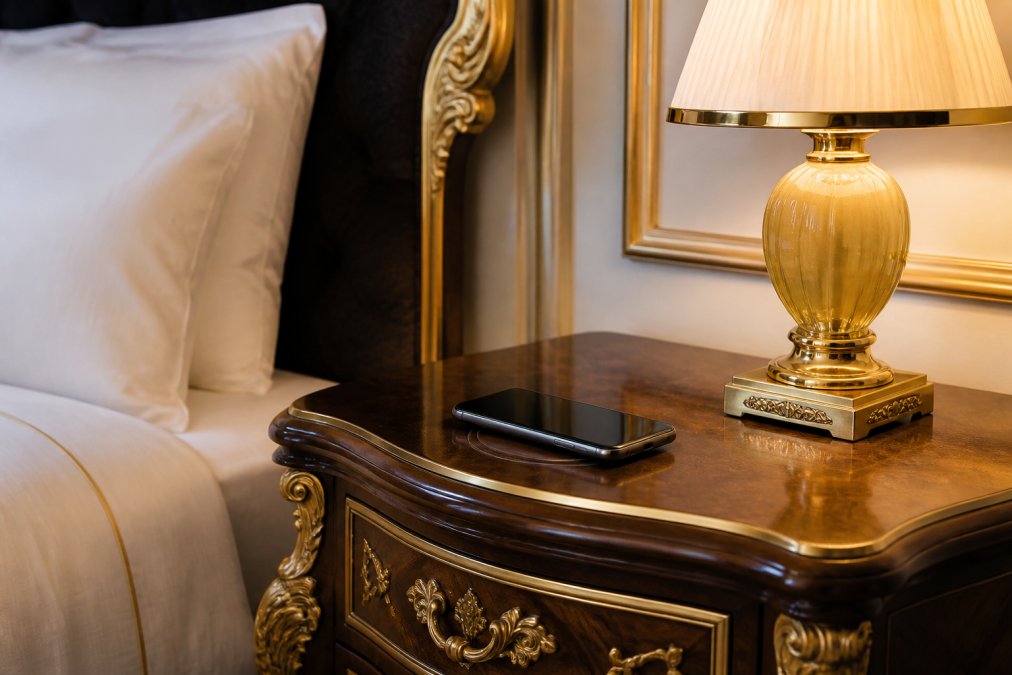
Elegant luxury hotel room with a baroque solid wood nightstand featuring an embedded inductive charging field; next to it, a warmly glowing, indirectly controlled table lamp with gold accents and a smartphone charging wirelessly

The crucial question is not which technology is available, but which one the guest understands without instructions.

Attention
If a charging field is installed behind a marble slab without checking the material thickness, the device will not charge. The guest reports a defect, the complaint ends up with the manufacturer, and the root cause lies in the planning.

Retrofitting Existing Furniture: What Can Be Implemented Without Buying New

Mainly three things can be retrofitted: charging fields under thin surfaces, sensor modules in drawers and cabinets, and control electronics in the plinth area. What cannot be retrofitted are missing cable paths and insufficient material thicknesses. Solid wood furniture offers the advantage here that millings can be executed cleanly and the structural integrity is maintained.

Modern Hotel Room Furnishings: Technology That Blends in Invisibly

Modern hotel room furnishings work when the guest does not perceive the technology as technology. A headboard with an integrated reading light, a console table with a concealed charging option, an armchair with a sensor for room lighting: all of these remain visibly a piece of furniture and invisibly a device.

Furnishing Element Technical Function Visibility Retrofit possible
Nightstand Inductive charging, reading light concealed yes
Headboard Light control, sensors integrated conditionally
Desk Charging, USB, data port concealed yes
Armchair Presence detection invisible conditionally
Wardrobe Sensor light, consumption measurement internal yes

The table shows: the deeper the technology goes into the construction, the more difficult retrofitting becomes. Those planning anew should provide empty conduits.

Bespoke Hotel Furnishing with Integrated Smart Room Technology

Bespoke hotel furnishing allows technology and form to be conceived in one go. Casa Padrino manufactures furniture according to individual room geometries and can plan integrations for sensors, charging fields, and cable paths directly into the construction. The “FutureHotel – Smart Hotel Room” study by the Fraunhofer-Institut describes scenarios for technologically optimized guest experiences through connected systems; precisely this connectivity only succeeds when furniture and technology are planned together.

Pro Tip
Have empty conduits planned with at least double the cross-section. The additional costs are low, but the leeway for future hardware generations is considerable.

Interfaces, Interoperability, and Operating Costs: What Matters Before the Investment

Interoperability determines whether connected furniture can speak to the hotel management system at all. Open interfaces are more important than individual functions because they allow hardware to be replaced without replacing the furniture. This is precisely where, in practice, the investment that lasts separates from the one that must be renewed after a few years.

How Furniture Hardware Communicates with the Property Management System

A connected piece of furniture is rarely directly linked to the PMS. The typical path runs through several levels:

  1. Sensor or actuator level – The piece of furniture itself contains presence detectors, charging fields, or light controls.
  2. Gateway level – A local gateway bundles the signals and translates them into a standardized protocol.
  3. Middleware level – An integration layer establishes the connection to the PMS, usually via a documented application programming interface (API).
  4. PMS level – Only here are occupancy, check-in status, and room release linked with the furniture functions.

The crucial point: the piece of furniture does not need to know the PMS – it only needs to speak a protocol that the middleware understands. Those who take this separation into account during planning can replace hardware without touching the furnishings.

Open APIs Instead of Proprietary Isolated Solutions

Proprietary protocols bind hoteliers to a single provider and complicate any subsequent expansion. Open, documented interfaces are the prerequisite for sensors, lighting, and charging technology to be updated independently of one another. Proven patterns are:

  • Open APIs with documented version maintenance
  • Cloud-based systems with local fallback logic, so that basic functions also work during a network outage
  • Standardized wireless standards for sensors and lighting
  • Documented maintenance intervals for electronic components

Maintenance and Life Cycle Costs

Classic furniture has life cycles of several decades. Electronics in furniture follow shorter cycles. This difference is the central cost factor that many hoteliers underestimate. Anyone installing charging fields, sensors, and control electronics permanently into a piece of furniture today must expect that individual components will need to be replaced before the furniture itself.

Get Started Today →

The solution lies in the construction: modular slots, accessible plinth areas, and replaceable panels. Casa Padrino plans precisely this accessibility for Luxury Hotel Furniture and Bespoke Furniture – technology remains maintainable, the piece of furniture is preserved.

Key Insight
Always plan electronics in furniture as a replaceable module, not as a permanent component. The additional costs in construction are low, but the difference during the first maintenance is significant.

Security Aspects and Data Protection for Connected Furniture

Connected furniture collects data: presence, usage times, energy consumption. Data protection begins with the question of what data actually needs to be collected. Presence sensors can be configured to only provide a signal, not an identity. The processing of personal data is governed by the General Data Protection Regulation (GDPR), and the state supervisory authorities publish guidance for hotel operations.

Security aspects also concern network separation: guest networks and control networks belong apart, and updates for electronic components require a fixed process. Those who consider these points when selecting furniture hardware save themselves costly retrofitting later.

A study by the University of Huddersfield on guest acceptance of hotel technology shows that technological conveniences influence the visit intention of future guests. However, mere implementation is not enough: without intuitive usability, no added value is created.

Accessibility Through Smart Furniture

Smart furniture can improve accessibility if it is considered from the very beginning. Automatically adjustable seat heights, contactless light switches, and voice-controlled room functions help guests with limited mobility without making the furniture look like medical aids. This is a difference that competitors rarely address – and an argument that should be considered early when planning Luxury Interior Design and Hotel Interior Solutions.

Security Aspects and Data Protection for Connected Furniture

Connected furniture collects data: presence, usage times, energy consumption. Data protection begins with the question of what data actually needs to be collected. Presence sensors can be configured to only provide a signal, not an identity. The processing of personal data is governed by the General Data Protection Regulation (GDPR), and the state supervisory authorities publish guidance for hotel operations.

Security aspects also concern network separation: guest networks and control networks belong apart, and updates for electronic components require a fixed process.

Conclusion: Smart Hotel Technology as Investment Protection for Luxury Hotels

Integrating smart hotel technology into furniture is less a question of technology than a question of planning. Those who plan furniture with empty conduits, modular slots, and open interfaces can replace hardware without renewing the interior. Those who retrofit cheaply pay twice. Casa Padrino combines traditional European craftsmanship with timeless design and plans technology integrations directly into bespoke hotel furnishings, from baroque furniture to modern forms.


The greatest challenge lies not in the technology, but in deciding when it must remain invisible. Casa Padrino develops luxury hotel furniture and complete furnishing concepts that accommodate sensors, charging functions, and lighting control in such a way that the design language is preserved. With bespoke furnishing solutions, high-quality materials such as solid wood and bronze, and over 20 years of experience in international hotel projects, Casa Padrino creates an ambiance that combines technology and elegance. Start your project at Casa Padrino and let your furniture be planned for the next generation.

Frequently Asked Questions

What defines a modern smart hotel?

A modern smart hotel combines connected systems with a clear guest experience. The crucial factor is not the amount of technology, but its added value: intuitive usability, energy efficiency, and personalization. The interplay of connected systems and well-thought-out interiors creates a harmonious guest experience.

How can digital technology be aesthetically integrated into luxury furniture?

Digital components disappear best within the construction, not on the surface. Inductive charging fields can be embedded directly into solid wood or marble tops, sensors for smart lighting can be accommodated in plinths and frames, and speakers behind fabric coverings. This keeps the look of baroque or Art Nouveau furniture unchanged, while the functions are usable at any time. Bespoke hotel furnishing allows recesses and cable paths to be planned right during manufacturing.

What advantages does the connectivity of hotel furniture offer the guest?

Connected furniture reacts to the guest instead of just existing: sensors detect presence and automatically adjust lighting and heating, which reduces energy consumption. Charging functions in nightstands or seating eliminate the search for power outlets. Technological conveniences can significantly influence guests’ intention to visit, provided they are intuitive to use and offer real added value.

What should be considered when choosing smart furniture for the hotel sector?

First, check the interfaces: does the hardware match your hotel management system and work with open APIs? Second, clarify the retrofittability of existing furniture to protect your investment. Third, maintenance and life cycle costs matter, as technology in furniture must run reliably for years. Fourth, security aspects and data protection must be regulated. And finally, the solution should be barrier-free to benefit all guests.

Sustainable Hotel Furniture for Eco-Conscious Guests

Table of Contents

Last updated: September 13, 2026

What Distinguishes Sustainable Hotel Furniture for Eco-Conscious Guests

The global hospitality market is growing to $5.82 trillion in 2026, up from $5.52 trillion the previous year, according to the 2026 Hospitality Trends Global Market Report. Sustainable hotel furniture for eco-conscious guests is no longer a niche topic, but a procurement criterion with a direct impact on booking decisions. Casa Padrino has been manufacturing luxury hotel furniture for over 20 years, combining traditional European craftsmanship with materials that withstand a long service life. Those who furnish rooms today are not planning for a season, but for decades.

Definition and Differentiation from Conventional Contract Furnishing

Sustainable hotel furniture refers to contract furniture whose ecological impact is evaluated over its entire lifecycle: raw material origin, manufacturing, service life, ease of maintenance, and disposal.

The difference from conventional contract furnishing lies less in the design and more in the balance sheet. Conventional room furniture is often designed for short replacement cycles. Sustainable contract furniture, on the other hand, relies on solid wood, repairable joints, and surfaces that can be refinished. This is precisely where it is decided whether a property actually reduces its carbon footprint or merely reports on it.

Why Guests Expect Sustainable Furnishings Today

European hotel guests now view sustainable furniture as a standard, not an additional service, as shown by HIT Preless on guest attitudes. According to Shiji Insights on guest preferences, over a third of guests belong to the next generation, which heavily prioritizes technology and sustainability. An important secondary finding: social pressure has a stronger effect on guests than purely ecological appeals, according to Scientific American. Visible sustainability in the interior is therefore more effective than any signpost.

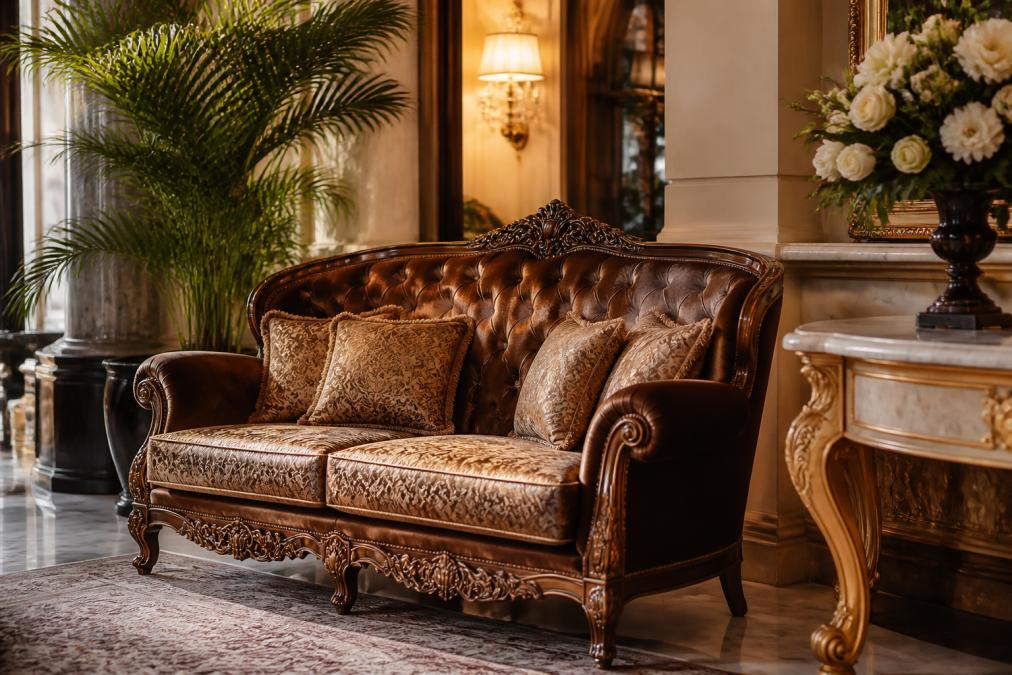
Elegant hotel lobby featuring a magnificent solid wood Baroque sofa by Casa Padrino, standing in warm light next to a marble console, conveying an atmosphere of timeless luxury and sustainability

Material Ecology: Recycled Plastics, Solid Wood, and Natural Raw Materials

Material ecology begins with the question of what happens to a chair after twenty years. Anyone purchasing hotel furniture should therefore not only check the recycling rate of a material, but the entire material chain: raw material origin, processing, repairability, and traceability. The following material groups cover the majority of sustainable contract furnishing and differ significantly in their strengths.

Solid Wood: Durability Through Refinishing

Solid wood is the classic choice among sustainable hotel furniture because, unlike veneer or particle board, it can be sanded down and re-oiled or waxed multiple times. Oak, walnut, and beech from European forestry provide the necessary hardness for professional hotel operations. At Casa Padrino, solid woods are used in high-quality solid wood Baroque furniture as well as in modern contract collections. The construction is crucial: solid wood moves, which is why it requires traditional mortise and tenon joints instead of rigid gluing to ensure a piece of furniture remains dimensionally stable for decades.

Marble and Natural Stone: Patina Instead of Replacement

Marble, granite, and travertine are mineral materials with a virtually unlimited lifespan. Scratches and stains can be professionally repolished, making replacement completely unnecessary. In hotel bathrooms, lobbies, and restaurants, natural stone slabs are therefore one of the most economical sustainable options. Casa Padrino processes marble in luxurious consoles and vanity units, among other things, which can be integrated into existing interiors without having to completely refurnish entire rooms.

Bronze and Metal: A Cycle Without Loss of Quality

Bronze, brass, and high-quality steel can theoretically be melted down and reshaped indefinitely without their material properties suffering. Unlike plastics, metal recycling does not result in downcycling. At Casa Padrino, bronze elements can be found in gilded Baroque seating groups and in fittings that can be supplied for decades to come – an important point for properties that want to keep their furnishings consistent over long periods.

Recycled Plastics: Sensible, but with Limits

Recycled plastics are sustainable when they are processed as single-variety materials and without harmful additives. Chairs made of recycled polypropylene or recycled PET are suitable for terraces, breakfast rooms, or high-traffic areas. The disadvantage: after several recycling cycles, the material quality decreases, and many composite plastics can hardly be separated at the end of their service life. For prestigious hotel areas, solid wood, marble, and metal therefore remain the more durable choice.

Natural Fibers and Textiles: Underestimated Levers

Upholstery fabrics made of wool, linen, hemp, or recycled polyester contribute significantly to indoor air quality because they emit fewer volatile organic compounds than coated synthetic fabrics. At the same time, high-quality upholstery fabrics can be reupholstered multiple times if the base frame is solid. This is precisely what production at Casa Padrino is designed for: durable covers on repairable frames, so that an armchair is reupholstered after ten years rather than replaced.

Key Insight
The most sustainable material choice is not the one with the highest recycling rate, but the one with the longest service life and the best repairability. Solid wood, marble, bronze, and natural fibers outperform short-lived composite materials in every lifecycle assessment.

Durability in Hotel Furnishing as the Most Important Sustainability Factor

Durability in hotel furnishing is the single largest lever for a property’s carbon footprint. A piece of furniture that remains in a room for thirty years instead of eight spreads its manufacturing emissions over almost four times as many operating years. This is mathematics, not ideology.

For operators, this means a shift in purchasing logic: away from the lowest unit price, toward investment security. Statement furniture made of solid wood costs more upfront but amortizes over its service life. This is precisely what production at Casa Padrino is designed for: durability for professional hotel operations, not for private homes.

Sustainable Hotel Interior Design: Circular Economy and Pollutant-Free Indoor Air

Sustainable hotel interior design means combining design, comfort, and responsibility in one concept, which according to Green Pearls on hotel furnishing is considered the supreme discipline of contract furnishing. The circular economy does not start with recycling, but with construction: furniture that can be disassembled, reupholstered, and converted keeps the material cycle within the property.

The second lever is indoor air quality. Sustainable products are often free of harmful chemicals, which improves air quality for guests and employees, according to Jording on material health. For properties with allergy-friendly rooms or long stay durations, this is a measurable gain in comfort, not a marketing argument.

Get Started Today →

High-Quality Contract Furniture: Certificates, TCO, and Take-Back Systems

High-quality contract furniture cannot be recognized from a catalog image alone. Three testing authorities determine whether an offer is reliable: verifiable certifications, an honest lifecycle cost calculation, and a contractually guaranteed take-back system.

Certifications and Seals for Hotel Furniture

Relevant proof concerns freedom from pollutants, wood origin, and manufacturing standards. In procurement practice, the following seals in particular have established themselves:

  • FSC (Forest Stewardship Council) and PEFC prove sustainable forest management and an uninterrupted supply chain for wood products. For solid wood hotel furniture, FSC is the most reliable proof.
  • Blue Angel (Blauer Engel) identifies low-emission furniture and is a recognized standard for indoor air quality in public procurement.
  • Cradle to Cradle Certified evaluates products based on material health, circularity, and social fairness – particularly relevant for properties that want to demonstrate a true circular economy.
  • OEKO-TEX Standard 100 applies to upholstery fabrics and textiles and excludes harmful substances that can affect the skin or respiratory tract.
  • EU Ecolabel covers furniture and furnishings, combining environmental and health criteria over the entire lifecycle.

Important: Ask specifically for material proofs and origin documents instead of just counting seal logos. A certificate without reference to the specific component says very little. Have it confirmed which component bears which seal – at Casa Padrino, you can receive the corresponding material documents for the woods, marbles, and upholstery fabrics used upon request.

Lifecycle Cost Analysis (TCO) for Hotel Operators

The TCO calculation includes acquisition, cleaning, maintenance, refinishing, and disposal. A cheap chair that is replaced after five years is more expensive than a solid wood model with a twenty-year lifespan. The decisive key figure is the price per year of use, not the unit price.

Criterion Short-Lived Furnishings Sustainable Contract Furniture
Service Life 5-8 Years 15-30 Years
Maintenance Replacement Refinishing, Reupholstery
Disposal Replacement Procurement Take-Back, Upcycling
Indoor Air Varying Materials Pollutant-Free
Repairability Mostly Glued Disassemblable, Reorderable

Disposal and Take-Back Systems

Take-back systems close the loop: furniture is taken back, refurbished, or disassembled into individual parts. Clarify this contractually before ordering. Three models have proven successful in the hotel industry:

  • Take-back guarantee: The manufacturer undertakes to take back furniture after a defined period of use and recycle or utilize it professionally.
  • Furniture-as-a-Service: Instead of purchasing, use over a defined period is agreed upon, including maintenance and take-back. Interesting for properties with frequent renovation cycles because there is no residual value risk.
  • Upcycling program: Disused furniture is reupholstered, converted, or reused in other areas – such as an armchair from the lobby that continues to live in the breakfast room after refurbishment.

Pay attention to three points in the contract: Who bears the transport costs for the return? In what condition must the furniture be returned? And what proof of recycling do you receive for your sustainability reporting? Casa Padrino accompanies hotel projects from planning and delivery to the subsequent delivery of individual components, so that furnishings remain consistent over the years and do not have to be completely replaced.

Pro Tip
Request a TCO table and a written take-back commitment with every tender.

Regional Supply Chains and Social Responsibility in Procurement

Regional supply chains shorten transport routes and increase planning security because manufacturing and subsequent delivery are closer to the property. Social responsibility in procurement specifically means: traceable manufacturing conditions, fair working conditions, and documented origin. Together, both result in a sustainable value chain that can be proven to guests and auditing bodies. Casa Padrino manufactures in the European craft tradition and supplies complete furnishing concepts for hotels, restaurants, and prestigious business premises, from Baroque seating groups to matching lighting.

Conclusion: Sustainable Hotel Furniture as an Investment in the Future

Sustainable hotel furniture for eco-conscious guests is an investment decision with a measurable return: lower replacement costs, better indoor air, and reliable sustainability reports. Anyone furnishing today should think of material ecology, durability, and take-back together, not as three separate projects.


The challenge lies in procurement: consistent quality across 50 rooms, traceable materials, and a supplier who remains accessible even after delivery. Casa Padrino delivers exactly that, with exclusive furniture collections in Baroque, Rococo, and Art Nouveau styles, tailor-made furnishing solutions according to customer requirements, and high-quality materials such as solid wood, marble, and bronze. Start your project at casa-padrino.de and have a furnishing concept created that combines luxury and durability.

Frequently Asked Questions

What criteria define sustainable hotel furniture?

Sustainable hotel furniture is characterized by the use of environmentally friendly materials such as recycled plastics or certified woods. Other criteria include high durability, pollutant-free surfaces for good indoor air quality, and resource-saving production. Repairability and the possibility of recycling at the end of the lifecycle also play a decisive role. Casa Padrino attaches great importance to these aspects in its high-quality contract furniture in order to meet both aesthetic and ecological demands.

How does Casa Padrino support sustainable hotel planning?

Casa Padrino offers tailor-made solutions for sustainable hotel planning. From the selection of durable materials to the conception of a sustainable interior design and the delivery of complete furnishing packages, Casa Padrino accompanies hoteliers. The combination of traditional craftsmanship and timeless design results in furniture that lasts for years, thereby conserving resources. In addition, Casa Padrino advises on certifications and take-back systems to minimize the ecological footprint.

Why do guests increasingly prefer sustainably furnished hotels?

European hotel guests increasingly expect sustainable furniture in their accommodation (Hit Preless, 2026). Over a third of today’s guests belong to the next generation, which heavily prioritizes technology and sustainability (Shiji Insights, 2026). Sustainable products are often free of harmful chemicals, which improves indoor air quality (Jording, 2026). In addition, studies show that social pressure and the gain in comfort from sustainable products are more effective than purely ecological appeals (Scientific American, 2026).

What advantages do high-quality, durable furniture offer for a hotel’s carbon footprint?

High-quality, durable furniture reduces resource consumption because it needs to be replaced less frequently. This significantly lowers a hotel’s ecological footprint. By using recycled materials and offering the possibility of upcycling, the circular economy is promoted. An improved carbon footprint is not only good for the environment but also a strong selling point for eco-conscious guests. Casa Padrino supports hotels in achieving their sustainability goals through durable contract furniture.

Bespoke Hotel Furniture vs. Mass-Produced Furniture: Advantages 2026

Table of Contents

Last updated: September 12, 2026

Bespoke Hotel Furniture vs. Mass-Produced Furniture: The Fundamental Difference

Anyone positioning a hotel today decides on more than just the visual impression with their choice of furniture. The difference between the advantages of bespoke hotel furniture compared to mass-produced goods is rarely visible at first glance, but rather in what remains after five years of operation.

Bespoke hotel furniture refers to interior pieces produced according to the specific dimensions, material specifications, and design requirements of a concrete project. Mass-produced furniture refers to serial furniture manufactured in fixed sizes and standard designs, regardless of its subsequent location.

At Casa Padrino, such custom-made pieces are crafted from solid wood, marble, bronze, and gold leaf, combined with Italian-inspired elegance and European craftsmanship. The decisive difference is not seen in the appearance on the day of delivery, but in the fact that bespoke hotel furniture convinces in terms of perfect fit, repairability, and value retention over its entire service life.

Elegant hotel lobby with a magnificent, hand-carved Baroque sofa made of velvet and a gilded wooden frame, next to it a simple standard sofa with a visibly thinner cover and simple frame, warm light falling through high arched windows
Criterion Bespoke Hotel Furniture Mass-Produced Furniture
Manufacturing According to room dimensions and design specifications Fixed standard sizes
Material share of lifespan Up to 70 % Lower, often veneer
Initial investment Higher Lower
Amortization Over life cycle Rarely calculated
Spare parts Can be reproduced Frequently discontinued
Brand impact Distinctive Interchangeable

Individual Hotel Interior Design Concepts for a Distinctive Brand Identity

Personalization in the luxury hotel segment is a crucial factor for brand loyalty and can be measurably managed using constructivist approaches in design strategy, as an analysis of personalization in the luxury hotel industry shows. This is the core of individual hotel interior design concepts: a guest recognizes the establishment without seeing the logo.

Mass-produced furniture cannot achieve this. It is deliberately kept neutral so that it works everywhere. Exactly this neutrality makes it worthless in competition. Bespoke furniture allows brand characteristics to be translated directly into the physical environment, from the carving profile of a lobby bench to the color finish of the armchairs in the restaurant.

For establishments with historical aspirations, this often means Baroque furniture as a statement, complemented by matching lighting solutions and home accessories. The effect is not created by a single piece, but by repeating a design vocabulary across all public areas.

Pro Tip
Before the tender, define a binding design manual with two to three recurring design elements. Contract furniture that incorporates these elements will act as a cohesive concept across different rooms, rather than a collection of individual purchases.

High-Quality Custom Hotel Furniture: Perfect Fit for Challenging Room Layouts

High-quality custom hotel furniture solves a problem that standard furniture structurally cannot: rooms that were not planned according to a catalog. Heritage protection requirements, sloped ceilings, niches, irregular axial dimensions, and historical floor plans can only be accommodated with ready-made furniture through compromises.

The result is gaps, plinth panels, and makeshifts that stand out during ongoing operations. A custom-made piece of furniture, on the other hand, fully utilizes the existing geometry. This increases space utilization while reducing maintenance efforts because no special solutions need to be replaced.

This pays off particularly in suites and reception areas. A built-in wardrobe under a sloped ceiling or a bench that fits exactly into a wall niche does not look like a compromise, but like deliberate interior design.

Attention
Anyone relying on standard dimensions for difficult floor plans is already planning for future repurchases. As soon as a series is discontinued, replacements for the special gap can no longer be procured, and the affected area must be completely refurnished.

Durability of Contract Furniture: Material Quality and Life Cycle Costs

When evaluating furniture quality for the hospitality industry, the material used determines around 70 percent of the total lifespan of a piece of furniture, as noted in an analysis of bespoke versus prefabricated hotel furniture for 2026. This is the most important figure in this discussion because it directly links the durability of contract furniture to the choice of materials.

In hotel operations, this means: a chair is not used once a day, but multiple times. Upholstery is compressed, frames are stressed, surfaces are cleaned. Solid wood, marble, and bronze react differently to this continuous stress than veneer or plastic composites. They show signs of wear later and can also be refurbished instead of replaced.

Material quality is therefore not an aesthetic argument, but a maintenance factor. A piece of contract furniture that can be reupholstered after ten years incurs different costs than a mass-produced model that is completely replaced after four years.

Key Insight
The decisive key figure is not the purchase price per piece, but the sum of purchase, cleaning, repair, and replacement over the planned period of use. Material quality shifts this sum more than any purchasing negotiation.

ROI Calculation for Hoteliers: Amortization and Investment Protection

A reliable amortization calculation for bespoke hotel furniture vs. mass-produced furniture works with four cost blocks summed up over the planned period of use: acquisition, maintenance, replacement, and downtime.

The decisive lever lies not in the first block, but in the following three. A mass-produced chair in a breakfast area is used, compressed, cleaned, and moved multiple times a day. A contract chair made of solid wood with high-quality upholstery undergoes the same stress but can be reupholstered and superficially refurbished instead of being completely replaced. Over a ten-year horizon, this creates two completely different cost curves.

The four blocks in detail:

  1. Acquisition. Higher for custom manufacturing because design, material selection, and individual production are factored in. This block is the only one where mass-produced goods are structurally cheaper.
  2. Maintenance. Cleaning, reupholstery, surface refreshing, spare parts. Here, the ratio reverses as soon as a piece of furniture can be refurbished and spare parts can be reproduced.
  3. Replacement. The most critical block. Mass-produced goods are replaced in cycles, the length of which depends on series availability. If a series is discontinued, replacement is not only more expensive but often only possible as a complete replacement of an entire furniture group.
  4. Downtime. Any closure of a room, suite, or restaurant area for furniture replacement generates lost revenue. This block is missing from almost every tender and is in practice the largest hidden cost factor.

A common pattern in practice: one establishment refurnishes its lobby in short cycles because upholstery is worn out and surfaces are scratched. Another establishment invests once in custom-fit quality and maintains it over a significantly longer period. Over the entire life cycle, the apparent price advantage of mass-produced goods is reversed because the sum of blocks two to four exceeds the initial savings.

Key Insight
The decisive key figure is not the unit price, but the sum of acquisition, maintenance, replacement, and downtime over the planned period of use. Anyone calculating these four blocks before the tender makes an investment decision rather than a purchasing decision.

For hoteliers who have gone through this calculation once, the question shifts. It is no longer about cheaper or more expensive, but about which piece of furniture generates the lower total burden over ten years. This is exactly where Casa Padrino plays to its strengths: Luxury Hotel Furniture and Bespoke Furniture are designed in such a way that reupholstery, surface refreshing, and spare parts reproduction remain possible throughout the entire cycle of use. An overview of corresponding bespoke hotel furniture for upscale properties shows how this design logic is reflected in concrete furniture series.

Get Started Today →

Fire Protection, Certifications, and Technical Requirements

In the contract sector, fire protection is not a formality, but a requirement for award. Upholstery in publicly accessible hotel areas must generally be flame-retardant. In practice, this means: for upholstered furniture in escape and rescue routes, corridors, lobbies, and guest areas, proof of fire behavior is required, which the operator must be able to present during an inspection by the responsible building authority or fire safety officer.

The decisive point for hoteliers: this proof is not optional and cannot be submitted later. Anyone buying furniture without documented fire behavior risks not only regulatory requirements but the replacement of entire furniture groups. In the case of custom manufacturing, fire protection certificates are part of the design and are documented on a project-specific basis. For mass-produced goods, the availability of such certificates depends on whether the series manufacturer provides them for the specific model at all.

Three technical requirements that matter in operation:

  1. Fire behavior of the upholstery. Flame-retardant covers and upholstery materials are standard in public areas. It is crucial that the certificates are model-specific and not just for a batch of material.
  2. Cleaning resistance of surfaces. Contract furniture must withstand the cleaning agents and disinfectants used in the establishment. A sensitive veneer that reacts to disinfectants by swelling becomes a recurring cost factor during ongoing operations. Custom manufacturing allows surfaces to be specifically tailored to the cleaning regime of the establishment.
  3. Ergonomics and functional dimensions. Seat heights, armrest heights, and table spacing in restaurants and conference areas follow different requirements than in residential areas. Custom manufacturing allows these specifications to be met instead of subordinating them to the available standard series dimensions.
Pro Tip
Request proof of fire behavior and cleaning resistance already in the tender, not only upon delivery. In addition, have a sample piece tested under real cleaning conditions in-house before series production starts. This allows you to identify material weaknesses before they multiply across hundreds of pieces of furniture.

For establishments with historical aspirations, a fourth point is added: the coordination between heritage protection requirements and fire protection requirements. Both requirements can conflict, for example, when visible wooden structures must be preserved, but the upholstery must still be flame-retardant. Custom-made solutions allow this tension to be resolved constructively instead of solving it through compromises on one of the two points.

Casa Padrino manufactures Luxury Hotel Furniture and Baroque Furniture in such a way that fire protection requirements, cleaning resistance, and ergonomics are incorporated into the design from the very beginning. For operators who require consistent furnishings across all public areas, this creates a uniform technical level that can be documented. A selection of corresponding bespoke contract furniture for the hotel industry shows how these requirements are implemented in concrete furniture series.

Logistics, Assembly, and Integration of Smart Hotel Technologies

Bespoke furniture brings an additional layer of complexity: they are not in stock but project-specific. This results in longer lead times and an assembly process that must be integrated with construction and renovation planning. Anyone who underestimates this plans the furniture delivery for a phase when the rooms are not yet ready for occupancy.

The integration of smart hotel technologies intensifies this requirement. Charging points in nightstands, indirect lighting with controls, sensors in seating furniture in public areas, and cable routes in built-in furniture must already be considered in the design phase. With standard furniture, this is only possible through visible retrofitting. With custom manufacturing, these elements are part of the design.

For hotel projects with multiple floors, a staggered delivery is worthwhile. This allows floors to be put into operation in sections instead of closing the entire building for an assembly block.

Casa Padrino accompanies such projects from planning through manufacturing to the furnishing of entire properties, including lighting solutions and home accessories. For establishments that require consistent furnishings across all areas, this eliminates the coordination of multiple suppliers.

Conclusion: When Bespoke Hotel Furniture Truly Pays Off

Bespoke hotel furniture pays off when three conditions come together: challenging room geometry, high intensity of use, and a positioning aspiration that wants to stand out from interchangeable standard furnishings. If one of these conditions is missing, mass-produced furniture is economically justifiable.

The calculation is not decided by the purchase price, but by the life cycle. Material quality, reproducibility of spare parts, and the possibility of refurbishment determine what a piece of furniture actually costs over ten years. Anyone who includes these factors in the tender makes a reliable decision instead of a visual one.


The greatest challenge lies not in choosing the more beautiful furniture, but in planning an interior that works over years and carries the brand. Casa Padrino combines traditional European craftsmanship with timeless design and delivers tailor-made furnishing solutions for the upscale hotel industry, from Baroque furniture to lighting solutions and complete hotel interior concepts. With over 20 years of experience in international hotel projects, spaces are created that bring individuality and durability together. Plan your project with Casa Padrino and secure furnishings that meet the standards of your establishment.

Frequently Asked Questions

Why is bespoke hotel furniture a sustainable investment?

Bespoke hotel furniture is sustainable because it has a significantly longer lifespan. Materials determine 70% of a furniture piece’s lifespan. High-quality materials such as solid wood and marble withstand the intensive use in hotel operations better than cheap alternatives. This reduces the need for replacement and thus resource consumption over decades. In addition, custom-fit manufacturing allows individual elements to be repaired instead of having to dispose of entire pieces of furniture. Casa Padrino manufactures furniture specifically designed for the requirements of the hospitality industry.

Does bespoke furniture differ in durability from mass-produced furniture?

Yes, significantly. Bespoke furniture from Casa Padrino uses solid wood, bronze, and gold leaf, which better withstand the wear and tear of daily hotel life. Mass-produced furniture often uses particle board and cheap fittings, which fail more quickly under daily stress. The higher initial investment amortizes through lower maintenance and replacement costs.

How can a uniform design concept be implemented through custom furniture?

Custom furniture enables a consistent design concept because each piece is coordinated with the room concept. Casa Padrino develops individual hotel interior design concepts that extend from the lobby to restaurants and rooms. Instead of combining different standard furniture, hoteliers receive a consistent line in material, color, and style. This strengthens brand identity and creates an ambiance that guests recognize. The perfect fit for challenging room layouts also ensures optimal space utilization.

What are the advantages of working with a specialized hotel furniture manufacturer?

A specialized manufacturer like Casa Padrino offers advice from planning to assembly. This includes adaptation to room layouts, sloped ceilings, and fire protection requirements. Hoteliers receive high-quality custom hotel furniture from a single source instead of ordering from multiple suppliers. Casa Padrino has over 20 years of experience in hotel projects and delivers complete furnishing solutions. This reduces coordination efforts and ensures a uniform quality level.

How does interior design influence guest satisfaction in luxury hotels?

Interior design shapes the first impression and the perception of the brand. Personalization in the luxury hotel segment is a crucial factor for brand loyalty. Guests who receive an individualized hotel experience are more willing to pay higher prices. Bespoke furniture creates a distinctive ambiance that remains in the memory. Casa Padrino combines traditional European craftsmanship with timeless design to create spaces that inspire guests and encourage them to return.

Robust Furniture for Exclusive Hotel Lobbies 2026

Table of Contents

Last updated: September 11, 2026

What robust furniture for exclusive hotel lobbies must deliver

According to Cognitive Market Research on the development of the luxury hotel furniture market, the market for luxury hotel furniture will reach a volume of around 8.34 billion US dollars by the end of 2026, up from 6.39 billion US dollars in 2021. Robust furniture for exclusive hotel lobbies is therefore no longer a niche topic, but an investment decision with a direct impact on guest loyalty and operating costs. Casa Padrino has been manufacturing and supplying contract furniture for grand hotels, restaurants, and prestigious business premises for over 20 years and knows the demands that a lobby places on upholstery, frames, and surfaces. Robust furniture for exclusive hotel lobbies must fulfill three tasks simultaneously: withstand the first impression, resist daily wear and tear, and be maintainable over years.

These three tasks are in tension with each other. A statement piece of furniture made of solid wood and marble supports a lobby visually, but weighs more and requires different care than a delicate model. Those who only pay attention to appearance will pay later during replacement. Those who only look at durability will lose the guest in the first moment. The following sections show how both can be combined.

Requirements for contract furniture in hotel and hospitality environments

Contract furniture for hotels differs from residential furniture primarily in the duration of use: a lobby is in use for many hours every day, often by changing people with luggage, strollers, and trays. For seating in high-traffic areas, the target lifespan is 5 to 10 years, while more robust pieces such as benches with metal frames are designed for 7 to 15 years (MingSun Group on hotel lobby furniture trends 2026 (https://www.mingsungroup.com/article/hotel-lobby-furniture-trends-2026.html)).

This results in four hard criteria:

  • Load-bearing capacity: Frames and connections must withstand permanent point loads, not just the weight when sitting.
  • Cleanability: Surfaces must be easy to wipe down daily without the stain, varnish, or upholstery underneath suffering.
  • Repairability: Legs, casters, upholstery, and covers should be replaceable so that damage does not devalue the entire piece of furniture.
  • Dimensional stability: Cushions must not sag after months, and frames must not warp or shift.
Attention
A common mistake is ordering from a catalog image without a sample. Without fabric swatches and frame samples, the actual durability cannot be assessed, and returns are usually excluded for contract furniture.

Material selection: Durability, resilience, and design aesthetics

The choice of material determines how long a piece of furniture will last in commercial use. Solid wood, marble, bronze, and gold leaf provide the look that an exclusive lobby needs, but require the appropriate construction underneath. For upholstery fabrics in commercial lounge areas, a rub resistance of at least 50,000 double rubs on the Wyzenbeek scale is considered the target (AB Newswire on boutique hotel furniture trends 2026 (https://www.abnewswire.com/pressreleases/boutique-hotel-furniture-trends-2026-unique-design-and-materials_832878.html)).

Material Advantage Disadvantage Suitable for
Solid wood Repairable, retains value Sensitive to moisture Frames, tables, seating bases
Marble Scratch-resistant, prestigious Heavy, prone to chipping at edges Table tops, side tables
Metal frame Very high load capacity Cold appearance Benches, bar stools, outdoor areas
Velvet and velour High seating comfort, elegant look Requires regular maintenance Lounge chairs, benches
Leather Durable, easy to clean Patina depending on use Reception areas, armchairs

Upholstered furniture and seating comfort for high-traffic lobbies

Upholstered furniture bears the brunt of wear and tear because it is compressed and released daily. Crucial is not only the cover, but the structure underneath: a dense foam core with dimensionally stable upholstery wadding lasts significantly longer than a pure foam filling, and a replaceable cover extends the lifespan by years. Casa Padrino offers upholstered furniture with covers that can be renewed if necessary, allowing the frame to continue to be used.

Weatherproof materials for patio furniture and outdoor areas

Patio furniture requires a different material logic than indoor furniture. Weatherproof here means: UV-resistant covers, corrosion-protected metal parts, and woods that can handle moisture and temperature fluctuations without cracking. Even if you think of the lobby and terrace as one continuous space, you should still not choose the same furniture line, but rather two lines that complement each other in shape and color.

Durable lounge furniture for hotel lobbies: Seating comfort and ergonomics

Durable lounge furniture for hotel lobbies must serve two groups of people with different needs. A study of the hotel lobby as a workplace for modern guests shows that lobbies are increasingly being used as workspaces, and the functionality of the furniture must be adapted to mobile workers (EXTERNAL_LINK: ResearchGate study on hotel lobbies as workplaces | researchgate.net).

Elegant hotel lobby with plush velvet lounge chairs, brass details, and marble side tables, warm lighting, sophisticated atmosphere, guests relaxing in the background

In practice, this means: a seat height between 42 and 46 centimeters so that guests with laptops can work comfortably. Armrests at a height that provides support when standing up. Tables within easy reach without blocking the walkway. A lounge chair designed only for sinking back will be avoided by working guests. An armchair that can do both will be used all day long.

Custom hotel furniture for a cohesive interior design concept

Custom hotel furniture solves the problem that standard off-the-shelf products cannot: unusual room geometries, fixed axes, and a design that should flow seamlessly from the lobby to the suite. A cohesive interior design concept is not created by many individual purchases, but by a line that recurs in all areas. Casa Padrino develops custom designs according to customer requirements, tailored to room dimensions, material selection, and color concepts, and delivers everything from lobby furnishings to the bar and the suite from a single source.

Luxury hotel interior design: Fire protection, acoustics, and sustainability

Luxury hotel interior design today must meet three requirements that are still treated separately in many tenders: fire protection, acoustics, and sustainability. Anyone who includes these three points early in the planning stage saves on subsequent adjustments later – and this is precisely where a well-founded interior design concept differs from a simple furniture order.

Fire protection: Building authority regulations for upholstery and textiles

In common areas and escape routes of public buildings, building authority regulations apply to upholstered furniture and textile surfaces. The relevant standards are DIN 4102-1 (building material classes A1 to B3) and the European DIN EN 13501-1 with classes A to F. For lobbies, reception areas, and corridors, at least class B1 (flame-retardant) or C-s1,d0 according to DIN EN 13501-1 is usually required. This affects not only the cover fabric, but also the foam core, the upholstery wadding, and – in the case of wall panels – the carrier material.

In practice, this means: cover fabrics with fire protection finishes, foam cores with flame-retardant formulations, and, where required, manufacturer certification. Casa Padrino offers upholstered furniture for commercial areas with fire-retardant covers and documents the materials used upon request, so that hotel operators can coordinate the requirements cleanly with fire safety officers and building authorities.

Attention
A common mistake is assuming that a visually identical cover fabric is automatically fire-tested. Two fabrics with the same appearance can have different fire classes. Always request the specific material with proof of testing – not the catalog image.

Acoustics: Why upholstered furniture reduces reverberation

Large lobbies with marble, glass, and high ceilings are acoustically hard: sound is barely absorbed, reverberation increases, and conversations become exhausting. DIN 18041 describes target values for reverberation time in rooms with speech communication – in prestigious lobbies, the target range is often between 0.6 and 1.2 seconds, depending on room volume and usage.

Upholstered furniture is an underestimated lever here. A densely upholstered lounge chair absorbs sound via the seat, back, and armrests; a fabric-covered bench has a similar effect. Together with carpets, curtains, and wall panels, reverberation can be noticeably reduced without the lobby losing its visual tranquility. A well-thought-out Hotel Interior Solutions concept therefore plans upholstered surfaces not only according to the number of seats, but also according to their acoustic effect in the room.

Sustainability: Origin, repair, and longevity

Sustainability in contract furnishing means three things: traceable origin of wood and textiles, a construction that allows repair instead of replacement, and a choice of materials that lasts for decades. For wood products, FSC (Forest Stewardship Council) certification is the best-known proof of sustainable forestry; for textiles, there are comparable standards such as OEKO-TEX Standard 100 for freedom from harmful substances.

However, the construction is more important than individual certificates: replaceable covers, bolted instead of glued connections, and spare parts that are available even after years. Casa Padrino offers Luxury Hotel Furniture with repairable structures and covers that can be renewed – the most effective form of sustainability in the contract sector is a piece of furniture that does not need to be replaced.

Care, maintenance, and ROI: The hotel lobby as a capital asset

A piece of furniture in the lobby is a capital asset, not a consumable item. The decisive key figure is therefore not the purchase price, but the price per year of use. A piece of contract furniture that lasts ten years and is cleaned weekly costs less over its useful life than three cheaper pieces that have to be replaced every three years – and this comparison becomes even clearer once you factor in the follow-up costs.

The hidden costs of premature replacement

Anyone who replaces a piece of furniture after three instead of ten years does not only pay the new price. In addition, there are:

  • Downtime costs: During the replacement, the area is closed, operations are restricted, and guests notice disruptions.
  • Logistics costs: Delivery, assembly, and disposal of the old furniture tie up staff and time.
  • Design inconsistency: If a model is reordered that is no longer in the product range, a visible gap in the concept is created.
  • Procurement lead time: Contract furniture is rarely delivered from stock; reorders take weeks.

These items do not occur or only occur to a small extent with a robust piece of furniture with replaceable covers and spare parts. This is precisely where the amortization lies: the higher initial price is recovered through the saved replacement cycles and downtimes.

Cleaning schedule and maintenance as an operational task

Care is not a side issue, but part of the investment calculation. A piece of furniture that has to be wiped down daily ties up housekeeping time; a cover that can only be dry-cleaned causes external costs. Therefore, the manufacturer’s cleaning recommendation belongs in the tender – not in the operating manual that nobody reads.

A simple maintenance plan has proven successful:

  • Daily: Wiping down table tops, armrests, and frames with a cleaner approved for the surface.
  • Weekly: Vacuuming upholstery and carpets, visual inspection of legs, casters, and connections.
  • Bi-annually: Tightening screw connections, checking covers for signs of wear/abrasion.
  • Annually: Deep cleaning of upholstery, replacement of worn casters or glides.

Procurement checklist

  • Check cover fabrics for rub resistance and cleaning recommendations
  • Request fire protection certification (DIN 4102 B1 / DIN EN 13501-1) for cover and upholstery core
  • Clarify the replaceability of cushions, casters, and legs in advance
  • Assess frame material for repairability
  • Coordinate the cleaning schedule with housekeeping
  • Order spare parts for the first few years at the same time
Pro Tip
Ordering replacement covers and a second set of casters with the initial order avoids delivery times in the event of damage. This is more cost-effective than a reorder and keeps the lobby in operation without interruption. For a consistent concept, it is worth looking at the entire range of Luxury Furniture – from the lobby bench to the side table – so that spare parts and covers remain available from the same line in the long term.

When custom manufacturing makes financial sense

Custom hotel furniture is not automatically more expensive in terms of total costs. For unusual room geometries, fixed axes, or a line that should run from the lobby to the suite, custom manufacturing avoids compromises and retrofits. Casa Padrino develops Bespoke Furniture according to customer requirements – tailored to room dimensions, material selection, and color concepts – and delivers everything from lobby furnishings to the bar and the suite from a single source. This reduces the number of suppliers, shortens coordination paths, and simplifies the supply of spare parts over the entire useful life.

Conclusion: Choosing the right robust furniture for exclusive hotel lobbies

The selection of robust furniture for exclusive hotel lobbies comes down to a few key points: material quality, construction, repairability, and a concept that fits together across all areas. Anyone who clarifies these points before ordering will get a lobby that is prestigious and yet withstands daily life.

Frequently Asked Questions

Which materials are best suited for high-traffic hotel lobbies?

Solid wood, metal frames, marble, and high-quality upholstery fabrics with over 50,000 rub cycles on the Wyzenbeek scale have proven themselves for high-traffic areas. According to industry data, metal frames achieve a useful life of 7 to 15 years, while seating in lobbies is designed for 5 to 10 years. Casa Padrino combines solid wood with bronze, gold leaf, and durable cover fabrics, so that design aesthetics and contract quality are preserved in the long term.

How do you combine aesthetics with durability in contract furniture for hotels?

The connection is achieved through material quality and craftsmanship: solid wood instead of veneer, metal frames instead of plastic, artisanal upholstery with replaceable covers. Casa Padrino manufactures contract furniture for hotels using traditional European craftsmanship, ensuring that statement furniture in Baroque or Art Nouveau styles retains its shape and surface even after years of intensive use. The key is to plan robustness not as a compromise, but as part of the interior design concept.

Why is custom furnishing crucial for luxury hotels?

Custom hotel furniture adapts precisely to room geometries, pathways, and design concepts. Standard off-the-shelf products often lead to compromises in proportions and material combinations. Casa Padrino develops custom designs for the lobby, bar, suite, and terrace from a single source, creating a cohesive design from the lobby to the suite. This increases prestige value, simplifies maintenance, and reduces coordination effort for large projects.

How do you maintain high-quality luxury furniture in public hotel areas?

Regular vacuuming with soft attachments, gentle solvent-free cleaning agents, and occasional refreshing of wood and metal surfaces preserve material quality. Upholstery covers should be removable or professionally cleanable. Casa Padrino supplies contract furniture for hotels with low-maintenance surfaces designed for daily hospitality use. A brief maintenance plan per zone significantly extends the lifespan and protects the investment.


A lobby that looks well-maintained for years and yet can be used daily is created from the right combination of craftsmanship and material. Casa Padrino manufactures Luxury Hotel Furniture, Baroque Furniture, and Bespoke Furniture to measure and delivers complete Hotel Interior Solutions from the lobby to the suite. Discover the collections and get advice for your project at Casa Padrino.

Checklist for Hotel Furniture Planning 2026

Table of Contents

Last updated: September 10, 2026

Why a Structured Checklist for Hotel Furniture Planning Determines Success

A checklist for hotel furniture planning is a systematic working tool that maps out all phases of a hotel project, from budgeting and tendering to installation. According to Univents on increasing efficiency in project preparation, error rates in the planning phase can be reduced by up to 95 percent through systematic checklists. For Casa Padrino, this structure is part of the craft: for over 20 years, the manufacturer has been furnishing grand hotels and luxury projects, knowing that crucial mistakes do not happen on the construction site, but during preparation. Anyone procuring contract furniture for 50 or 200 rooms works with six- to seven-figure investment costs. Without a clear sequence, a design project quickly becomes a financial risk.

The following guide leads through eight planning blocks. It shows where hoteliers typically lose money and which points must not be missing from any checklist.

Budget Planning and Investment Costs: The First Block of the Checklist for Hotel Furniture Planning

Budgeting comes first because it limits every subsequent decision. In 2026, hoteliers face the challenge of making budgets not only comprehensive but also future-oriented, as described by The Guestbook on hotel budgeting 2026. Therefore, plan in three pots:

  1. Acquisition costs for contract furniture, textiles, and lighting
  2. Reserves for sampling, delivery, and installation
  3. Provisions for the first renovation cycle

A common mistake is focusing solely on the purchase price. This is precisely where lifecycle cost analysis comes in.

Lifecycle Cost Analysis Instead of Pure Purchase Price

Lifecycle cost analysis considers all costs over the useful life of a piece of furniture: acquisition, maintenance, cleaning, repair, and replacement. A solid wood nightstand with a high-quality surface finish costs more to purchase than a chipboard alternative, but it lasts significantly longer in hotel operations and extends the renovation cycle. Casa Padrino manufactures specifically for this level of wear and tear using solid wood, marble, bronze, and gold leaf.

Cost Block One-time Recurring Typical Mistake
Acquisition Yes No Only comparing price
Installation Yes No Forgetting buffer
Maintenance No Annually Not planned for
Renovation No Every 7-12 years Calculated too late

Dividing Cost Blocks Realistically

Experienced project managers do not calculate contract furniture as individual items, but as a bundle. A division into five blocks has proven successful: furniture, textiles, lighting, installation, and reserve. The reserve should not be less than ten percent of the total furniture budget, as custom dimensions, re-sampling, and transport damage experience shows that additional costs arise later. Those who cut the reserve will have to finance it later from ongoing operations—a pattern repeated in almost every hotel project.

Quantifying Lifecycle Costs

The purchase is only a fraction of the total cost. Over a typical renovation cycle of seven to twelve years, cleaning, minor repairs, spare parts, and ultimately replacement are distributed. A solid wood wardrobe with a sealed surface can be sanded down and resealed multiple times; a veneered version on a carrier board may have to be completely replaced after damage. Therefore, calculate three values per piece of furniture: acquisition, annual maintenance, and expected replacement time. These three values turn a price comparison into an investment decision.

Pro Tip
Perform the lifecycle calculation per room type, not per piece of furniture. This allows you to see immediately which room type will be the most expensive over the cycle and where higher-quality materials pay off first.

Reserves for the Renovation Cycle

The first renovation cycle comes faster than planned. In highly frequented hotels, it is often between seven and twelve years, and even less in high-wear suites. Build up the reserve from the start of operations, not just the year before the renovation. Those who rely on durable luxury furniture made of solid wood early on significantly reduce subsequent replacement costs and can extend the cycle in a controlled manner.

Checking Subsidies and Tax Treatment

Investitions in accessibility and energy efficiency measures may be eligible for funding programs. Clarify the treatment of contract furniture with your tax advisor before the tender starts, as the depreciation period affects the annual burden. This coordination belongs in the early budget phase, not in the post-calculation.

From Room Concept to Tender: Step-by-Step Project Planning

A hotel project runs in clear stages. The following sequence has proven successful in practice:

  1. Define room concept and design language
  2. Room planning and furniture configuration per room type
  3. Create FF&E (Furniture, Fixtures & Equipment) list
  4. Align budget framework and investment costs
  5. Prepare tender and request quotes from suppliers
  6. Conduct sampling
  7. Schedule delivery and installation
  8. Acceptance and inventory

The tender should bindingly request material quality, fire protection class, ergonomics, and delivery time. Further details on customized hotel furniture production according to customer requirements can be found directly from the manufacturer.

Timeline and Milestones

Do not plan in weeks, but in milestones. A reliable framework for a property with 50 to 200 rooms looks like this:

Phase Typical Duration Milestone
Room concept and design language 4-8 weeks Approval of design manual
FF&E list and quantities 2-4 weeks Final bill of quantities per room type
Tendering and quote comparison 4-6 weeks Award decision
Sampling 2-4 weeks Sample approval
Manufacturing 8-16 weeks Factory acceptance
Delivery and installation 2-6 weeks Room-by-room acceptance
Inventory 1-2 weeks Handover to operations

The manufacturing time of custom contract furniture depends on quantity, material availability, and logistics. Scheduling installation during peak season risks room vacancies; therefore, plan installation during the off-season or block rooms deliberately.

Responsibilities and Approval Loops

Every milestone needs a responsible person and an approval. Typical roles include project management, purchasing, technical department, and operations. Without clear approval, delays occur because decisions get stuck between departments. Determine who approves the design manual, bill of quantities, and samples, and by what deadline.

Setting Up the Tender Correctly

The tender is the control instrument of the project. Bindingly include: material quality, fire protection class, ergonomics, delivery time, scope of installation, warranty, and spare parts availability. Demand samples and proof, not just prices. A supplier who cannot guarantee spare parts over the renovation cycle can become a cost risk later.

Planning Sampling, Delivery Time, and Installation Early

Sampling is not a formality, but the final check before mass production. Check the material, color tone, surface, and workmanship on the original. Plan delivery time and installation with a buffer: for custom contract furniture, there is regularly a time window between order and delivery that depends on quantity, material availability, and logistics. Scheduling installation during peak season risks room vacancies.

Attention
A single reference piece before the start of series production reveals dimensional deviations that remain invisible in the drawing. Without sample approval, factory acceptance turns into expensive rework.

Digital Inventory from Day One

The handover to operations is the moment digital inventory begins. Record every piece of furniture with its location, model, delivery date, material, and warranty period. This data significantly shortens subsequent maintenance and secures proof in the event of an operator change. For individual room geometries, custom-made hotel furniture solutions tailored exactly to specifications are ideal.

Hotel Room Furnishing Concept: Equipment, Ergonomics, and Psychology of Interior Design

A hotel room furnishing concept combines three levels: equipment, ergonomics, and the psychology of interior design. The latter is omitted in most checklists, even though it determines the guest experience. Warm materials, balanced proportions, and a clear design language create tranquility; harsh contrasts and overloaded surfaces create restlessness.

Get Started Today →

Elegant hotel room in a luxurious Baroque style with an opulent solid wood bed with gold leaf embellishments, matching nightstands, decorative floor lamp, heavy velvet curtains, warm lighting, marble floor, and a stylish armchair in the reading corner

The basic equipment per room includes a bed and headboard, nightstands, desk, seating, wardrobe, lighting, and textiles. Pay attention to ergonomics: seat height, table height, and reading light must match, otherwise functionality suffers. For prestigious properties, it is worth looking at Baroque hotel furniture for upscale room concepts.

Hotel Furniture Fire Safety Requirements and Accessibility According to DIN 18040-2

Hotel furniture fire safety requirements primarily affect upholstered furniture, textiles, and wall coverings. Demand proof of the fire protection class from every supplier and document this in the tender. Missing proof becomes a problem during acceptance, especially in escape routes and public areas.

Accessibility according to DIN 18040-2 also belongs on the checklist. Among other things, it regulates clearance spaces, reach heights, and the usable width of passageways. Plan accessible rooms early because furniture dimensions can hardly be adjusted later. For individual room geometries, custom-made hotel furniture solutions tailored exactly to specifications are ideal.

Custom Hotel Furniture: Bespoke Contract Furniture for Individual Room Geometries

Custom hotel furniture solves the problem of uneven floor plans. Listed buildings, corner rooms, and suites with bay windows can rarely be neatly furnished with standard items. Bespoke contract furniture adapts to the room geometry and makes better use of space.

Casa Padrino manufactures furnishing solutions according to customer requirements, combining Italian-inspired elegance with European craftsmanship. For hotels, this means a consistent design language across all room types without compromising on custom dimensions. A look at luxury hotel furniture for grand hotels shows the range between Baroque, Rococo, Neoclassicism, and Art Nouveau.

Pro Tip
Always have a sample piece made for custom dimensions before starting series production. A single reference piece reveals dimensional deviations that remain invisible in the drawing.

Durability of Hotel Furniture: Material Quality, Wear and Tear, and Renovation Cycle

The durability of hotel furniture depends on three factors: material quality, workmanship, and care. Solid wood, marble, and metal generally withstand daily wear and tear better than veneer on carrier boards. During sampling, check edges, joints, and surface sealing, as this is where wear and tear shows first.

Calculate the renovation cycle realistically. In highly frequented hotels, renovation intervals are often between seven and twelve years, depending on wear and material choice. High-quality furniture reduces maintenance costs over the entire cycle. Those who rely on durable luxury furniture made of solid wood early on significantly reduce subsequent replacement costs.

Digitalization of Furniture Management: Inventory, Par Levels, and Maintenance

The digitalization of furniture management is the point that classic checklists almost always overlook. A digital inventory records every piece of furniture with its location, model, delivery date, and material. This significantly shortens maintenance because damage can be immediately assigned to a specific piece.

Work with par level values: define the minimum quantity of spare parts and reserve furniture per room type and storage. If values fall below this, a reorder is automatically triggered. This method prevents a damaged chair from blocking a room for weeks. Combined with a maintenance plan, this creates a closed loop of inventory, maintenance, and procurement.

Attention
Without digital inventory, hotels lose track of equipment and warranty periods with every operator change. The result is duplicate purchases and unnecessary investment costs.

Frequently Asked Questions About Hotel Furniture Planning

How long does the planning of a hotel furniture project take?

The planning phase takes several months depending on the project size. Room concept, tendering, and sampling take up the largest part. For the manufacturing and delivery of custom contract furniture, an additional time window should be planned, which depends on quantity and material.

What fire safety requirements apply to hotel furniture?

Upholstered furniture and textiles must meet defined fire protection classes depending on the area of use. Demand proof from the manufacturer and document this in the tender, especially for escape routes and public areas.

What does accessibility according to DIN 18040-2 mean for furnishing?

The standard regulates clearance spaces, reach heights, and passage widths in accessible rooms. Furniture dimensions and arrangement must comply with these specifications, which is why accessible rooms belong in the room planning early on.

How do you recognize durable hotel furniture?

Solid wood, high-quality surface sealing, and clean joints are the most important features. Check edges and joints during sampling, as this is where wear and tear shows first.


Hotel furniture planning rarely fails because of design, but rather due to a lack of structure: unclear budgets, delayed sampling, missing fire safety certificates. This is precisely where Casa Padrino comes in. With over 20 years of experience in international hotel projects, custom furnishing solutions according to customer requirements, and a collection of Baroque, Rococo, and Art Nouveau furniture in solid wood, marble, and gold leaf, Casa Padrino delivers complete furnishings from a single source. Discover luxury hotel furniture and exclusive furnishing concepts and start your project with a partner who reliably accompanies planning, manufacturing, and installation.

Frequently Asked Questions

What requirements must hotel furniture meet in Germany?

In Germany, hotel furniture must primarily meet the fire safety requirements of the state building regulations, especially for upholstered furniture in escape and rescue routes. DIN 18040-2 for accessible use as well as requirements for stability and low pollutant emissions are also relevant. For hotel classification, equipment, functionality, and material quality play a central role. A checklist for hotel furniture planning should address these points before tendering to avoid adjustments during installation.

How do you plan a durable and aesthetic hotel room interior?

A durable hotel room interior is created by combining robust materials, high-quality workmanship, and a clear room concept. Solid wood, marble, and metal fittings withstand daily use in hotel operations longer than veneered lightweight constructions. A lifecycle cost analysis is crucial: it is not the purchase price that matters, but the costs over the entire renovation cycle. Systematic checklists can significantly reduce errors during project preparation. This leaves more budget for design and guest experience.

What role does the fire safety regulation play in the selection of hotel furniture?

The fire safety regulations of the state building codes stipulate that furniture in escape and rescue routes as well as in public areas must meet certain fire protection classes. For hotels, this means: upholstered furniture, curtains, and wall coverings need corresponding proof, usually according to DIN 4102 or DIN EN 13501. When planning hotel furniture, the fire protection class and certificates should already be recorded in the tender. This prevents delays during acceptance and protects guests as well as insurance coverage.

Which materials are best suited for high-quality hotel furniture?

Solid wood, marble, bronze, brass, and gold leaf are ideal for high-quality hotel furniture because they combine durability with a prestigious appearance. Solid wood lasts for decades, marble tops are scratch-resistant and easy to clean, and metal fittings ensure stable connections. For textiles, it is worth looking at abrasion resistance and fire protection class. Anyone wishing to ensure the durability of hotel furniture combines robust material quality with a design language that remains viable even after several renovation cycles. Custom hotel furniture from Casa Padrino addresses exactly this.

Luxury Hotel Furniture Manufacturer Comparison 2026

Table of Contents

Last updated: September 9, 2026

Choosing the right supplier determines the success of a hotel project. The market for luxury hotel furniture is growing continuously and, according to Cognitive Market Research, will reach a volume of around 8.34 billion US dollars by the end of 2026. A comparison of luxury hotel furniture manufacturers is therefore not a pure price analysis, but a strategic examination of quality, design expertise, and delivery capability. At Demotex GmbH, the company behind the Casa Padrino brand, we have been observing this market for over two decades. This guide shows what really matters when making a selection and how to succeed in a hotel furniture manufacturer comparison that convinces not just on paper.

A comparison of manufacturers quickly reveals significant differences in material quality, craftsmanship precision, and the ability to implement complex spatial concepts. The choice of the right partner shapes the guest experience daily.

Why the Manufacturer Comparison Determines Project Success

A hotel is more than the sum of its rooms. It is a promise to the guest, manifested in every surface, every seam, and every material. The global hotel market generated revenue of over 450 billion US dollars in 2025, as reported by Statista. In this competitive landscape, interior design becomes the decisive differentiator.

Those who cut corners when choosing a manufacturer often save in the wrong place. Subsequent renovations, premature wear, or an inconsistent design concept cause costs that far exceed the initial savings. A thorough hotel furniture manufacturer comparison provides the necessary security for investment decisions intended to last for years.

The Most Important Criteria in the Luxury Hotel Furniture Manufacturer Comparison

A reliable comparison is based on objective criteria. These include the range of styles, the capability for custom manufacturing, the quality of materials, and the logistical competence of the provider. Only by considering all these aspects can you find a partner that meets both aesthetic and operational requirements.

Material Quality and Craftsmanship as the Foundation

The foundation of any luxurious hotel furnishing is the substance used. Solid wood, marble, bronze, and gold leaf are materials that not only look exquisite but also withstand the intense demands of hotel operations. Current industry developments confirm this direction: design trends for 2026 increasingly rely on natural wood with striking grain, such as walnut and red oak, to create an atmospheric, luxurious ambiance, as analyzed by LinkedIn Hospitality Furniture Design Trends.

The quality of craftsmanship is revealed in the details: in the precision of the carvings, the uniformity of the surface finish, and the stability of the constructions. Durability and wear resistance are not optional features, but vital criteria for contract quality in the hotel business.

Design Expertise: From Baroque to Modern

A manufacturer’s design expertise determines whether a spatial concept succeeds. Casa Padrino masters the entire spectrum from magnificent Baroque and Rococo furniture to Neoclassicism and elegant Art Nouveau. This diversity makes it possible to develop the perfect identity for every hotel.

The ability to combine historical style elements with the demands of modern hospitality distinguishes excellent manufacturers. An essential component of hotel interiors is bespoke lighting concepts, which act as mood creators and purposefully showcase the architecture.

Hotel Interior Solutions for Discerning Demands in Detail

An outstanding manufacturer is distinguished by the ability to offer complete solutions. The strategic planning of furniture, fixtures, and equipment, known in the industry as FF&E, is crucial for competitiveness in the luxury segment, emphasizes Ming Sun Group. The market for this equipment is estimated at 67.6 billion US dollars in 2026.

Spacious hotel lobby with opulent Baroque furniture, elaborately carved armchairs, a large crystal chandelier, and polished marble floors, warm evening light falling through tall windows

Complete Furnishing for Lobby, Restaurant, and Suites

The lobby is the hotel’s calling card, the restaurant is the place of culinary delights, and the suite is the guest’s private retreat. Each area places different demands on the furnishings. A single supplier capable of furnishing all these areas with stylistic consistency is an invaluable advantage for brand identity.

The outfitting of a luxury hotel requires precise coordination of furniture, lighting, and accessories. Only those who cover the entire spectrum of interior design can guarantee a harmonious overall picture and avoid the risk of individual pieces looking out of place.

Bespoke Lighting Concepts as Mood Creators

Lighting is more than mere brightness. It creates atmosphere, directs the gaze, and emphasizes the effect of high-quality materials. A well-thought-out lighting concept further enhances even excellent furniture and is a central building block of a refined sense of space.

From opulent crystal chandeliers to subtle designer lights: the selection must be coordinated with the respective interior design concept. Energy-efficient options also play an increasingly important role in professional hotel operations.

The Advantages of Custom-Made Hotel Furniture over Mass-Produced Items

Custom-made hotel furniture is the supreme discipline of the industry. While mass-produced items require compromises in fit, custom manufacturing allows for perfect adaptation to specific spatial geometries. The advantages of custom-made hotel furniture are obvious: they optimize space utilization, emphasize the exclusivity of the establishment, and create a distinctive ambiance.

Individual manufacturing allows design concepts to be implemented precisely and even demanding architectural conditions to be solved elegantly. This approach increases the prestige value of the hotel and ensures high recognition value that remains anchored in the memory of the guests.

Investing in High-Quality Hotel Furniture: Quality That Pays Off

An investment in high-quality hotel furniture is an investment in the future of the business. Durable materials and first-class craftsmanship pay off over the entire period of use. The projected annual growth rate of the luxury hotel furniture market of 4.4 percent until 2035, documented by Business Research Insights, underlines the ongoing importance of this segment.

High-quality furniture needs to be replaced less frequently, retains its prestigious appearance longer, and thus reduces long-term operating costs. Crucially, the quality must not only be superficial but must run through the entire construction.

From Consultation to Installation: The Process with the Manufacturer

Collaborating with a manufacturer of luxury hotel furniture is a complex project that goes far beyond pure product selection. A crucial difference between a mere furniture supplier and a partner for Hotel Interior Solutions is evident in the quality of project management. Casa Padrino accompanies projects from the initial concept idea to turnkey handover, structuring the process into clearly defined phases.

Get Started Today →

Phase 1: Needs Analysis and Spatial Concept

The process does not begin with the selection of individual seating furniture, but with a precise analysis of the requirements. Which guest segments are to be targeted? How high is the expected frequency of use in the lobby compared to the suites? Is there a listed building structure that requires special consideration? In this phase, the interior designers and project consultants at Casa Padrino create a detailed spatial concept that forms the basis for all subsequent steps. This also incorporates specifications from fire protection assessments and house rules.

Phase 2: Technical Planning and Prototype Production

Before mass production begins, technical drawings are created and, for custom solutions, prototypes are manufactured. This step is essential, especially when manufacturing custom furniture for unusual spatial geometries. A prototype allows the buyer to realistically test materials, proportions, and seating comfort before the final order is placed. In this phase, the exact specifications for upholstery fabrics, woods, and surface treatments are also defined. Casa Padrino offers a selection of fine fabrics and leather types suitable for contract projects.

Phase 3: Logistics and Delivery during Ongoing Operations

The delivery of large-volume hotel furniture is a logistical masterpiece that is often underestimated. Unlike a private delivery, delivery in a hotel operation must be precisely planned so as not to disrupt ongoing operations. The following aspects must be considered:

  • Elevator dimensions and escape routes: Are the furniture pieces dimensioned so that they can be transported through the existing elevators and doors? For difficult-to-access areas, modular construction or on-site assembly may be required.
  • Delivery times: As a rule, deliveries must take place in the early morning or late evening hours to avoid disturbing guests. An experienced project manager coordinates these time slots with the hotel management.
  • Protective measures: Transport through public areas such as the lobby and corridors requires the use of special protective blankets and films to protect floors and walls from damage.

Phase 4: Professional Installation and Final Inspection

On-site installation is the final crucial step. A qualified installation team from Casa Padrino handles not only the assembly of the furniture but also the professional alignment, wall mounting (e.g., for high sideboards or decorative wall panels), and the final inspection for any transport damage. After installation, a joint walkthrough is conducted with the hotel’s project manager to document acceptance. This service is particularly valuable for extensive renovation projects where multiple trades work in parallel and close coordination is required.

Maintenance and Care for Lasting Beauty

The care of high-quality furniture differs fundamentally from the treatment of simple mass-produced furniture. A good manufacturer therefore offers not only the product but also the knowledge of its proper care. Casa Padrino provides detailed care instructions for the materials used upon request and advises the hotel’s housekeeping team so that the investment retains its luster for decades. Professional maintenance preserves the beauty of the materials and significantly extends the lifespan of the interior. For luxury hotel outfitting, this means that even after years, professional surface restoration or reupholstering of upholstered furniture is still possible to restore the original condition.

Certifications, Standards, and Sustainability in the Luxury Segment

For professional buyers, the reference to “high-quality materials” alone is not a sufficient decision criterion. A reliable hotel furniture manufacturer comparison must also answer the question of which standards and testing procedures the furniture is actually manufactured and tested under. Especially in the contract sector, specific requirements apply in Germany and the EU that go beyond purely visual quality. Casa Padrino aligns the production of its luxury hotel furniture with established standards for the European contract market and advises project developers and interior designers specifically on the relevant testing criteria.

Relevant EU Standards for the Contract Sector

Unlike pure residential furniture, furniture for commercial use is subject to stricter load tests. The central standard for testing the stability and strength of tables is DIN EN 12521 (Furniture – Strength, durability and safety – Requirements for domestic tables). For seating in non-domestic areas, including seating in hotel lobbies, restaurants, or conference areas, DIN EN 16139 is the authoritative standard. It defines higher load requirements than the standard for pure residential furniture (DIN EN 12520) and simulates more intensive use by changing guests.

A reputable manufacturer should be able to document compliance with relevant standards. The testing typically includes stability, durability, and static load tests.

Fire Protection: A Non-Negotiable Factor

Another often underestimated aspect is the fire behavior of the materials. In public areas of hotels, strict specifications of the respective state building regulations (LBO) apply in Germany. Furniture and textiles must be flame-retardant. Make sure that the manufacturer can provide corresponding certificates for upholstery fabrics and covering materials confirming suitability for contract use. Casa Padrino offers expert advice on suitable, fire-safe materials for projects in public spaces.

Sustainability as a Result of Longevity

The debate about sustainability in the luxury segment is often reduced to the origin of the wood. However, the lifespan of the interior is far more decisive for a hotel’s ecological footprint. A solid, handcrafted table made of European oak that can still be restored after 30 years is more sustainable than a cheaper product that has to be replaced after a few years. The ability for restoration and refurbishment is a crucial quality feature that is often overlooked in hotel furniture manufacturer comparisons.

Casa Padrino relies on durable constructions in manufacturing that allow for later refurbishment. Solid wood joints made with traditional techniques are easier to repair than glued chipboard constructions. This philosophy of longevity is a central component of Casa Padrino’s sustainability approach and distinguishes its products from short-lived mass-produced goods. For buyers, this means: ask not only about the origin of the wood, but also about the repairability of the furniture and the availability of spare parts beyond the time of purchase.

Easy-Care Surfaces for Daily Hotel Operations

Sustainability in hotel operations also means minimizing resource consumption during cleaning. High-quality, sealed surfaces and stain-resistant upholstery fabrics reduce the need for aggressive cleaning agents and water. An experienced manufacturer advises you on the care properties of the materials in relation to the desired appearance. While a high-gloss lacquer looks very elegant, for example, it is more susceptible to fingerprints in everyday use than an open-pored, oiled surface. The choice of material should therefore always be made in the context of daily use and available housekeeping resources.

Conclusion: Finding the Right Luxury Hotel Furniture Manufacturer

The right hotel furniture manufacturer comparison does not end with a price comparison, but with the question of which partner can realize your design concept most convincingly. The combination of craftsmanship excellence, a comprehensive product range, and experience in international projects makes Casa Padrino a leading provider of luxury hotel furniture.

Anyone looking for an individual, high-quality, and holistic solution will find in Casa Padrino a partner that offers all services from a single source, from the initial consultation to installation. The combination of traditional European craftsmanship and timeless design creates spaces that delight guests and remain in their memories for the long term.


Choosing the right manufacturer is a strategic decision that shapes the character of your establishment for decades. Whether you are renovating an existing hotel or planning a new project, Casa Padrino offers bespoke furnishing solutions for the highest demands. Discover the collection for luxury hotel furniture and contact our team for individual project advice. Visit Casa Padrino and let yourself be inspired by the world of exclusive hotel outfitting.

Frequently Asked Questions

Which criteria are most important in a luxury hotel furniture manufacturer comparison?

Pay attention to material quality, craftsmanship, and durability of the furniture. Also crucial are the manufacturer’s design expertise, the possibilities for custom manufacturing, and the services offered, such as project management, logistics, and installation. An experienced manufacturer advises you holistically and delivers complete solutions tailored precisely to your spatial concept.

What advantages do custom-made hotel furniture offer over mass production?

Custom-made hotel furniture is adapted precisely to your spatial geometry, design concept, and brand identity. You receive unique pieces that give your hotel a distinctive character and set it apart from the competition. In addition, materials and equipment can be optimally matched to the requirements of hotel operations, which increases durability.

How does the quality of hotel furniture influence the guest experience?

High-quality hotel furniture creates an atmosphere of luxury and comfort that guests perceive as particularly valuable. They contribute significantly to a positive overall impression and can increase recommendation rates. Durable materials and first-class craftsmanship ensure that the furniture retains its prestigious character even after years of intensive use.

Why is collaborating with an experienced hotel interior manufacturer crucial?

An experienced manufacturer like Casa Padrino brings comprehensive knowledge in outfitting luxury hotels. They understand the specific requirements of the hospitality industry and offer solutions that combine aesthetics and functionality. From the initial consultation through manufacturing to installation, you receive everything from a single source and benefit from a smooth project process.

Buying Furniture for High-End Restaurants: The Guide

Table of Contents

Last updated: September 8, 2026

The physical environment of a restaurant is a crucial factor for brand credibility and long-term guest loyalty. A 2020 study in the Sustainability Journal (MDPI) proves that the quality of furniture and ambience in luxury gastronomy has a direct impact on customer retention. Anyone looking to buy furniture for high-end restaurants is facing a strategic investment that encompasses much more than pure aesthetics. In this guide from Casa Padrino, you will learn how to choose furnishings that combine aesthetics, durability, and cost-effectiveness.

What Matters When Buying Furniture for High-End Restaurants

Investing in restaurant furnishings determines the first impression and daily operational comfort. The balance between prestigious design and contract-grade durability is crucial, as your chairs and tables must withstand high customer traffic.

An elegant, luxurious dining room of a fine dining restaurant with opulent upholstered chairs, noble tables, and atmospheric lighting

A common mistake is choosing purely residential furniture that cannot cope with the demands of continuous use. Instead, look for stability, ease of care, and high abrasion resistance of the covers. These factors determine how long your investment security is maintained and how quickly the purchase amortizes.

The Comparison: Chairs, Tables, Benches, and Barstools for Your Concept

The choice of seating is a fundamental decision that shapes the entire room concept. We compare the most important categories so that you can find the optimal solution for every area of your business.

Piece of Furniture Best Areas of Application Core Benefits Important Criteria
Chairs Main restaurant, private dining rooms Seating comfort, ergonomics Stackability, stability
Benches & Systems Niches, walls, lounge Maximum space efficiency Modular design
Barstools Bar, counter, bar area Style, footrest Upholstery quality
Tables Center of the dining room Material, stability Table edges, frames

High-Quality Chairs for Restaurants: Seating Comfort Meets Durability

High-quality chairs for restaurants are the foundation of a successful room concept. They must be ergonomically shaped to prevent guest fatigue even during a long evening, while offering a stable construction for daily use. Contract experience shows that solid wood frames and excellent upholstery fabrics are the most durable choice here.

Tables, Bench Systems, and Barstools: The Foundation of Your Dining Room Design

For efficient dining room design, tables, bench systems, and barstools are crucial. Modular bench systems make optimal use of space and create an inviting atmosphere along the walls. A 2021 comparative study of restaurant furniture shows that the choice of furniture significantly influences the perceived atmosphere and functional efficiency.

Materials and Durability: The Quality Question for the Contract Sector

The choice of material determines the lifespan of your furniture for high-end restaurants. In the contract sector, solid wood, natural stone, powder-coated metal, and high-quality upholstery fabrics have proven themselves. However, merely naming the material is not enough – the specific properties, standards, and care requirements that determine the profitability of your investment over the years are crucial.

Solid Wood: More Than Just Aesthetics

Not all solid wood is suitable for the hospitality industry. Hardwoods such as oak or walnut offer natural resistance to impacts and moisture. The type of surface treatment is crucial: oiled or lacquered surfaces with high scratch resistance are essential in the contract sector. An important aspect that many restaurateurs overlook is FSC certification. For a modern, responsible ambience, choosing wood from sustainable forestry is not only a boost to your image but is increasingly becoming mandatory in public tenders and for companies with sustainability goals. Look for the FSC seal when purchasing as proof of an uninterrupted supply chain.

Natural Stone and Ceramics: The Indestructible Classics

For table tops in the fine dining sector, natural stone such as marble or granite, as well as high-quality ceramics, are the first choice. These materials offer unbeatable resistance to heat, scratches, and stains. A crucial difference lies in porosity: while granite is virtually non-porous and therefore extremely easy to care for, marble requires regular sealing to resist stains from red wine or citrus fruits. Modern compact ceramics (e.g., in thicknesses of 6 to 12 mm) are virtually indestructible, heat-resistant up to over 600 °C, and available in visual variants that imitate natural stone with deceptive realism. This material is an investment in the future, as it looks flawless even after years of intensive use.

Metal and Coatings: The Silent Support

Metal frames and bases are the backbone of stable furniture. Here, the type of coating is crucial for durability. Powder coating is significantly more resistant than conventional paint, as it is baked at high temperatures and forms a thick, scratch-resistant layer. For outdoor areas, hot-dip galvanized steel or stainless steel (V2A/V4A) is the only sensible choice to prevent rust formation. Pay attention to the quality of the weld seams and the wall thickness of the tubes – this shows whether a piece of furniture is designed for daily contract use or only for private residential spaces.

Upholstery Fabrics: Abrasion Resistance as Hard Currency

The abrasion resistance of a fabric is measured in Martindale cycles. For private use, 20,000 cycles are sufficient; for intensive contract use in a restaurant, it should be at least 50,000, or even better, 100,000 cycles. This value is the objective indicator of the fabric’s wear resistance. In addition, lightfastness (scale 1-8) must be considered to prevent fading from sunlight; a value of 5 or higher is recommended for dining rooms. For daily cleaning, fabrics with an easy-clean finish or removable covers are a significant advantage, as they meet the hygiene standards in high-end gastronomy.

Attention
Avoid purchasing upholstery fabrics without checking the care instructions. Many high-quality natural fabrics such as linen or silk are visually appealing, but are unsuitable for the contract sector without special finishing, as they wear out quickly and react sensitively to liquids.

Sustainability as a Strategic Advantage

Beyond the pure choice of materials, the sustainability of furniture is becoming increasingly important. This includes not only the material itself, but also the production conditions and transport routes. Furniture manufactured in Europe has a lower CO₂ footprint than imports from overseas. Look for modular systems that allow for subsequent repair or replacement of individual components. This significantly extends the useful life and reduces long-term costs. A growing number of restaurateurs actively use these aspects in communication with their guests to create awareness of quality and responsibility.

Choosing the right materials is a strategic decision that goes far beyond aesthetics. In its luxury gastronomy collections, Casa Padrino offers furniture made of exquisite materials specifically developed for the high demands of the contract sector. From solid oak tables to upholstered chairs with certified covers, you will find pieces here that combine design and function in perfection.

Get Started Today →

Luxurious Restaurant Interior Design: More Than Just Beautiful Furniture

A luxurious restaurant interior is a complete work of art where every detail counts. In addition to the furniture, lighting, accessories, and spatial arrangement play a key role in the perception of your brand. Current industry trends for 2026, according to the NJBiz analysis of restaurant furniture trends, show that individual textures and customized surfaces are in demand to create a distinctive ambience.

Acoustic Optimization and Space Planning for Greater Space Efficiency

An often underestimated aspect is acoustics. Upholstered furniture and fabric-covered wall elements absorb sound, thereby significantly improving the conversational atmosphere. In combination with thoughtful space planning, you increase space efficiency by creating different zones for different guest needs without making the room feel cramped.

Legal Requirements: Fire Protection Classes and Abrasion Resistance

Strict regulations apply in the commercial sector. When purchasing, pay attention to the corresponding fire protection classes of the upholstery fabrics and the documented abrasion resistance of the covers. These certifications are not only a matter of safety but also proof of contract suitability, facilitating approval by the relevant authorities.

High-End Gastronomy Interior Design: Your Style Determines the Ambience

Interior design for high-end gastronomy thrives on a clear style concept. Whether timeless neoclassicism or opulent baroque, the furnishings must reflect the culinary philosophy and the target group. Casa Padrino offers extensive collections for this, ranging from design classics to extravagant individual pieces, giving your establishment a distinctive character.

Pro Tip
Plan your interior as a single unit, from the table surface to the lighting. A harmonious overall picture only emerges when the color and material palette of the furniture harmonizes with the lighting concept and decorative elements.

Custom Hotel Furniture and Individual Solutions for Your Project

Every dining room has its own architectural features. Custom hotel furniture and individual bespoke designs are the solution when standard dimensions do not fit or a specific design needs to be implemented. Casa Padrino realizes tailor-made furnishing solutions according to customer requirements, combining traditional European craftsmanship with the demands of the modern contract business.

Conclusion: Finding the Right Strategy for High-End Restaurant Furniture

Buying furniture for high-end restaurants is an investment in the future of your establishment. The right strategy begins with a clear analysis of the space concept, the target group, and operational processes. Consider aspects such as durability, ease of care, and legal requirements to make a decision that pays off in the long term.


Casa Padrino combines over 20 years of experience in furnishing luxury projects with a collection that leaves nothing to be desired. From the luxury gastronomy chairs collection to prestigious restaurant tables, exclusive barstools, and custom-made bench and lounge systems, you get everything from a single source. Benefit from our expertise in Hotel Interior Solutions and create an ambience that delights your guests. Discover the world of Casa Padrino and design your high-end gastronomy with furniture that sets standards.

Frequently Asked Questions

Which materials are best suited for high-quality restaurant furniture?

For the contract sector in high-end gastronomy, solid wood, robust powder-coated metal frames, and high-quality upholstery fabrics with high abrasion resistance are the first choice. Table tops made of marble or durable materials such as ceramics withstand daily wear and tear. For upholstery fabrics, ensure an abrasion resistance of at least 50,000 cycles to guarantee a long lifespan. Casa Padrino uses precisely these durable materials for its gastronomy furniture, which retain their elegant appearance even after years of intensive use.

Why is choosing the right gastronomy furniture crucial for the guest experience?

The furniture shapes the first impression and significantly influences the atmosphere of your restaurant. The physical environment and the quality of the furniture are crucial factors for your brand’s credibility and long-term customer loyalty. Comfortable chairs invite guests to linger, stable tables convey quality, and a well-thought-out room concept guides the guests’ gaze. High-quality gastronomy furniture is therefore a direct investment in the satisfaction of your guests and the economic success of your establishment.

What advantages do custom-made furniture offer for exclusive restaurant concepts?

Custom-made furniture, such as the tailor-made solutions offered by Casa Padrino, allows for perfect adaptation to your spatial conditions and your individual design concept. You can choose sizes, materials, colors, and details exactly according to your ideas. This is particularly advantageous for unusual room geometries or a specific style such as Baroque or Art Deco. This creates a unique interior that is one of a kind and clearly sets your restaurant apart from competitors. In addition, aspects such as space efficiency and desired customer traffic can be optimally integrated into the planning.

How can a luxurious ambience be emphasized through targeted furniture selection?

A luxurious ambience is created through the interplay of design, materials, and light. Choose furniture with opulent details such as intricate carvings, fine upholstery fabrics, or gold leaf embellishments to leave a lasting impression. Complementary lighting solutions made of crystal or brass skillfully showcase your furniture. A consistent line in chairs, tables, and accessories creates a harmonious overall picture. Casa Padrino offers extensive collections for this, ranging from Baroque to Neoclassicism, which can be perfectly combined into an exclusive overall concept.

What should be considered when planning the interior design for high-end gastronomy?

When planning the interior design for high-end gastronomy, several factors are central: creating a harmonious room concept that reflects your brand, optimizing space efficiency to generate revenue, and selecting durable furniture for daily contract operations. Also think about acoustics: upholstered furniture and curtains can absorb sound, thereby increasing the comfort of your guests. In addition, your furniture must comply with the applicable fire protection classes. Professional advice, such as that offered by Casa Padrino with its Hotel Interior Solutions service, helps you to take all these aspects into account right from the start.

High-Quality Hotel Furniture: What You Need to Consider

Table of Contents

Last updated: September 7, 2026

The hotel industry is investing heavily in its interiors: the global market for hotel furniture, fixtures, and equipment is estimated at USD 52.8 billion for 2026 and is growing annually by 4.8% (Future Market Insights Market Report 2026(https://www.futuremarketinsights.com/reports/hotel-furniture-fixtures-equipment-market)). These figures show that high-quality hotel furniture is no longer an optional extra, but a decisive competitive factor. Casa Padrino has been supporting international hotel projects for over two decades and knows exactly what matters when making a selection. Knowing what to look for in premium hotel furniture not only creates an elegant ambiance but also ensures long-term investment security and delighted guests. After all, the quality of the interior directly determines how your property is perceived.

Why the Quality of Hotel Furniture Makes the Difference

The quality of your hotel furniture is the silent ambassador of your property. It communicates hospitality, style, and comfort before a single word is spoken. Studies prove the direct connection: guests’ subjective evaluation of interior quality correlates strongly with the physical furnishings and design of the furniture (MDPI Journal of Buildings Study 2022(https://www.mdpi.com/journal/buildings)).

The economic significance is equally clear: 58% of guests now consciously choose superior or luxury rooms over standard rooms, an increase of 4 percentage points compared to the previous year (SiteMinder Hotel Industry Trend Report 2026(https://www.siteminder.com/r/latest-trends-in-hotel-industry/)). This development shows that guests are willing to pay more for high-quality environments. The right furnishings are therefore not a pure expense, but a strategic investment in the future of your hotel.

Material Quality and Craftsmanship: The Foundation of Longevity

Hotel room furniture is subject to extreme wear and tear: daily use, professional cleaning, and frequent guest turnover put heavy strain on materials. High-quality hotel furniture is therefore characterized by robust materials such as solid wood and high-quality coated surfaces that can withstand intensive use (Hotel Room Furnishing Expert Advice 2026(https://hotelzimmereinrichtung.eu/hotelmoebel-kaufen-worauf-sie-beim-moebelkauf-fuer-hotels-achten-sollten/)).

Pay attention to these details when making your selection:

  • Solid wood instead of veneered particle board for frames and carcasses
  • Abrasion resistance of upholstery fabrics of at least 100,000 Martindale rubs
  • Surface finish: Scratch-resistant lacquers and easy-care sealants
  • Wear resistance of fittings and hinges for thousands of opening cycles
Close-up of the edge of an elegant solid wood hotel bed frame with fine upholstery and noble fabric cover in a luxurious setting

A common mistake when planning hotel room furnishings is focusing on the first impression rather than daily wear and tear. The haptics and material quality determine whether your furniture will still look prestigious after five years or already show signs of wear. Casa Padrino relies on solid wood, marble, bronze, and gold leaf combined with European craftsmanship for manufacturing. These are high-quality materials that ensure longevity and a luxurious ambiance.

Contract Furniture Fire Safety Requirements: Applicable Standards

Fire safety requirements for contract furniture are a non-negotiable part of any professional hotel fit-out. In Germany, hotel furniture must meet strict fire protection classes, which can vary depending on the area of application and the federal state. Relevant testing standards include DIN EN 1021 for upholstered furniture and DIN 4102 for the fire behavior of building materials and components.

For operators, this means: always request the corresponding certificates and test reports from your supplier. Reputable manufacturers of contract furniture provide documented proof of compliance with fire protection classes. As a B2B customer, you can obtain the relevant certificates from Casa Padrino upon request for your tenders and regulatory inspections. Compliance with these standards not only protects your guests but is also a prerequisite for your operating license and insurance coverage.

Planning Hotel Room Furnishings: Design Concept and Ergonomics

Planning hotel room furnishings is about more than aesthetics: ergonomics and functionality determine your guests’ comfort and, consequently, your property’s reviews. A well-thought-out spatial concept combines design, material quality, and practical requirements into a harmonious whole. The 2026 design trends show a clear shift toward authentic, locally rooted concepts that stand out from generic, mass-produced aesthetics (Wimberly Interiors Design Trends 2026(https://www.watg.com/interior-design-trends-2026-authenticity-resonance-and-resilience/)).

A focus on wellness also plays a growing role: integrating wellness aspects into the physical hotel environment is considered a key factor for guest satisfaction in 2026 (EXTERNAL_LINK: ADA Cosmetics Expert Stories 2026 | ada-cosmetics.com).

A professional planning approach includes:

  1. Zoning: Clearly defining sleeping, working, and lounge areas
  2. Ergonomics: Aligning bed heights, seating geometries, and work surfaces with guest needs
  3. Lighting concept: Combining atmospheric lighting with functional layers
  4. Acoustics: Choosing materials that absorb sound and promote tranquility
  5. Clearance space: Sufficient space for luggage, comfort, and accessibility
Pro Tip
A professional provider like Casa Padrino not only advises you on furniture selection but also supports you with Luxury Interior Design and Hotel Interior Solutions in developing a coherent overall concept that unites brand identity and guest expectations.

What many planners underestimate: rushing to approve design plans often leads to functional deficits in later hotel operations (EXTERNAL_LINK: Focus Furnishing Industry Analysis 2026 | focusfurnishing.com). Take your time with detailed planning and involve housekeeping and maintenance teams early on.

Benefits of Custom-Made Hotel Furniture for Your Project

Custom-made hotel furniture offers decisive advantages over mass-produced furniture: it is tailored precisely to your room geometries, design concepts, and functional requirements. The benefits of custom hotel furniture are particularly evident in unusual floor plans, listed heritage buildings, or a strong brand presence that needs to stand out from the competition.

For a 50-room hotel, a single supplier can deliver a complete, consistent furnishing solution, rather than you having to coordinate with multiple vendors. Casa Padrino realizes custom furnishing solutions according to customer wishes, combining traditional craftsmanship with timeless design. From the initial sketch to the final production, you receive furniture that is perfectly tailored to your property while still offering the durability of professional contract furnishings.

Logistics, Assembly, and Maintenance: Post-Delivery Service

The most careful furniture selection is of little use if logistics and assembly are not professionally organized. Especially with international deliveries and large quantities, the quality of service determines the project’s success. An experienced provider coordinates delivery, on-site assembly, and handover to your housekeeping team. But the service does not end with the handover – the crucial phase only begins during ongoing hotel operations.

Logistics in Active Hotel Operations: Planning is Everything

Delivery to an operational hotel is a logistical masterpiece. Unlike a new build, the lobby cannot be blocked for days, and guests must not be disturbed in their rooms. Experienced project managers therefore plan deliveries in specific time windows, often in the early morning hours or overnight. For transporting large items such as beds or wardrobes, freight elevators, sufficiently wide corridors, and protective films for floors and walls must be planned. A professional provider like Casa Padrino can coordinate these processes, relieving your property of operational risks.

The Rhythm of Maintenance: Cleaning and Maintenance Cycles

Daily cleaning is the greatest strain on hotel furniture. High-quality materials such as solid wood and special surface coatings make the housekeeping team’s job much easier and reduce your operating costs in the long run. However, a systematic maintenance plan that goes beyond daily cleaning is crucial:

Get Started Today →

  • Daily cleaning: Microfiber cloths and pH-neutral cleaners for sealed surfaces; no aggressive solvents or abrasive sponges.
  • Monthly inspection: Checking hinges, fittings, and runners; tightening screws prevents premature wear.
  • Annual care: For solid wood surfaces, refreshing with special care oils is recommended to maintain the protective layer and protect the wood from drying out.
  • Cyclical replacement: Upholstery fabrics and mattresses have a limited lifespan. A planned replacement after 5–7 years maintains the prestigious condition of your rooms and prevents negative reviews.

A common mistake is using multi-purpose cleaners that attack the surface sealant. Therefore, clarify before purchasing which cleaning agents and methods are suitable for the specific materials. Casa Padrino advises you on selecting easy-care surfaces that withstand daily demands while preserving their noble character.

Warranty, Guarantee, and Spare Parts Availability

For long-term operation, spare parts availability is a crucial factor. Ask your supplier whether fittings, upholstery fabrics, and surface materials can still be reordered years after delivery. A single defective hinge should not require replacing an entire piece of furniture. Reputable manufacturers document their production batches and keep spare parts in stock for a defined period. Also, clarify warranty periods and the handling of complaints – a transparent process is a sign of the manufacturer’s quality.

Planning cleaning and maintenance cycles is not a tedious chore, but a strategic lever for your hotel’s profitability. Anyone who considers these processes from the outset reduces downtime, extends the lifespan of the furniture, and thus secures long-term investment safety. Casa Padrino supports you with Luxury Hotel Furniture and custom-made solutions that are not only visually convincing but also designed for demanding daily hotel operations.

Certifications and Sustainability as Proof of Quality

Certifications are objective proof of the quality of contract furniture. Materials tested for harmful substances, sustainable production processes, and documented supply chains distinguish professional manufacturers from pure importers. For the hotel industry, sustainability aspects are also gaining importance, as guests and investors increasingly value environmentally conscious interiors.

Sustainability Certificates: What Really Matters

In the jungle of sustainability labels, clear guidance helps. For wood products, the FSC certificate (Forest Stewardship Council) is the globally recognized standard for responsible forest management. The PEFC seal (Programme for the Endorsement of Forest Certification Schemes) is another important certificate for sustainable forestry. Both seals guarantee that the wood comes from controlled and sustainably managed forests.

For the pollutant load of furniture in Germany, the “Blue Angel” certificate is the benchmark. It identifies products that are particularly low-emission and meet strict requirements for material health. DIN EN 16516 for measuring emissions from construction products and furniture is also a relevant standard that documents compliance with indoor air limit values.

Accessibility: DIN 18040 as an Obligation and Opportunity

One aspect overlooked in most guides is the accessibility of hotel furniture. DIN 18040-2 “Barrier-free construction – Public buildings and workplaces” defines the requirements for accessible hotels in Germany. This standard is not only a legal obligation for publicly accessible buildings but also a decisive competitive advantage in a growing market segment.

The requirements for furniture are precisely defined:

  • Clearance space: In accessible rooms, there must be sufficient clearance space of at least 150 cm in diameter in front of beds and wardrobes. Furniture must not restrict these areas.
  • Bed heights: The seat height of beds should be between 46 and 48 cm to allow easy transfer from a wheelchair.
  • Wheelchair accessibility: Desks and washbasins must offer wheelchair accessibility with legroom of at least 67 cm in height and 30 cm in depth.
  • Controls: Switches, handles, and controls must be mounted at a height between 85 and 105 cm and must be operable without effort.
  • High-contrast design: For visually impaired guests, high-contrast color designs of furniture and surfaces are helpful to facilitate orientation.

Custom-made furniture offers a decisive advantage here: it can be tailored precisely to the requirements of DIN 18040 without compromising the design concept. Casa Padrino realizes accessible luxury furniture that combines functionality and elegance – from wheelchair-accessible desks to height-adjustable beds that blend seamlessly into the overall aesthetic.

Transparency as a Quality Feature

When evaluating suppliers, look for documented certifications, transparent production capacities, and references from comparable hotel projects. A manufacturer’s experience is reflected in the quality of advice, the precision of manufacturing, and the reliability of delivery dates. Casa Padrino looks back on over 20 years of experience in hotel projects and has furnished international brands such as Gucci, Cavalli, and Louboutin. These references prove the ability to realize even demanding projects on time and in the highest quality. For your tenders, you can obtain the relevant certificates regarding materials, fire protection, and sustainability from Casa Padrino upon request – documented and verifiable.

Conclusion: How to Make the Right Choice for Your Hotel

The decision to invest in high-quality hotel furniture is an investment in the future of your property. Applying the right criteria not only ensures an elegant ambiance but also longevity, guest satisfaction, and a clear competitive advantage. The combination of material quality, fire protection compliance, well-thought-out design, and professional service makes the difference between simple furnishings and an unmistakable hotel concept.

Decision Criterion What to Look For Impact
Material Quality Solid wood, abrasion resistance, surfaces Longevity in hotel operations
Fire Protection DIN EN 1021, DIN 4102, certificates Operating license, guest safety
Design Concept Ergonomics, zoning, lighting, acoustics Guest satisfaction, positive reviews
Customization Adaptation to room geometry, brand presence Unique ambiance, differentiation
Service Logistics, assembly, maintenance, warranty Smooth operations, minimal downtime
Key Takeaway
The key takeaway: High-quality hotel furniture is the right choice when it combines material quality, fire protection compliance, well-thought-out design, and professional service in one. This is exactly the combination that Casa Padrino offers with its exclusive collections and custom-made solutions.

For your hotel project, this means: trust a partner who understands the requirements of the hospitality industry and has the production capacity to realize even large projects. Casa Padrino combines Italian-inspired elegance with European craftsmanship, creating spaces that delight your guests and give your property an unmistakable profile.


Choosing the right hotel furniture is demanding, but feasible with the right partner. Casa Padrino offers you exclusive luxury hotel furniture, custom furnishing solutions, and the experience of over two decades of international hotel projects. Discover our collections and let our experts advise you on transforming your hotel into an incomparable ambiance. Visit Casa Padrino and start your project today.

Frequently Asked Questions

What fire protection requirements apply to hotel furniture in Germany?

In Germany, upholstered furniture and curtains in hotels must meet the requirements of DIN 4102 or DIN EN 1021. The furniture must be flame-retardant and must not emit toxic gases in the event of a fire. Casa Padrino uses materials tested for harmful substances that comply with German fire protection standards for contract furniture. It is advisable to have the corresponding test certificates documented before ordering to be on the safe side during inspections and star classification.

How does the durability of contract furniture differ from residential furniture?

Contract furniture is designed for continuous, high-frequency use. While a residential sofa is used for a few hours a day, a hotel armchair often has to withstand 16 hours of daily use. High-quality contract furniture therefore uses solid wood instead of veneered particle board, an abrasion resistance of over 100,000 Martindale rubs for upholstery fabrics, and reinforced frame constructions. These quality features significantly extend the lifespan and secure your investment over a period of 10 to 15 years.

Why is custom hotel furnishing crucial for luxury hotels?

Custom-made hotel furniture allows for perfect adaptation to the room geometry of your property. Standard furniture often leaves gaps or looks generic. A custom concept takes columns, slopes, and niches into account and creates a coherent spatial concept that underlines your brand identity. For luxury hotels, this individuality is crucial, as 58 percent of guests now specifically book premium rooms. Casa Padrino manufactures according to your specifications, combining traditional craftsmanship with the functional requirements of hotel operations.

Which materials are best suited for high-traffic hotel areas?

In high-traffic areas such as the lobby or breakfast room, solid woods with resistant surfaces and upholstery fabrics with high abrasion resistance of at least 50,000 Martindale rubs are recommended. Leather and special microfiber fabrics with protective finishes are resistant to liquids and easy to clean. For tables, you should pay attention to scratch-resistant surface finishes. Casa Padrino advises you on the selection of materials so that your furniture remains prestigious even after years of intensive use.