Optimizing Hotel Furniture Delivery Times: Tips for 2026

Table of Contents

Last updated: September 16, 2026

Why Hotel Furniture Delivery Times So Often Become a Project Risk

The market for hotel furniture and equipment is set to reach a volume of USD 52.8 billion in 2026, with an annual growth rate of 4.8 percent (Future Market Insights on hotel furniture market development). Anyone looking to optimize hotel furniture delivery times in this environment encounters a persistent problem: delivery time is almost always treated as a static value in procurement. This is precisely one of the most common reasons for project delays when it is not factored into planning as a dynamic variable (PM Furniture on delivery time risks in hotel projects).

At Casa Padrino, we have been supporting hotel projects for over 20 years and see the same root cause time and again: deadlines are calculated backwards from the opening date without factoring in production, transport, and customs as moving variables. The consequences are backorders, partial furnishings, and compromises on design.

This guide shows you how to systematically manage hotel furniture delivery times instead of just hoping for them.

Contract Furnishing and Hotel Planning: The Schedule as a Management Tool

Reliable hotel contract furnishing planning does not begin with the floor plan, but with the schedule. It is the actual management tool, not just an appendix to the design concept.

Milestones Instead of Wish Dates

Work with verifiable milestones: design drawing approval, order confirmation, production start, quality control, loading, arrival at the construction site. Every milestone needs a responsible person and a date.

Calculating Buffers Realistically

Buffers are not a weakness, but part of the calculation. Plan reserves for customs clearance, adjustments, and installation windows. A buffer that is visible in the schedule can be defended. An invisible buffer is used up at the very first delay.

The Advantages of Custom-Made Hotel Furniture for On-Time Delivery

The advantages of custom-made hotel furniture are rarely where you expect them. The obvious benefit is the fit: furniture is tailored to room geometries instead of filling gaps with makeshift solutions. The less obvious benefit is on-time delivery.

With mass-produced goods, the delivery date depends on stock levels that you cannot control. With custom-manufactured goods, it depends on a production schedule that you can define together with the manufacturer. This shifts control back to the planner.

Pro Tip
In every tender, ask for the production start date, not just the delivery time. A manufacturer who cannot name a start date does not have a binding end date either.

Hotel Furniture Procurement Strategies: Delivery Time as a Dynamic Variable

Hotel furniture procurement strategies fail most frequently because delivery time is written into the tender as a constant. However, it is the result of several moving factors.

Correctly Evaluating Delivery Time Factors

Evaluate each factor individually: material availability, manufacturing capacity, transport route, customs clearance, and installation lead time. Only the sum of these yields a realistic range. Sustainability plays a growing role here, as European guests increasingly demand sustainable furniture concepts, which favors local manufacturing with shorter delivery routes (HIT Preless on sustainability in the hotel industry).

Checklist for Evaluating Delivery Performance

Use this checklist before awarding a contract:

Get Started Today →

  • Does the provider state a binding production start date?
  • Is there a reference from a comparable project scope?
  • Are the transport route and customs clearance documented?
  • Is there a dedicated contact person for logistics?
  • Are spare parts and follow-up deliveries contractually regulated?
  • Is on-site installation included in the schedule?

Hotel Interior Solutions: Interfaces Between Design and Logistics

Hotel Interior Solutions only work when design and logistics speak the same language. In practice, both processes often run in parallel without coordination: the design team issues approvals while logistics should have triggered orders long ago.

Digital tools for process automation help optimize sales and procurement cycles before guests arrive (HotelNetSolutions on procurement automation). However, a clear interface remains crucial: who issues which approval, and which order may only be triggered afterwards?

Attention
The most common mistake is late design approval. Every week of delay in approval shifts the production start, without the opening date shifting accordingly. In the end, furniture is missing on the move-in date.

Optimizing Hotel Furniture Delivery Times: Step by Step

How to optimize hotel furniture delivery times in practice, from the tender to installation.
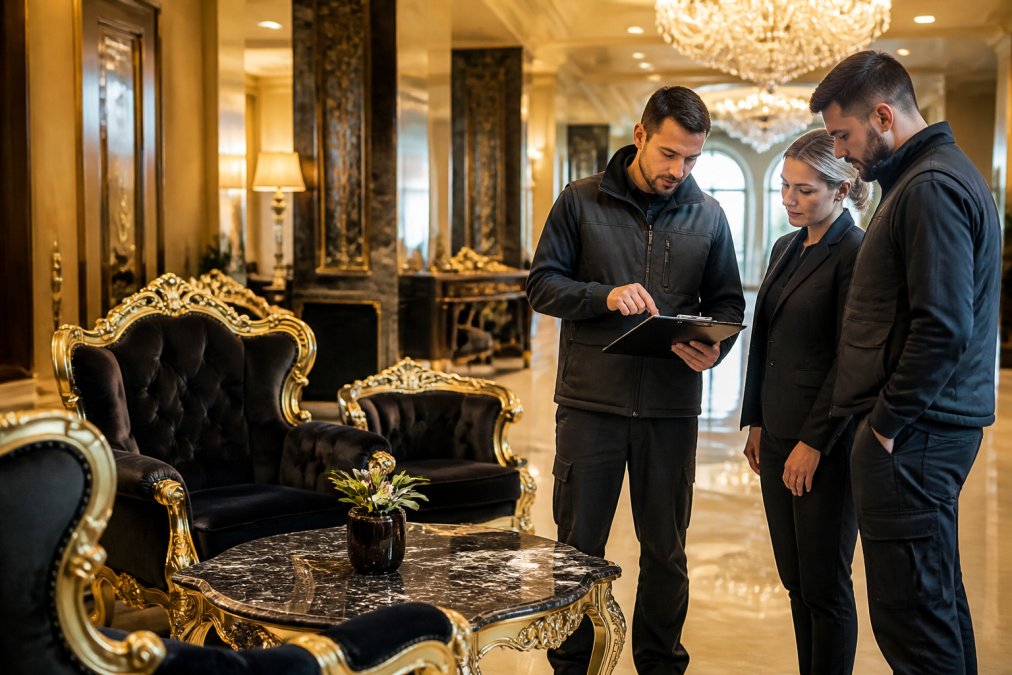
Elegant hotel lobby with baroque armchairs and marble tables, next to it a logistics team checks a delivery plan on a tablet, warm light, luxurious atmosphere
  1. Build the schedule backwards. Start with the opening date and work your way back through installation, transport, and production.
  2. Tender delivery time as a range. Request a realistic range instead of a single desired date.
  3. Contractually fix the production start. The start date is the most reliable variable in the entire process.
  4. Review milestones weekly. A brief weekly status report prevents surprises in week twelve.
  5. Plan installation windows. Installation requires time, access, and personnel, not just a delivery date.

Avoiding Common Mistakes in Delivery Planning

The most expensive mistake is assuming that delivery time is a matter of negotiation. It is a result of production and logistics. Anyone who squeezes it without changing the underlying factors merely shifts the risk to the installation phase.

Mistake Cause Impact
Desired date instead of range Delivery time planned as a constant Delay in installation
Late design approval Missing design/logistics interface Production start is delayed
No production start date Unclear order clarification No reliable end date
Installation not planned Focus only on delivery Furniture remains unassembled

Conclusion: On-Time Delivery Begins with Choosing the Right Partner

The 2026 Global Hospitality Furniture Market Analysis cites resurgent tourism as the main driver of demand, both for refurbishments and new builds (Global Hospitality Furniture Market Report 2026). At the same time, guest expectations regarding the quality and durability of interior furnishings are rising.

On-time delivery therefore does not originate in logistics, but in the choice of partner. A manufacturer who commits to a binding production start and milestones removes the greatest project risk for you.


The greatest challenge with hotel furniture remains the coordination between design, manufacturing, and scheduling. As a manufacturer and wholesaler, Casa Padrino combines exclusive luxury hotel furniture with custom interior solutions, ranging from baroque furniture to complete hotel interior solutions. With over 20 years of experience in international hotel projects, high-quality materials such as solid wood, marble, and gold leaf, as well as custom adaptation to your room geometries, Casa Padrino accompanies your project from planning to installation. Start your project with Casa Padrino and secure on-time furnishing at the highest level: Discover Casa Padrino luxury hotel furniture.

Frequently Asked Questions

Why are delivery times for high-quality hotel furniture often long?

High-quality hotel furniture is often handcrafted using materials such as solid wood, marble, or gold leaf. This manufacturing process takes time, and delivery time is not a static figure but a dynamic variable that depends on material availability, factory capacity, and transport routes. If it is not treated as a variable in planning, delays occur. Early ordering and clear milestones in hotel contract furnishing planning significantly reduce this risk.

How can hotel furniture planning be made more efficient?

Efficient planning begins with a binding schedule that separately details manufacturing, transport, and installation. Digital process automation tools help shorten procurement cycles and secure delivery dates before guests arrive. Utilizing the advantages of custom-made hotel furniture—meaning perfectly fitting pieces instead of standard items—reduces on-site adjustments and subsequent delays. A dedicated contact person at the manufacturer further accelerates coordination.

What role does early ordering play in contract furnishing?

The earlier an order is placed, the more flexibility remains for material procurement and manufacturing. Early ordering secures capacity and prevents a project from falling into a bottleneck phase. Casa Padrino therefore plans delivery dates together with the client.

How can delivery delays be avoided during hotel renovations?

Delays rarely occur during transport, but rather during preparation. Clear hotel furniture procurement strategies, a checklist for evaluating delivery performance, and defined buffer times prevent the most common mistakes. It is also important not to treat delivery time as a fixed value, but to review it regularly. Working with a specialized manufacturer who manages both production and logistics from a single source keeps the schedule intact.
High-Quality Hotel Furniture: What You Need to Consider

Table of Contents

Last updated: September 7, 2026

The hotel industry is investing heavily in its interiors: the global market for hotel furniture, fixtures, and equipment is estimated at USD 52.8 billion for 2026 and is growing annually by 4.8% (Future Market Insights Market Report 2026(https://www.futuremarketinsights.com/reports/hotel-furniture-fixtures-equipment-market)). These figures show that high-quality hotel furniture is no longer an optional extra, but a decisive competitive factor. Casa Padrino has been supporting international hotel projects for over two decades and knows exactly what matters when making a selection. Knowing what to look for in premium hotel furniture not only creates an elegant ambiance but also ensures long-term investment security and delighted guests. After all, the quality of the interior directly determines how your property is perceived.

Why the Quality of Hotel Furniture Makes the Difference

The quality of your hotel furniture is the silent ambassador of your property. It communicates hospitality, style, and comfort before a single word is spoken. Studies prove the direct connection: guests’ subjective evaluation of interior quality correlates strongly with the physical furnishings and design of the furniture (MDPI Journal of Buildings Study 2022(https://www.mdpi.com/journal/buildings)).

The economic significance is equally clear: 58% of guests now consciously choose superior or luxury rooms over standard rooms, an increase of 4 percentage points compared to the previous year (SiteMinder Hotel Industry Trend Report 2026(https://www.siteminder.com/r/latest-trends-in-hotel-industry/)). This development shows that guests are willing to pay more for high-quality environments. The right furnishings are therefore not a pure expense, but a strategic investment in the future of your hotel.

Material Quality and Craftsmanship: The Foundation of Longevity

Hotel room furniture is subject to extreme wear and tear: daily use, professional cleaning, and frequent guest turnover put heavy strain on materials. High-quality hotel furniture is therefore characterized by robust materials such as solid wood and high-quality coated surfaces that can withstand intensive use (Hotel Room Furnishing Expert Advice 2026(https://hotelzimmereinrichtung.eu/hotelmoebel-kaufen-worauf-sie-beim-moebelkauf-fuer-hotels-achten-sollten/)).

Pay attention to these details when making your selection:

  • Solid wood instead of veneered particle board for frames and carcasses
  • Abrasion resistance of upholstery fabrics of at least 100,000 Martindale rubs
  • Surface finish: Scratch-resistant lacquers and easy-care sealants
  • Wear resistance of fittings and hinges for thousands of opening cycles
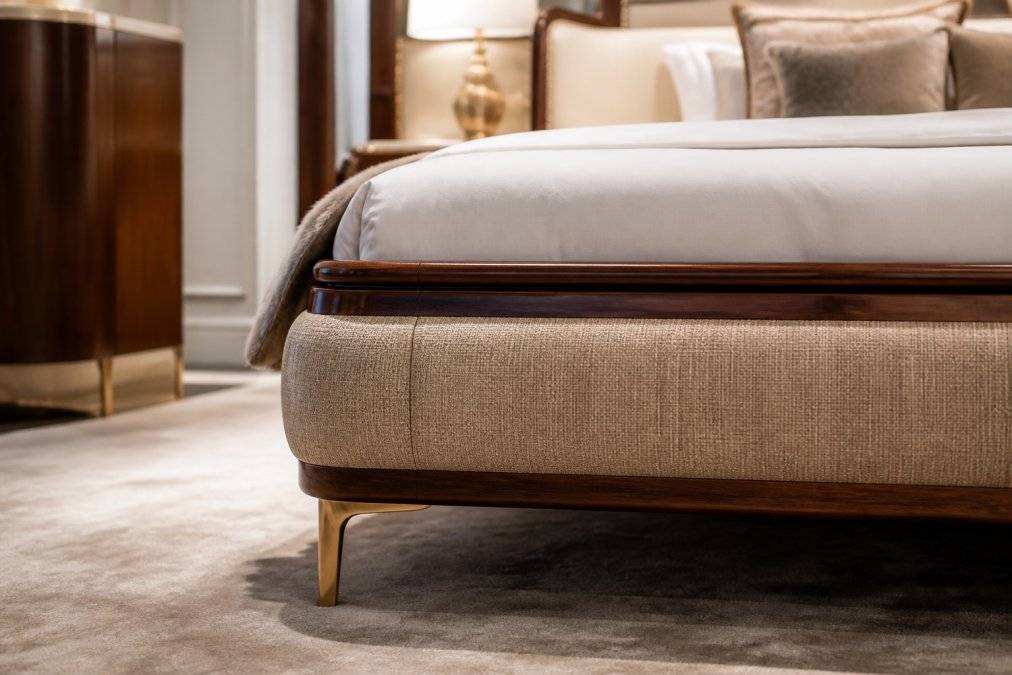
Close-up of the edge of an elegant solid wood hotel bed frame with fine upholstery and noble fabric cover in a luxurious setting

A common mistake when planning hotel room furnishings is focusing on the first impression rather than daily wear and tear. The haptics and material quality determine whether your furniture will still look prestigious after five years or already show signs of wear. Casa Padrino relies on solid wood, marble, bronze, and gold leaf combined with European craftsmanship for manufacturing. These are high-quality materials that ensure longevity and a luxurious ambiance.

Contract Furniture Fire Safety Requirements: Applicable Standards

Fire safety requirements for contract furniture are a non-negotiable part of any professional hotel fit-out. In Germany, hotel furniture must meet strict fire protection classes, which can vary depending on the area of application and the federal state. Relevant testing standards include DIN EN 1021 for upholstered furniture and DIN 4102 for the fire behavior of building materials and components.

For operators, this means: always request the corresponding certificates and test reports from your supplier. Reputable manufacturers of contract furniture provide documented proof of compliance with fire protection classes. As a B2B customer, you can obtain the relevant certificates from Casa Padrino upon request for your tenders and regulatory inspections. Compliance with these standards not only protects your guests but is also a prerequisite for your operating license and insurance coverage.

Planning Hotel Room Furnishings: Design Concept and Ergonomics

Planning hotel room furnishings is about more than aesthetics: ergonomics and functionality determine your guests’ comfort and, consequently, your property’s reviews. A well-thought-out spatial concept combines design, material quality, and practical requirements into a harmonious whole. The 2026 design trends show a clear shift toward authentic, locally rooted concepts that stand out from generic, mass-produced aesthetics (Wimberly Interiors Design Trends 2026(https://www.watg.com/interior-design-trends-2026-authenticity-resonance-and-resilience/)).

A focus on wellness also plays a growing role: integrating wellness aspects into the physical hotel environment is considered a key factor for guest satisfaction in 2026 (EXTERNAL_LINK: ADA Cosmetics Expert Stories 2026 | ada-cosmetics.com).

A professional planning approach includes:

  1. Zoning: Clearly defining sleeping, working, and lounge areas
  2. Ergonomics: Aligning bed heights, seating geometries, and work surfaces with guest needs
  3. Lighting concept: Combining atmospheric lighting with functional layers
  4. Acoustics: Choosing materials that absorb sound and promote tranquility
  5. Clearance space: Sufficient space for luggage, comfort, and accessibility
Pro Tip
A professional provider like Casa Padrino not only advises you on furniture selection but also supports you with Luxury Interior Design and Hotel Interior Solutions in developing a coherent overall concept that unites brand identity and guest expectations.

What many planners underestimate: rushing to approve design plans often leads to functional deficits in later hotel operations (EXTERNAL_LINK: Focus Furnishing Industry Analysis 2026 | focusfurnishing.com). Take your time with detailed planning and involve housekeeping and maintenance teams early on.

Benefits of Custom-Made Hotel Furniture for Your Project

Custom-made hotel furniture offers decisive advantages over mass-produced furniture: it is tailored precisely to your room geometries, design concepts, and functional requirements. The benefits of custom hotel furniture are particularly evident in unusual floor plans, listed heritage buildings, or a strong brand presence that needs to stand out from the competition.

For a 50-room hotel, a single supplier can deliver a complete, consistent furnishing solution, rather than you having to coordinate with multiple vendors. Casa Padrino realizes custom furnishing solutions according to customer wishes, combining traditional craftsmanship with timeless design. From the initial sketch to the final production, you receive furniture that is perfectly tailored to your property while still offering the durability of professional contract furnishings.

Logistics, Assembly, and Maintenance: Post-Delivery Service

The most careful furniture selection is of little use if logistics and assembly are not professionally organized. Especially with international deliveries and large quantities, the quality of service determines the project’s success. An experienced provider coordinates delivery, on-site assembly, and handover to your housekeeping team. But the service does not end with the handover – the crucial phase only begins during ongoing hotel operations.

Logistics in Active Hotel Operations: Planning is Everything

Delivery to an operational hotel is a logistical masterpiece. Unlike a new build, the lobby cannot be blocked for days, and guests must not be disturbed in their rooms. Experienced project managers therefore plan deliveries in specific time windows, often in the early morning hours or overnight. For transporting large items such as beds or wardrobes, freight elevators, sufficiently wide corridors, and protective films for floors and walls must be planned. A professional provider like Casa Padrino can coordinate these processes, relieving your property of operational risks.

The Rhythm of Maintenance: Cleaning and Maintenance Cycles

Daily cleaning is the greatest strain on hotel furniture. High-quality materials such as solid wood and special surface coatings make the housekeeping team’s job much easier and reduce your operating costs in the long run. However, a systematic maintenance plan that goes beyond daily cleaning is crucial:

Get Started Today →

  • Daily cleaning: Microfiber cloths and pH-neutral cleaners for sealed surfaces; no aggressive solvents or abrasive sponges.
  • Monthly inspection: Checking hinges, fittings, and runners; tightening screws prevents premature wear.
  • Annual care: For solid wood surfaces, refreshing with special care oils is recommended to maintain the protective layer and protect the wood from drying out.
  • Cyclical replacement: Upholstery fabrics and mattresses have a limited lifespan. A planned replacement after 5–7 years maintains the prestigious condition of your rooms and prevents negative reviews.

A common mistake is using multi-purpose cleaners that attack the surface sealant. Therefore, clarify before purchasing which cleaning agents and methods are suitable for the specific materials. Casa Padrino advises you on selecting easy-care surfaces that withstand daily demands while preserving their noble character.

Warranty, Guarantee, and Spare Parts Availability

For long-term operation, spare parts availability is a crucial factor. Ask your supplier whether fittings, upholstery fabrics, and surface materials can still be reordered years after delivery. A single defective hinge should not require replacing an entire piece of furniture. Reputable manufacturers document their production batches and keep spare parts in stock for a defined period. Also, clarify warranty periods and the handling of complaints – a transparent process is a sign of the manufacturer’s quality.

Planning cleaning and maintenance cycles is not a tedious chore, but a strategic lever for your hotel’s profitability. Anyone who considers these processes from the outset reduces downtime, extends the lifespan of the furniture, and thus secures long-term investment safety. Casa Padrino supports you with Luxury Hotel Furniture and custom-made solutions that are not only visually convincing but also designed for demanding daily hotel operations.

Certifications and Sustainability as Proof of Quality

Certifications are objective proof of the quality of contract furniture. Materials tested for harmful substances, sustainable production processes, and documented supply chains distinguish professional manufacturers from pure importers. For the hotel industry, sustainability aspects are also gaining importance, as guests and investors increasingly value environmentally conscious interiors.

Sustainability Certificates: What Really Matters

In the jungle of sustainability labels, clear guidance helps. For wood products, the FSC certificate (Forest Stewardship Council) is the globally recognized standard for responsible forest management. The PEFC seal (Programme for the Endorsement of Forest Certification Schemes) is another important certificate for sustainable forestry. Both seals guarantee that the wood comes from controlled and sustainably managed forests.

For the pollutant load of furniture in Germany, the “Blue Angel” certificate is the benchmark. It identifies products that are particularly low-emission and meet strict requirements for material health. DIN EN 16516 for measuring emissions from construction products and furniture is also a relevant standard that documents compliance with indoor air limit values.

Accessibility: DIN 18040 as an Obligation and Opportunity

One aspect overlooked in most guides is the accessibility of hotel furniture. DIN 18040-2 “Barrier-free construction – Public buildings and workplaces” defines the requirements for accessible hotels in Germany. This standard is not only a legal obligation for publicly accessible buildings but also a decisive competitive advantage in a growing market segment.

The requirements for furniture are precisely defined:

  • Clearance space: In accessible rooms, there must be sufficient clearance space of at least 150 cm in diameter in front of beds and wardrobes. Furniture must not restrict these areas.
  • Bed heights: The seat height of beds should be between 46 and 48 cm to allow easy transfer from a wheelchair.
  • Wheelchair accessibility: Desks and washbasins must offer wheelchair accessibility with legroom of at least 67 cm in height and 30 cm in depth.
  • Controls: Switches, handles, and controls must be mounted at a height between 85 and 105 cm and must be operable without effort.
  • High-contrast design: For visually impaired guests, high-contrast color designs of furniture and surfaces are helpful to facilitate orientation.

Custom-made furniture offers a decisive advantage here: it can be tailored precisely to the requirements of DIN 18040 without compromising the design concept. Casa Padrino realizes accessible luxury furniture that combines functionality and elegance – from wheelchair-accessible desks to height-adjustable beds that blend seamlessly into the overall aesthetic.

Transparency as a Quality Feature

When evaluating suppliers, look for documented certifications, transparent production capacities, and references from comparable hotel projects. A manufacturer’s experience is reflected in the quality of advice, the precision of manufacturing, and the reliability of delivery dates. Casa Padrino looks back on over 20 years of experience in hotel projects and has furnished international brands such as Gucci, Cavalli, and Louboutin. These references prove the ability to realize even demanding projects on time and in the highest quality. For your tenders, you can obtain the relevant certificates regarding materials, fire protection, and sustainability from Casa Padrino upon request – documented and verifiable.

Conclusion: How to Make the Right Choice for Your Hotel

The decision to invest in high-quality hotel furniture is an investment in the future of your property. Applying the right criteria not only ensures an elegant ambiance but also longevity, guest satisfaction, and a clear competitive advantage. The combination of material quality, fire protection compliance, well-thought-out design, and professional service makes the difference between simple furnishings and an unmistakable hotel concept.

Decision Criterion What to Look For Impact
Material Quality Solid wood, abrasion resistance, surfaces Longevity in hotel operations
Fire Protection DIN EN 1021, DIN 4102, certificates Operating license, guest safety
Design Concept Ergonomics, zoning, lighting, acoustics Guest satisfaction, positive reviews
Customization Adaptation to room geometry, brand presence Unique ambiance, differentiation
Service Logistics, assembly, maintenance, warranty Smooth operations, minimal downtime
Key Takeaway
The key takeaway: High-quality hotel furniture is the right choice when it combines material quality, fire protection compliance, well-thought-out design, and professional service in one. This is exactly the combination that Casa Padrino offers with its exclusive collections and custom-made solutions.

For your hotel project, this means: trust a partner who understands the requirements of the hospitality industry and has the production capacity to realize even large projects. Casa Padrino combines Italian-inspired elegance with European craftsmanship, creating spaces that delight your guests and give your property an unmistakable profile.


Choosing the right hotel furniture is demanding, but feasible with the right partner. Casa Padrino offers you exclusive luxury hotel furniture, custom furnishing solutions, and the experience of over two decades of international hotel projects. Discover our collections and let our experts advise you on transforming your hotel into an incomparable ambiance. Visit Casa Padrino and start your project today.

Frequently Asked Questions

What fire protection requirements apply to hotel furniture in Germany?

In Germany, upholstered furniture and curtains in hotels must meet the requirements of DIN 4102 or DIN EN 1021. The furniture must be flame-retardant and must not emit toxic gases in the event of a fire. Casa Padrino uses materials tested for harmful substances that comply with German fire protection standards for contract furniture. It is advisable to have the corresponding test certificates documented before ordering to be on the safe side during inspections and star classification.

How does the durability of contract furniture differ from residential furniture?

Contract furniture is designed for continuous, high-frequency use. While a residential sofa is used for a few hours a day, a hotel armchair often has to withstand 16 hours of daily use. High-quality contract furniture therefore uses solid wood instead of veneered particle board, an abrasion resistance of over 100,000 Martindale rubs for upholstery fabrics, and reinforced frame constructions. These quality features significantly extend the lifespan and secure your investment over a period of 10 to 15 years.

Why is custom hotel furnishing crucial for luxury hotels?

Custom-made hotel furniture allows for perfect adaptation to the room geometry of your property. Standard furniture often leaves gaps or looks generic. A custom concept takes columns, slopes, and niches into account and creates a coherent spatial concept that underlines your brand identity. For luxury hotels, this individuality is crucial, as 58 percent of guests now specifically book premium rooms. Casa Padrino manufactures according to your specifications, combining traditional craftsmanship with the functional requirements of hotel operations.

Which materials are best suited for high-traffic hotel areas?

In high-traffic areas such as the lobby or breakfast room, solid woods with resistant surfaces and upholstery fabrics with high abrasion resistance of at least 50,000 Martindale rubs are recommended. Leather and special microfiber fabrics with protective finishes are resistant to liquids and easy to clean. For tables, you should pay attention to scratch-resistant surface finishes. Casa Padrino advises you on the selection of materials so that your furniture remains prestigious even after years of intensive use.