
Table of Contents
- Why a Structured Checklist for Hotel Furniture Planning Determines Success
- Budget Planning and Investment Costs: The First Block of the Checklist for Hotel Furniture Planning
- From Room Concept to Tender: Step-by-Step Project Planning
- Hotel Room Furnishing Concept: Equipment, Ergonomics, and Psychology of Interior Design
- Hotel Furniture Fire Safety Requirements and Accessibility According to DIN 18040-2
- Custom Hotel Furniture: Bespoke Contract Furniture for Individual Room Geometries
- Durability of Hotel Furniture: Material Quality, Wear and Tear, and Renovation Cycle
- Digitalization of Furniture Management: Inventory, Par Levels, and Maintenance
- Frequently Asked Questions About Hotel Furniture Planning
- Frequently Asked Questions
Last updated: September 10, 2026
Why a Structured Checklist for Hotel Furniture Planning Determines Success
A checklist for hotel furniture planning is a systematic working tool that maps out all phases of a hotel project, from budgeting and tendering to installation. According to Univents on increasing efficiency in project preparation, error rates in the planning phase can be reduced by up to 95 percent through systematic checklists. For Casa Padrino, this structure is part of the craft: for over 20 years, the manufacturer has been furnishing grand hotels and luxury projects, knowing that crucial mistakes do not happen on the construction site, but during preparation. Anyone procuring contract furniture for 50 or 200 rooms works with six- to seven-figure investment costs. Without a clear sequence, a design project quickly becomes a financial risk.
The following guide leads through eight planning blocks. It shows where hoteliers typically lose money and which points must not be missing from any checklist.
Budget Planning and Investment Costs: The First Block of the Checklist for Hotel Furniture Planning
Budgeting comes first because it limits every subsequent decision. In 2026, hoteliers face the challenge of making budgets not only comprehensive but also future-oriented, as described by The Guestbook on hotel budgeting 2026. Therefore, plan in three pots:
- Acquisition costs for contract furniture, textiles, and lighting
- Reserves for sampling, delivery, and installation
- Provisions for the first renovation cycle
A common mistake is focusing solely on the purchase price. This is precisely where lifecycle cost analysis comes in.
Lifecycle Cost Analysis Instead of Pure Purchase Price
Lifecycle cost analysis considers all costs over the useful life of a piece of furniture: acquisition, maintenance, cleaning, repair, and replacement. A solid wood nightstand with a high-quality surface finish costs more to purchase than a chipboard alternative, but it lasts significantly longer in hotel operations and extends the renovation cycle. Casa Padrino manufactures specifically for this level of wear and tear using solid wood, marble, bronze, and gold leaf.
| Cost Block | One-time | Recurring | Typical Mistake |
|---|---|---|---|
| Acquisition | Yes | No | Only comparing price |
| Installation | Yes | No | Forgetting buffer |
| Maintenance | No | Annually | Not planned for |
| Renovation | No | Every 7-12 years | Calculated too late |
Dividing Cost Blocks Realistically
Experienced project managers do not calculate contract furniture as individual items, but as a bundle. A division into five blocks has proven successful: furniture, textiles, lighting, installation, and reserve. The reserve should not be less than ten percent of the total furniture budget, as custom dimensions, re-sampling, and transport damage experience shows that additional costs arise later. Those who cut the reserve will have to finance it later from ongoing operations—a pattern repeated in almost every hotel project.
Quantifying Lifecycle Costs
The purchase is only a fraction of the total cost. Over a typical renovation cycle of seven to twelve years, cleaning, minor repairs, spare parts, and ultimately replacement are distributed. A solid wood wardrobe with a sealed surface can be sanded down and resealed multiple times; a veneered version on a carrier board may have to be completely replaced after damage. Therefore, calculate three values per piece of furniture: acquisition, annual maintenance, and expected replacement time. These three values turn a price comparison into an investment decision.
Perform the lifecycle calculation per room type, not per piece of furniture. This allows you to see immediately which room type will be the most expensive over the cycle and where higher-quality materials pay off first.
Reserves for the Renovation Cycle
The first renovation cycle comes faster than planned. In highly frequented hotels, it is often between seven and twelve years, and even less in high-wear suites. Build up the reserve from the start of operations, not just the year before the renovation. Those who rely on durable luxury furniture made of solid wood early on significantly reduce subsequent replacement costs and can extend the cycle in a controlled manner.
Checking Subsidies and Tax Treatment
Investitions in accessibility and energy efficiency measures may be eligible for funding programs. Clarify the treatment of contract furniture with your tax advisor before the tender starts, as the depreciation period affects the annual burden. This coordination belongs in the early budget phase, not in the post-calculation.
From Room Concept to Tender: Step-by-Step Project Planning
A hotel project runs in clear stages. The following sequence has proven successful in practice:
- Define room concept and design language
- Room planning and furniture configuration per room type
- Create FF&E (Furniture, Fixtures & Equipment) list
- Align budget framework and investment costs
- Prepare tender and request quotes from suppliers
- Conduct sampling
- Schedule delivery and installation
- Acceptance and inventory
The tender should bindingly request material quality, fire protection class, ergonomics, and delivery time. Further details on customized hotel furniture production according to customer requirements can be found directly from the manufacturer.
Timeline and Milestones
Do not plan in weeks, but in milestones. A reliable framework for a property with 50 to 200 rooms looks like this:
| Phase | Typical Duration | Milestone |
|---|---|---|
| Room concept and design language | 4-8 weeks | Approval of design manual |
| FF&E list and quantities | 2-4 weeks | Final bill of quantities per room type |
| Tendering and quote comparison | 4-6 weeks | Award decision |
| Sampling | 2-4 weeks | Sample approval |
| Manufacturing | 8-16 weeks | Factory acceptance |
| Delivery and installation | 2-6 weeks | Room-by-room acceptance |
| Inventory | 1-2 weeks | Handover to operations |
The manufacturing time of custom contract furniture depends on quantity, material availability, and logistics. Scheduling installation during peak season risks room vacancies; therefore, plan installation during the off-season or block rooms deliberately.
Responsibilities and Approval Loops
Every milestone needs a responsible person and an approval. Typical roles include project management, purchasing, technical department, and operations. Without clear approval, delays occur because decisions get stuck between departments. Determine who approves the design manual, bill of quantities, and samples, and by what deadline.
Setting Up the Tender Correctly
The tender is the control instrument of the project. Bindingly include: material quality, fire protection class, ergonomics, delivery time, scope of installation, warranty, and spare parts availability. Demand samples and proof, not just prices. A supplier who cannot guarantee spare parts over the renovation cycle can become a cost risk later.
Planning Sampling, Delivery Time, and Installation Early
Sampling is not a formality, but the final check before mass production. Check the material, color tone, surface, and workmanship on the original. Plan delivery time and installation with a buffer: for custom contract furniture, there is regularly a time window between order and delivery that depends on quantity, material availability, and logistics. Scheduling installation during peak season risks room vacancies.
A single reference piece before the start of series production reveals dimensional deviations that remain invisible in the drawing. Without sample approval, factory acceptance turns into expensive rework.
Digital Inventory from Day One
The handover to operations is the moment digital inventory begins. Record every piece of furniture with its location, model, delivery date, material, and warranty period. This data significantly shortens subsequent maintenance and secures proof in the event of an operator change. For individual room geometries, custom-made hotel furniture solutions tailored exactly to specifications are ideal.
Hotel Room Furnishing Concept: Equipment, Ergonomics, and Psychology of Interior Design
A hotel room furnishing concept combines three levels: equipment, ergonomics, and the psychology of interior design. The latter is omitted in most checklists, even though it determines the guest experience. Warm materials, balanced proportions, and a clear design language create tranquility; harsh contrasts and overloaded surfaces create restlessness.
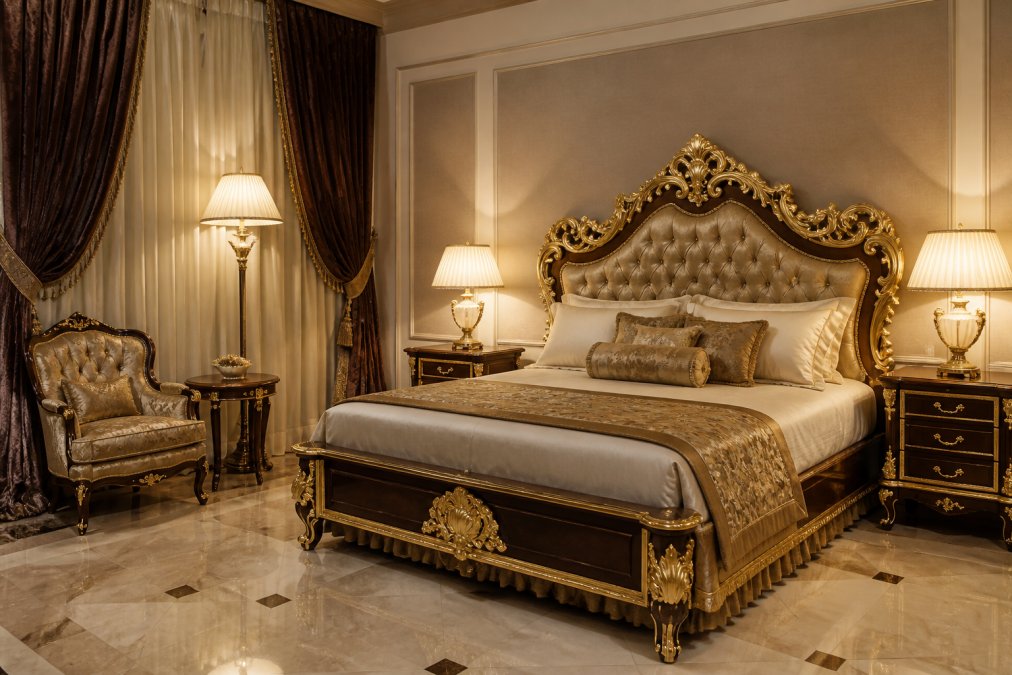
The basic equipment per room includes a bed and headboard, nightstands, desk, seating, wardrobe, lighting, and textiles. Pay attention to ergonomics: seat height, table height, and reading light must match, otherwise functionality suffers. For prestigious properties, it is worth looking at Baroque hotel furniture for upscale room concepts.
Hotel Furniture Fire Safety Requirements and Accessibility According to DIN 18040-2
Hotel furniture fire safety requirements primarily affect upholstered furniture, textiles, and wall coverings. Demand proof of the fire protection class from every supplier and document this in the tender. Missing proof becomes a problem during acceptance, especially in escape routes and public areas.
Accessibility according to DIN 18040-2 also belongs on the checklist. Among other things, it regulates clearance spaces, reach heights, and the usable width of passageways. Plan accessible rooms early because furniture dimensions can hardly be adjusted later. For individual room geometries, custom-made hotel furniture solutions tailored exactly to specifications are ideal.
Custom Hotel Furniture: Bespoke Contract Furniture for Individual Room Geometries
Custom hotel furniture solves the problem of uneven floor plans. Listed buildings, corner rooms, and suites with bay windows can rarely be neatly furnished with standard items. Bespoke contract furniture adapts to the room geometry and makes better use of space.
Casa Padrino manufactures furnishing solutions according to customer requirements, combining Italian-inspired elegance with European craftsmanship. For hotels, this means a consistent design language across all room types without compromising on custom dimensions. A look at luxury hotel furniture for grand hotels shows the range between Baroque, Rococo, Neoclassicism, and Art Nouveau.
Always have a sample piece made for custom dimensions before starting series production. A single reference piece reveals dimensional deviations that remain invisible in the drawing.
Durability of Hotel Furniture: Material Quality, Wear and Tear, and Renovation Cycle
The durability of hotel furniture depends on three factors: material quality, workmanship, and care. Solid wood, marble, and metal generally withstand daily wear and tear better than veneer on carrier boards. During sampling, check edges, joints, and surface sealing, as this is where wear and tear shows first.
Calculate the renovation cycle realistically. In highly frequented hotels, renovation intervals are often between seven and twelve years, depending on wear and material choice. High-quality furniture reduces maintenance costs over the entire cycle. Those who rely on durable luxury furniture made of solid wood early on significantly reduce subsequent replacement costs.
Digitalization of Furniture Management: Inventory, Par Levels, and Maintenance
The digitalization of furniture management is the point that classic checklists almost always overlook. A digital inventory records every piece of furniture with its location, model, delivery date, and material. This significantly shortens maintenance because damage can be immediately assigned to a specific piece.
Work with par level values: define the minimum quantity of spare parts and reserve furniture per room type and storage. If values fall below this, a reorder is automatically triggered. This method prevents a damaged chair from blocking a room for weeks. Combined with a maintenance plan, this creates a closed loop of inventory, maintenance, and procurement.
Without digital inventory, hotels lose track of equipment and warranty periods with every operator change. The result is duplicate purchases and unnecessary investment costs.
Frequently Asked Questions About Hotel Furniture Planning
How long does the planning of a hotel furniture project take?
The planning phase takes several months depending on the project size. Room concept, tendering, and sampling take up the largest part. For the manufacturing and delivery of custom contract furniture, an additional time window should be planned, which depends on quantity and material.
What fire safety requirements apply to hotel furniture?
Upholstered furniture and textiles must meet defined fire protection classes depending on the area of use. Demand proof from the manufacturer and document this in the tender, especially for escape routes and public areas.
What does accessibility according to DIN 18040-2 mean for furnishing?
The standard regulates clearance spaces, reach heights, and passage widths in accessible rooms. Furniture dimensions and arrangement must comply with these specifications, which is why accessible rooms belong in the room planning early on.
How do you recognize durable hotel furniture?
Solid wood, high-quality surface sealing, and clean joints are the most important features. Check edges and joints during sampling, as this is where wear and tear shows first.
Hotel furniture planning rarely fails because of design, but rather due to a lack of structure: unclear budgets, delayed sampling, missing fire safety certificates. This is precisely where Casa Padrino comes in. With over 20 years of experience in international hotel projects, custom furnishing solutions according to customer requirements, and a collection of Baroque, Rococo, and Art Nouveau furniture in solid wood, marble, and gold leaf, Casa Padrino delivers complete furnishings from a single source. Discover luxury hotel furniture and exclusive furnishing concepts and start your project with a partner who reliably accompanies planning, manufacturing, and installation.
Frequently Asked Questions
What requirements must hotel furniture meet in Germany?
In Germany, hotel furniture must primarily meet the fire safety requirements of the state building regulations, especially for upholstered furniture in escape and rescue routes. DIN 18040-2 for accessible use as well as requirements for stability and low pollutant emissions are also relevant. For hotel classification, equipment, functionality, and material quality play a central role. A checklist for hotel furniture planning should address these points before tendering to avoid adjustments during installation.
How do you plan a durable and aesthetic hotel room interior?
A durable hotel room interior is created by combining robust materials, high-quality workmanship, and a clear room concept. Solid wood, marble, and metal fittings withstand daily use in hotel operations longer than veneered lightweight constructions. A lifecycle cost analysis is crucial: it is not the purchase price that matters, but the costs over the entire renovation cycle. Systematic checklists can significantly reduce errors during project preparation. This leaves more budget for design and guest experience.
What role does the fire safety regulation play in the selection of hotel furniture?
The fire safety regulations of the state building codes stipulate that furniture in escape and rescue routes as well as in public areas must meet certain fire protection classes. For hotels, this means: upholstered furniture, curtains, and wall coverings need corresponding proof, usually according to DIN 4102 or DIN EN 13501. When planning hotel furniture, the fire protection class and certificates should already be recorded in the tender. This prevents delays during acceptance and protects guests as well as insurance coverage.
Which materials are best suited for high-quality hotel furniture?
Solid wood, marble, bronze, brass, and gold leaf are ideal for high-quality hotel furniture because they combine durability with a prestigious appearance. Solid wood lasts for decades, marble tops are scratch-resistant and easy to clean, and metal fittings ensure stable connections. For textiles, it is worth looking at abrasion resistance and fire protection class. Anyone wishing to ensure the durability of hotel furniture combines robust material quality with a design language that remains viable even after several renovation cycles. Custom hotel furniture from Casa Padrino addresses exactly this.