Table of Contents
- Integrating Smart Hotel Technology into Furniture: What is Possible Today
- IoT in Hotel Design: Sensors, Charging Functions, and Smart Lighting
- Modern Hotel Room Furnishings: Technology That Blends in Invisibly
- Bespoke Hotel Furnishing with Integrated Smart Room Technology
- Interfaces, Interoperability, and Operating Costs: What Matters Before the Investment
- Security Aspects and Data Protection for Connected Furniture
- Conclusion: Smart Hotel Technology as Investment Protection for Luxury Hotels
- Frequently Asked Questions
Last updated: September 14, 2026
Integrating Smart Hotel Technology into Furniture: What is Possible Today
According to Grand View Research on the development of the smart hospitality market, the global market for smart hospitality solutions will grow from USD 49.2 billion in 2026 to USD 197.3 billion by 2033. Integrating smart hotel technology into furniture means incorporating sensors, charging functions, lighting control, and connectivity into tables, nightstands, headboards, and seating in such a way that the technology disappears into the design and the guest only notices the comfort. For Casa Padrino, this is not a contradiction to classic craftsmanship: solid wood, marble, and bronze can be combined with inductive charging fields and contactless light control without destroying the design language. This guide shows which paths exist, what can be retrofitted, and what hoteliers should look out for before investing.
From Retrofitting to New Furnishings: Three Integration Paths
Three paths lead to connected furniture, and they differ primarily in effort and investment protection.
- Retrofitting: Charging fields, sensors, and control modules are installed in existing furniture. Suitable if the basic structure is of high quality.
- Partial Integration: Individual rooms are refurnished, such as suites or meeting areas, while standard rooms remain unchanged.
- New Furnishing: Furniture is planned from the start with technology integration in mind, including cable ducts, empty conduits, and modular slots.
The third path costs more but protects the investment for years. Anyone wishing to retrofit later needs space, which is simply lacking in cheap furniture.
IoT in Hotel Design: Sensors, Charging Functions, and Smart Lighting
IoT in hotel design specifically means: furniture becomes data points. Presence sensors detect whether a guest is in the room and adjust lighting and heating accordingly, which reduces energy consumption, as described in the FR-One Blog on energy-efficient interior design. Inductive charging fields in nightstands and desks replace loose cables. Smart lighting adjusts brightness and color temperature to the time of day and usage.
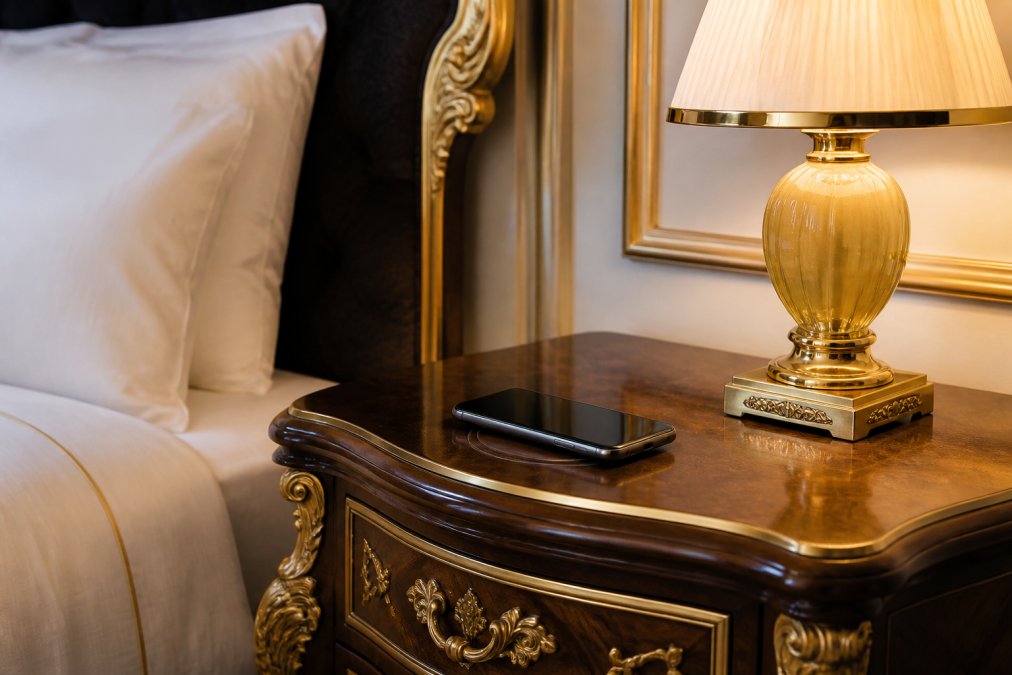
The crucial question is not which technology is available, but which one the guest understands without instructions.
If a charging field is installed behind a marble slab without checking the material thickness, the device will not charge. The guest reports a defect, the complaint ends up with the manufacturer, and the root cause lies in the planning.
Retrofitting Existing Furniture: What Can Be Implemented Without Buying New
Mainly three things can be retrofitted: charging fields under thin surfaces, sensor modules in drawers and cabinets, and control electronics in the plinth area. What cannot be retrofitted are missing cable paths and insufficient material thicknesses. Solid wood furniture offers the advantage here that millings can be executed cleanly and the structural integrity is maintained.
Modern Hotel Room Furnishings: Technology That Blends in Invisibly
Modern hotel room furnishings work when the guest does not perceive the technology as technology. A headboard with an integrated reading light, a console table with a concealed charging option, an armchair with a sensor for room lighting: all of these remain visibly a piece of furniture and invisibly a device.
| Furnishing Element | Technical Function | Visibility | Retrofit possible |
|---|---|---|---|
| Nightstand | Inductive charging, reading light | concealed | yes |
| Headboard | Light control, sensors | integrated | conditionally |
| Desk | Charging, USB, data port | concealed | yes |
| Armchair | Presence detection | invisible | conditionally |
| Wardrobe | Sensor light, consumption measurement | internal | yes |
The table shows: the deeper the technology goes into the construction, the more difficult retrofitting becomes. Those planning anew should provide empty conduits.
Bespoke Hotel Furnishing with Integrated Smart Room Technology
Bespoke hotel furnishing allows technology and form to be conceived in one go. Casa Padrino manufactures furniture according to individual room geometries and can plan integrations for sensors, charging fields, and cable paths directly into the construction. The “FutureHotel – Smart Hotel Room” study by the Fraunhofer-Institut describes scenarios for technologically optimized guest experiences through connected systems; precisely this connectivity only succeeds when furniture and technology are planned together.
Have empty conduits planned with at least double the cross-section. The additional costs are low, but the leeway for future hardware generations is considerable.
Interfaces, Interoperability, and Operating Costs: What Matters Before the Investment
Interoperability determines whether connected furniture can speak to the hotel management system at all. Open interfaces are more important than individual functions because they allow hardware to be replaced without replacing the furniture. This is precisely where, in practice, the investment that lasts separates from the one that must be renewed after a few years.
How Furniture Hardware Communicates with the Property Management System
A connected piece of furniture is rarely directly linked to the PMS. The typical path runs through several levels:
- Sensor or actuator level – The piece of furniture itself contains presence detectors, charging fields, or light controls.
- Gateway level – A local gateway bundles the signals and translates them into a standardized protocol.
- Middleware level – An integration layer establishes the connection to the PMS, usually via a documented application programming interface (API).
- PMS level – Only here are occupancy, check-in status, and room release linked with the furniture functions.
The crucial point: the piece of furniture does not need to know the PMS – it only needs to speak a protocol that the middleware understands. Those who take this separation into account during planning can replace hardware without touching the furnishings.
Open APIs Instead of Proprietary Isolated Solutions
Proprietary protocols bind hoteliers to a single provider and complicate any subsequent expansion. Open, documented interfaces are the prerequisite for sensors, lighting, and charging technology to be updated independently of one another. Proven patterns are:
- Open APIs with documented version maintenance
- Cloud-based systems with local fallback logic, so that basic functions also work during a network outage
- Standardized wireless standards for sensors and lighting
- Documented maintenance intervals for electronic components
Maintenance and Life Cycle Costs
Classic furniture has life cycles of several decades. Electronics in furniture follow shorter cycles. This difference is the central cost factor that many hoteliers underestimate. Anyone installing charging fields, sensors, and control electronics permanently into a piece of furniture today must expect that individual components will need to be replaced before the furniture itself.
The solution lies in the construction: modular slots, accessible plinth areas, and replaceable panels. Casa Padrino plans precisely this accessibility for Luxury Hotel Furniture and Bespoke Furniture – technology remains maintainable, the piece of furniture is preserved.
Always plan electronics in furniture as a replaceable module, not as a permanent component. The additional costs in construction are low, but the difference during the first maintenance is significant.
Security Aspects and Data Protection for Connected Furniture
Connected furniture collects data: presence, usage times, energy consumption. Data protection begins with the question of what data actually needs to be collected. Presence sensors can be configured to only provide a signal, not an identity. The processing of personal data is governed by the General Data Protection Regulation (GDPR), and the state supervisory authorities publish guidance for hotel operations.
Security aspects also concern network separation: guest networks and control networks belong apart, and updates for electronic components require a fixed process. Those who consider these points when selecting furniture hardware save themselves costly retrofitting later.
A study by the University of Huddersfield on guest acceptance of hotel technology shows that technological conveniences influence the visit intention of future guests. However, mere implementation is not enough: without intuitive usability, no added value is created.
Accessibility Through Smart Furniture
Smart furniture can improve accessibility if it is considered from the very beginning. Automatically adjustable seat heights, contactless light switches, and voice-controlled room functions help guests with limited mobility without making the furniture look like medical aids. This is a difference that competitors rarely address – and an argument that should be considered early when planning Luxury Interior Design and Hotel Interior Solutions.
Security Aspects and Data Protection for Connected Furniture
Connected furniture collects data: presence, usage times, energy consumption. Data protection begins with the question of what data actually needs to be collected. Presence sensors can be configured to only provide a signal, not an identity. The processing of personal data is governed by the General Data Protection Regulation (GDPR), and the state supervisory authorities publish guidance for hotel operations.
Security aspects also concern network separation: guest networks and control networks belong apart, and updates for electronic components require a fixed process.
Conclusion: Smart Hotel Technology as Investment Protection for Luxury Hotels
Integrating smart hotel technology into furniture is less a question of technology than a question of planning. Those who plan furniture with empty conduits, modular slots, and open interfaces can replace hardware without renewing the interior. Those who retrofit cheaply pay twice. Casa Padrino combines traditional European craftsmanship with timeless design and plans technology integrations directly into bespoke hotel furnishings, from baroque furniture to modern forms.
The greatest challenge lies not in the technology, but in deciding when it must remain invisible. Casa Padrino develops luxury hotel furniture and complete furnishing concepts that accommodate sensors, charging functions, and lighting control in such a way that the design language is preserved. With bespoke furnishing solutions, high-quality materials such as solid wood and bronze, and over 20 years of experience in international hotel projects, Casa Padrino creates an ambiance that combines technology and elegance. Start your project at Casa Padrino and let your furniture be planned for the next generation.
Frequently Asked Questions
What defines a modern smart hotel?
A modern smart hotel combines connected systems with a clear guest experience. The crucial factor is not the amount of technology, but its added value: intuitive usability, energy efficiency, and personalization. The interplay of connected systems and well-thought-out interiors creates a harmonious guest experience.
How can digital technology be aesthetically integrated into luxury furniture?
Digital components disappear best within the construction, not on the surface. Inductive charging fields can be embedded directly into solid wood or marble tops, sensors for smart lighting can be accommodated in plinths and frames, and speakers behind fabric coverings. This keeps the look of baroque or Art Nouveau furniture unchanged, while the functions are usable at any time. Bespoke hotel furnishing allows recesses and cable paths to be planned right during manufacturing.
What advantages does the connectivity of hotel furniture offer the guest?
Connected furniture reacts to the guest instead of just existing: sensors detect presence and automatically adjust lighting and heating, which reduces energy consumption. Charging functions in nightstands or seating eliminate the search for power outlets. Technological conveniences can significantly influence guests’ intention to visit, provided they are intuitive to use and offer real added value.
What should be considered when choosing smart furniture for the hotel sector?
First, check the interfaces: does the hardware match your hotel management system and work with open APIs? Second, clarify the retrofittability of existing furniture to protect your investment. Third, maintenance and life cycle costs matter, as technology in furniture must run reliably for years. Fourth, security aspects and data protection must be regulated. And finally, the solution should be barrier-free to benefit all guests.