Table of Contents
- High-Quality Lighting for Upscale Gastronomy: Fundamentals of Lighting Design
- Lighting Concepts for Upscale Gastronomy: Implementing Zone Lighting Correctly
- LED Lighting in Gastronomy: Technology and Light Quality
- Gastronomy Lighting Trends: Designer Luminaires and Modern Solutions
- Restaurant Lighting Design: Psychological Impact and Guest Experience
- Maintenance, Cleaning, and ROI Calculation of Gastronomy Lighting
- Lighting Concepts for Different Gastronomy Types: From Fine Dining to Casual Dining
- Implementing High-Quality Lighting with Casa Padrino
High-Quality Lighting for Upscale Gastronomy: The 2026 Lighting Concept Guide
Last updated: July 27, 2026
The right lighting defines the dining experience. High-quality lighting for upscale gastronomy creates atmosphere, directs attention, and influences how long guests stay and how much they spend. Casa Padrino, a renowned specialist in exclusive gastronomy furniture and lighting solutions, has learned through over 20 years of hotel projects that lighting design is just as important as the choice of furniture. The lighting concept determines the success or failure of a restaurant.
In this guide, we will show you how to systematically plan, implement, and optimize high-quality lighting for upscale gastronomy. We cover lighting design, zone lighting, LED technology, psychological effects, and practical maintenance tips. By the end, you will understand how professional restaurateurs light their spaces.
High-Quality Lighting for Upscale Gastronomy: Fundamentals of Lighting Design
Lighting design in gastronomy differs fundamentally from residential lighting. A restaurant must function consistently every day: clear structure, repeatable settings, and lighting elements that work reliably 365 days a year.
A good lighting concept begins with three questions: What should the space communicate? What functions does each zone require? How do I create flexibility for different times of day and occasions? Many restaurateurs light their spaces based on gut feeling and later wonder why guests do not stay long or why the food looks unappealing.
The best lighting design does not start with luminaires, but with a floor plan drawing and color-coded markings for different functional areas. Only then do you select lights that optimally illuminate these zones.
High-quality lighting for upscale gastronomy follows proven principles: ambient lighting for safe navigation, accent lighting for focus and atmosphere, and flexible control for different operational phases.
Why Lighting Design is Crucial in Gastronomy
Light influences three critical factors: safety, appetite, and length of stay. A space that is too dark feels unprofessional and unsafe. A space that is too bright feels uncomfortable. A room with poor color rendering makes high-quality dishes look unappealing.
Research shows that lighting mood directly influences the willingness to spend. Warm white light (2700-3000 Kelvin) promotes relaxation and longer stays. A restaurant that correctly utilizes high-quality lighting for upscale gastronomy earns measurably more.
Lighting Mood and Atmosphere as a Success Factor
The lighting mood is the first thing a guest perceives when entering a restaurant. It decides in milliseconds whether the space feels welcoming. A professional lighting mood is created by three elements: light color (Kelvin value), light intensity (Lux value), and light distribution (direct vs. indirect).
A restaurant with only direct light feels harsh and clinical. A restaurant with only indirect light feels dark. The balance between the two creates coziness without a lack of orientation.
Lighting mood follows measurable rules. Warm white light + indirect component + dimmability = luxury atmosphere. This combination works in any upscale restaurant.
Casa Padrino understands these principles and offers lighting solutions for gastronomy that combine mood and functionality. Their designer luminaires, from pendant lights to recessed spotlights, are specially calibrated for gastronomy projects.
Lighting Concepts for Upscale Gastronomy: Implementing Zone Lighting Correctly
Zone lighting is the backbone of any professional lighting concept. A restaurant is not a single space; it consists of several functional zones with different requirements. A table zone requires different lighting than the bar or the entrance area.
Each zone gets its own light layer. Tables need focused, soft light. The bar needs accent lighting for drama. The entrance needs orientation light. Together, these layers create a coherent concept that works and looks beautiful.
Combining Ambient and Accent Lighting
Ambient lighting ensures that guests can move safely and recognize food. Accent lighting creates drama and focus. Together, they tell a story.
For upscale gastronomy, the rule is: ambient lighting should be between 150-300 Lux. Accent lighting can then add an additional 50-100 Lux. A common mistake is sizing the accent lighting too weakly. Accent lighting should be at least 2-3 times brighter than the surrounding ambient lighting.
Differentiating Table Zones, Bar Areas, and Entrance Areas
Table zones need focused, soft light without glare. Pendant lights work perfectly; they illuminate the table without flooding the room. Dimmability is essential to adjust the mood.
The bar area is the most dramatic place in a restaurant. Accent lighting on bottles, shelves, or the work surface creates energy and focus. A bar without accent lighting feels like a storage room.
The entrance area must feel welcoming and guide guests. A mix of ambient lighting (for safety) and subtle accent lighting (for elegance) works optimally.
| Zone | Lux Range | Light Color | Type | Effect |
|---|---|---|---|---|
| Tables | 150-250 | 2700-3000K | Pendant lights | Cozy, appetizing |
| Bar | 200-400 | 2700-3500K | Accent + Ambient light | Drama, energy |
| Entrance | 200-300 | 3000K | Ambient light + Accent | Welcoming, clear |
| Restrooms | 300-500 | 4000K | Bright functional light | Safe, functional |
LED Lighting in Gastronomy: Technology and Light Quality
LED is the standard in gastronomy today. A good LED luminaire lasts 50,000 hours, which is 20 years at 8 hours a day. This means: LED not only saves electricity costs but also maintenance costs.
But not all LEDs are created equal. Quality depends on two critical factors: the CRI value (Color Rendering Index) and the color temperature (Kelvin). A restaurant with poor LEDs looks cheaper than one with good LEDs.
Understanding Color Rendering Index (CRI) and Ra Value
The Color Rendering Index (CRI or Ra value) measures how natural colors look under a light source. A CRI of 100 means: colors look just as natural as under daylight. A CRI of 70 means: colors look distorted and dull.
For upscale gastronomy, a CRI of at least 90 is non-negotiable. With CRI 90+, meat looks red, salad looks green, and wine looks vibrant. With CRI 70, everything looks gray and unappealing.
A CRI value below 85 is unacceptable for restaurants. With a poor CRI, high-quality dishes look cheap.
Color Temperature and Kelvin Values for Different Areas
The color temperature determines whether light feels warm or cold. 2700K is warm and cozy. 5000K is cold and activating.
For upscale gastronomy, the following applies:
- 2700K: Ideal for tables, lounge areas, intimacy
- 3000K: Universally applicable, warm but not too dark
- 3500K: For bars and accent lighting, more energetic
- 4000K: Only for functional areas (kitchen, restrooms)
A good lighting concept uses a maximum of two Kelvin values that differ by no more than 500K.
Gastronomy Lighting Trends: Designer Luminaires and Modern Solutions
Gastronomy lighting is evolving rapidly. A restaurant operating with outdated lighting feels neglected. Current trends include: statement lights, flexible control, sustainable materials, and smart integration.
Casa Padrino offers an extensive collection of designer lights for gastronomy, specially developed for upscale restaurants. From classic pendant lights to modern recessed spotlights, every piece is crafted to high standards and atmospherically well-thought-out.
Pendant Lights as Statement Elements
Pendant lights are the queens of gastronomy lighting. They are functional and decorative. A good pendant light is a statement; it says: this restaurant takes quality seriously.
Modern pendant lights for upscale gastronomy have these characteristics:
- Dimmable for lighting mood
- CRI 90+ for color rendering
- 2700-3000K for warmth
- Glare-free design through diffusers or shades
- High-quality materials (metal, glass, ceramics)
A single pendant light over a table creates focus. Multiple pendant lights in a row create rhythm. The placement is just as important as the luminaire itself.
Cordless Table Lamps for Flexible Room Design
Cordless table lamps enable flexibility that permanently installed lights cannot offer. They can stand on the table, on the bar, or even on a terrace, without power cables.
For upscale gastronomy, cordless table lamps are ideal for flexible event spaces, terraces without power supply, lounge areas with changing layouts, and special events. A good cordless table lamp lasts 8-12 hours and recharges in 2-3 hours.
Glare Protection and Lighting Comfort
Glare is an underestimated problem in gastronomy lighting. A guest who is glared at will not stay long. Glare protection is achieved through diffusers, shades, indirect light, and correct placement. A pendant light over a table should be positioned so that the light falls on the table, not into the guests’ eyes.
Restaurant Lighting Design: Psychological Impact and Guest Experience
Light affects the psyche. Warm white light activates different brain regions than cold white light. Bright light increases heart rate. Dimmed light lowers it. A restaurant that utilizes high-quality lighting for upscale gastronomy psychologically earns more and has more satisfied guests.
How Light Colors Influence Purchasing Behavior and Length of Stay
Warm white light (2700-3000K) increases the length of stay. Guests feel more relaxed and stay longer. This is ideal for fine dining restaurants. Warm white light also increases the willingness to spend; guests order more drinks and desserts.
Cold white light (above 4000K) shortens the length of stay. This is ideal for casual dining concepts where revenue is generated through table turnover. A restaurant can use these effects strategically.
The light color determines not only how a space looks, but also how long guests stay and how much they spend. This is measurable and reproducible.
Smart Home Integration and IoT in Gastronomy
Smart lighting is no longer a luxury; it is a necessity in modern restaurants. With smart home integration, lighting moods can be programmed and automated. A restaurant can automatically set the lighting mood to energetic at lunchtime and to cozy in the evening.
The benefits include automation based on the time of day, energy efficiency through automatic shut-off, scene management for different events, and remote control from a smartphone. For upscale gastronomy, smart lighting is a key differentiator.
Maintenance, Cleaning, and ROI Calculation of Gastronomy Lighting
High-quality lighting is an investment that requires maintenance to retain its value. The good news: LED lighting is low-maintenance. No bulb changes every few months. Just regular cleaning and occasional checks.
Energy Efficiency and Sustainability in Lighting
An LED light consumes 80% less electricity than a halogen light with the same brightness. For a restaurant with 50 lights, this means electricity savings of several thousand euros per year.
An LED light that lasts 50,000 hours is more sustainable than one that lasts 3,000 hours. The reason: less manufacturing, less transport, less waste. For an upscale restaurant, sustainability is also a selling point.
Practical Tips for Cleaning and Maintenance
LED lights are robust, but dirt and dust reduce brightness. Monthly cleaning is ideal:
- Switch off the power supply
- Dust with a dry brush or cloth
- For stubborn dirt: Slightly damp cloth with distilled water
- Dry
- Switch the power supply back on and test
A restaurant should keep a simple maintenance logbook. That is professionalism.
Lighting Concepts for Different Gastronomy Types: From Fine Dining to Casual Dining
Not every restaurant needs the same lighting. A fine dining restaurant needs a different lighting mood than a pizzeria. High-quality lighting for upscale gastronomy must match the restaurant.
Fine Dining Restaurants: Elegance and Intimacy
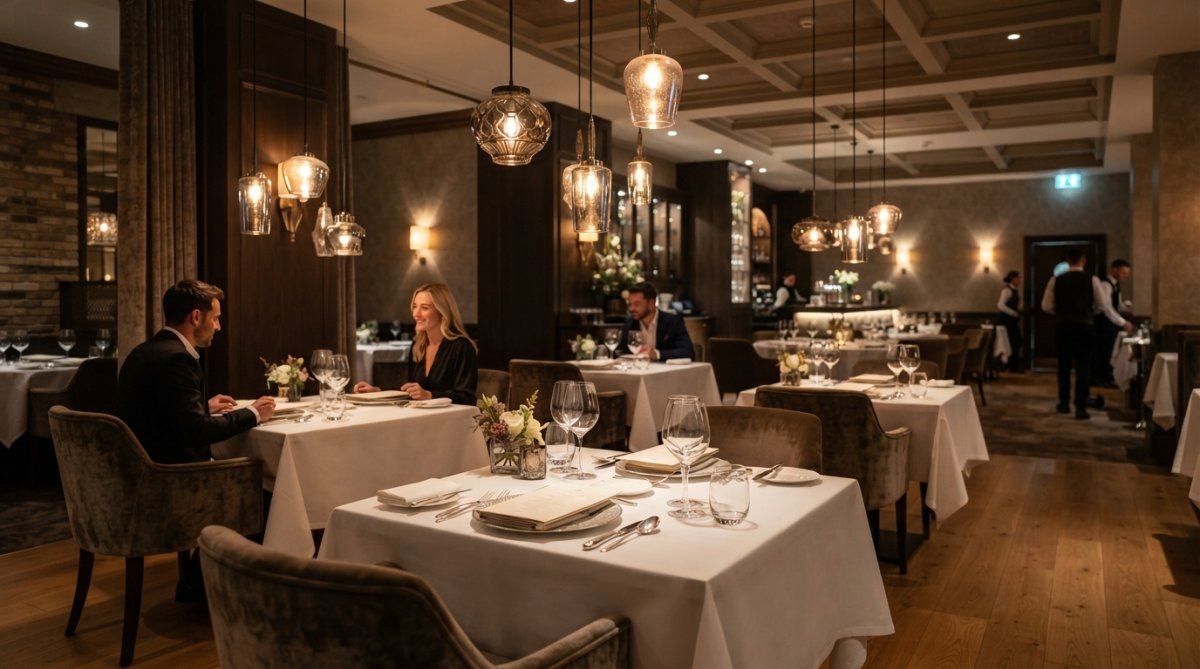
A fine dining restaurant is a place for slow enjoyment and intimacy. The lighting must support this: warm white, dimmed, focused on the tables, with subtle accent lighting for drama.
The ideal lighting values for fine dining:
- Ambient lighting: 100-150 Lux (dim but safe)
- Table lighting: 200-300 Lux (focused, warm)
- Light color: 2700K (warm like candlelight)
- Dimmability: 0-100% (full control over mood)
- CRI: 95+ (colors must be perfect)
Pendant lights are ideal for fine dining. They create focus and intimacy. Indirect wall lighting creates depth. A fine dining restaurant with good lighting feels luxurious.
Casual Dining and Bars: Energy and Flexibility
A casual dining restaurant or a bar needs a brighter, more energetic lighting mood. The lighting should encourage guests to eat faster and drink more.
The ideal lighting values for casual dining:
- Ambient lighting: 200-300 Lux (bright, clear)
- Light color: 3000-3500K (neutral to warm)
- Accent lighting: Strong and visible
- CRI: 85+ (good enough)
For bars, several small lights work better than one large one. They create rhythm and allow accent lighting on different elements. Flexible lights are important because casual dining restaurants often host events or change their layout.
Implementing High-Quality Lighting with Casa Padrino
Casa Padrino is not just a furniture manufacturer; it is a specialist in complete gastronomy solutions. The company understands that lighting and furniture must work together. A beautiful light over a poor table feels out of place. A beautiful table under poor light looks cheap.
Casa Padrino offers integrated solutions: furniture, lights, and accessories that together form a coherent concept. Their designer lights for upscale gastronomy are specially developed with high CRI, warm light, and glare-free design.
The collection includes pendant lights, wall lights, recessed spotlights, and accent lighting. All lights are dimmable and available in various styles, from classic to modern. A restaurant can get a complete lighting solution from a single provider without compromising on quality or style.
Casa Padrino also offers consulting. The company has over 20 years of experience with hotel projects and knows the requirements of upscale gastronomy. With Casa Padrino, you get not only lights but also expertise in Luxury Hotel Furniture and Hotel Interior Solutions.
High-quality lighting for upscale gastronomy is not a luxury; it is a necessity. A restaurant without a good lighting concept loses guests and revenue. A restaurant with professional lighting wins both.
The investment in high-quality lighting pays off through longer stays, higher spending, and better reviews. With the right lights, the right CRI value, and the right lighting mood, a restaurant becomes not only more functional but unforgettable.
Casa Padrino has the expertise and the collection to transform your restaurant into a place guests love. With lighting solutions specially developed for upscale gastronomy, you create an atmosphere that perfectly showcases your food and service. Discover the lighting solutions and luxury furniture from Casa Padrino and learn how professional lighting design transforms your restaurant.
Frequently Asked Questions
What color temperature is ideal for high-quality lighting in upscale gastronomy?
For upscale gastronomy, a color temperature between 2,700 and 3,000 Kelvin (warm white) is recommended in the dining area to create an inviting, luxurious atmosphere. These Kelvin values promote relaxation and well-being. In the bar area, 3,000-3,500 K can be selected to convey more energy. A high CRI value (Ra ≥ 90) is crucial so that food, drinks, and guests appear in authentic colors.
What role does the Color Rendering Index (CRI) play in gastronomy lighting?
The CRI value (Ra value) determines how natural colors look under a light source. In upscale gastronomy, the CRI should be at least 90, ideally ≥ 95. A high Ra value ensures that food looks appetizing, drinks look vibrant, and guests’ skin is illuminated flatteringly – essential for the guest experience and the perception of quality.
How can I effectively implement zone lighting in my restaurant?
Divide your dining area into zones: ambient lighting (approx. 300-500 Lux) for general orientation, table lighting (400-800 Lux) for food and guests, accent lighting for artwork or design elements, and separate lighting for the bar and entrance area. Use dimmable LED lights to adjust the light intensity depending on the time of day and guest volume. This creates flexibility and an optimal lighting mood.
Which designer lights are particularly suitable for upscale gastronomy?
High-quality pendant lights with glare-free light, elegant chandeliers for reception areas, and modern recessed spotlights are ideal. Materials such as brass, polished aluminum, or glass add luxury. Designer lights should match the overall concept of your restaurant – from classic baroque to contemporary. Casa Padrino offers exclusive lighting solutions specially developed for luxurious gastronomy spaces that meet the highest quality standards.
How do light colors influence the purchasing behavior and length of stay of guests?
Warm white light (2,700-3,000 K) promotes relaxation and longer stays, ideal for fine dining. Cooler color temperatures (3,500+ K) have an energizing effect, suitable for bars and casual dining. Psychologically, warm light is welcoming and increases the willingness to spend more. A well-thought-out lighting mood with a high CRI value enhances the perception of quality and contributes to positive guest reviews.