Table of Contents
- Handcrafted Furniture for Discerning Interior Designers: Why Craftsmanship Matters
- Bespoke Luxury Furniture: The Foundation of Individual Interior Design
- Individual Interior Design through Unique Designer Furniture
- Unique Designer Furniture for High-End Projects
- Hotel Interior Design Furniture: Professional Solutions for B2B Projects
- Collaboration with Interior Designers: Project Support from Start to Finish
- Why Handcrafted Furniture is Indispensable for Demanding Projects
Handcrafted Furniture for Interior Designers: Bespoke Solutions
Last updated: July 24, 2026
Interior designers who want to furnish their projects with timeless elegance and handcrafted precision know: handcrafted furniture for discerning interior designers is not just furniture. They are investments in quality, individuality, and the lasting impression a room leaves behind. Demotex GmbH has specialized in exactly this requirement for over two decades – combining European craftsmanship with timeless design for professionals who refuse to compromise. This guide shows you how bespoke solutions can transform your spatial concepts and why handcrafted quality makes all the difference.
Handcrafted Furniture for Discerning Interior Designers: Why Craftsmanship Matters
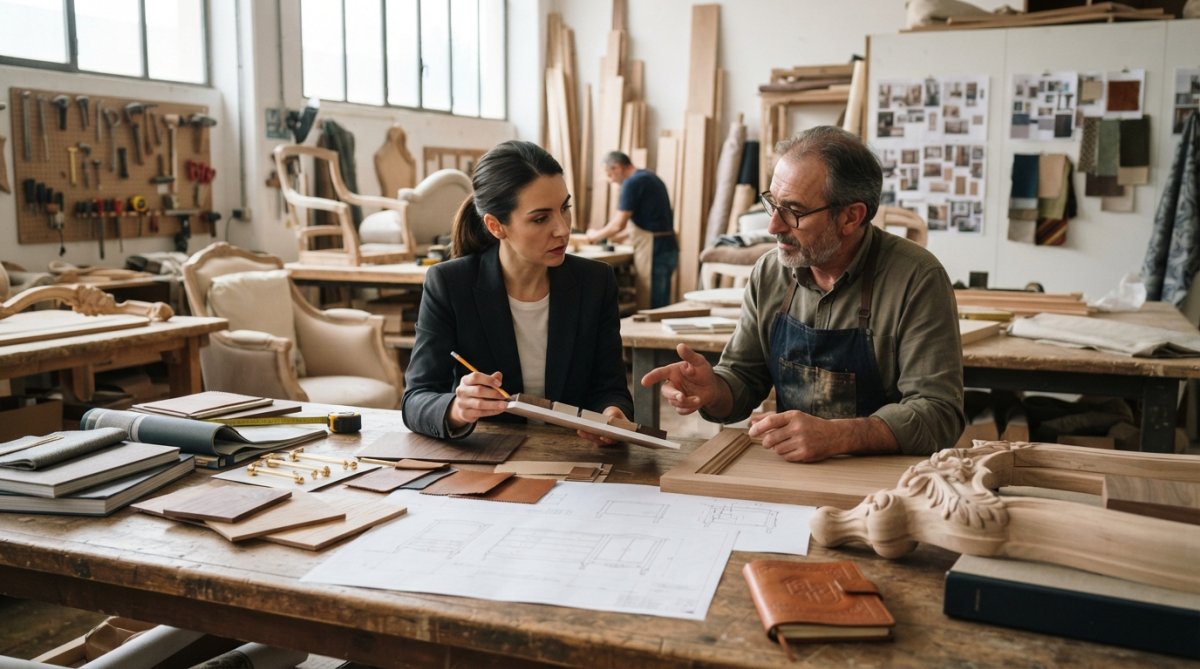
The distinction between industrial mass production and genuine manufacturing lies in the details that no one sees – until you sit in a room and feel the quality. Handcrafted furniture for discerning interior designers is not created on automated production lines, but by skilled artisans who inspect, adjust, and refine every single piece.
This process makes it possible to respond to specific spatial requirements that are impossible to meet with standard furniture. A Baroque armchair with bespoke proportions for a low-ceilinged penthouse living room. A Neoclassical chest of drawers that fits exactly into an unusually wide niche. A hotel headboard with integrated lighting according to precise CAD specifications.
Many interior designers underestimate the time advantage of craftsmanship: while you often have to make compromises with standard solutions, an experienced workshop integrates your requirements directly into production – no redesign, no adjustments after delivery required.
Durability is another critical factor. Handcrafted furniture lasts for decades – sometimes generations. In professional hotel operations, where furniture is subjected to intensive daily use, the higher investment quickly pays off through reduced replacement cycles and consistent aesthetics over the years.
Bespoke Luxury Furniture: The Foundation of Individual Interior Design
Bespoke solutions are the foundation upon which genuine interior design is built. Every project has different requirements – varying room geometries, styles, functional demands, and budget frameworks. Bespoke luxury furniture responds to this variability instead of ignoring it.
Material Selection and Handcrafted Precision
The choice of materials determines not only the aesthetics but also the durability and character of a space. Handcrafted furniture for discerning interior designers traditionally uses high-quality materials: solid woods such as mahogany, walnut, and oak; marble slabs for table tops; bronze for fittings; gold leaf for embellishments.
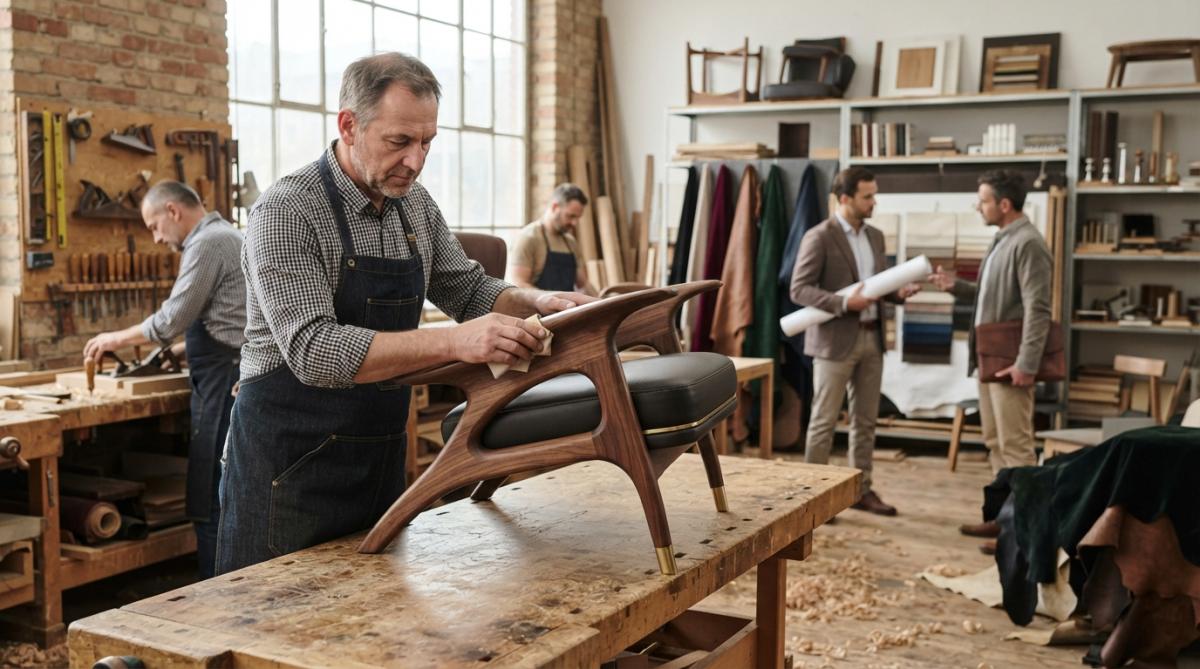
Every material is carefully inspected before processing. A block of wood is not cut immediately – it is seasoned to dry optimally. Veneers are selected and arranged by grain to create visual harmony. Surface finishing is carried out in multiple layers: sanding, priming, lacquering, polishing – each step controlled by hand.
Handcrafted precision is shown in millimeters: a cabinet whose doors close absolutely flush, even though the room has settled by 2 cm. A table whose top is just as level after years as it was on the first day.
Casa Padrino works with the finest European materials and has access to rare wood species and finishing techniques that industrial manufacturers cannot offer. This material quality is not interchangeable – it is part of a project’s identity.
CAD Planning and Technical Interfaces for Professionals
Modern interior design demands precise technical interfaces. You need CAD data to refine your planning. You need BIM integration for complex hotel projects. You need exact dimensions to ensure coordination with other trades.
Professional workshops understand this requirement. Planning begins with your specifications – whether as a PDF, a room sketch, or a digital file. The workshop creates detailed working drawings that are not only used for production but also serve you in coordinating with architects, electricians, and other specialists.
CAD planning also allows variants to be thought through quickly. Should the chest of drawers be 85 or 92 cm wide? How does this affect the proportions? A good partner will show you several options – digitally, before a single screw is turned.
Individual Interior Design through Unique Designer Furniture
Unique designer furniture pieces are not simply “more expensive furniture”. They are spatial solutions that respond to the specific situation – architecturally, functionally, and aesthetically.
From Baroque to Neoclassicism: Style Confidence in Contract Furnishing
Styles are more than decoration – they are a language that allows the space and the user to communicate with each other. A Baroque cabinet is not simply “playful”; it creates an atmosphere of elegance and history. A Neoclassical table communicates order, proportion, and timeless sophistication.
For interior designers, style confidence is crucial. You cannot improvise. A Baroque armchair that looks too “cheap” undermines the entire project. A Neoclassical shelf that is not perfectly proportioned is noticed immediately – negatively.
Casa Padrino offers comprehensive experience in classic European styles. Baroque with elaborate carvings and gilding. Rococo with playful shapes and fine details. Neoclassicism with stricter proportions and elegant restraint. Art Nouveau with flowing lines and organic shapes. These styles are not “trends” – they are proven design languages that work because they are based on decades or centuries of tested aesthetics.
For high-end hotel projects, this means: guests immediately recognize that they are in a space of quality. Not because of a price tag, but because of the craftsmanship, the choice of materials, and the stylistic coherence.
Spatial Concepts Combining Functionality and Aesthetics
A unique piece of designer furniture must function. A hotel bedside table that looks beautiful but has no power outlet is a failure. A desk whose proportions are elegant but whose work surface is too small is not usable.
True contract furnishing combines both. The bedside table has hidden power lines and magnetic holders for tablets. The desk has an optimal working height and integrated cable routing. Beauty arises through intelligent design, not despite functionality.
A common mistake: interior designers order furniture based on photos without clarifying the functional details. Later, it turns out that the cabinet is too deep to open the door fully, or that the drawers block each other. Clarify all functional requirements in writing before production begins.
Unique Designer Furniture for High-End Projects
A unique piece of designer furniture is a conscious decision against standard solutions. It is the recognition that a project deserves something special – and that this distinctiveness has a price that is worth it.
Handcrafted Precision versus Mass Production
The difference lies in control. In mass production, thousands of identical parts are manufactured. Quality control is done on a random basis. Defects are accepted as long as they are within the tolerance range. A cabinet with 2 mm of play in the hinges is “fine”.
In handcrafted production, every piece is inspected individually. The hinges are adjusted so that the doors close absolutely flush. Scratches on the surface are reworked. Proportions are checked with a trained eye – not just with measuring tools.
This takes time. A handcrafted cabinet takes longer than an industrially manufactured one. But the quality is incomparable. After years, the handcrafted cabinet is still as good as on day one. The industrially manufactured one shows wear and tear.
Surface Finishing and Material Quality as a Differentiating Feature
The surface is what you see and touch. It is therefore the primary signal of quality. A high-quality surface finish not only looks better – it also protects the material underneath.
Handcrafted finishing is done in layers. For a stained solid wood cabinet, this means: sanding the wood, applying stain, intermediate sanding, priming, first coat of lacquer, second sanding, second coat of lacquer, polishing. Every step is manually controlled.
The result is a surface that is not only smooth and glossy but also feels premium to the touch. Some surface finishes use traditional techniques such as a wax finish or shellac – materials that gain character over the years instead of fading.
For high-end hotel projects, this means: a chest of drawers cleaned daily by housekeeping retains its beauty. The surface finish is strong enough for intensive use, yet fine enough to exude elegance.
Hotel Interior Design Furniture: Professional Solutions for B2B Projects
Hotels have specific requirements that residential furniture does not have to meet. Guests use furniture more intensively, unpredictably, and sometimes more carelessly than private individuals. A hotel bed is made and unmade daily. A hotel armchair is used by hundreds of different people. A hotel cabinet must conceal household appliances while looking elegant at the same time.
Durability and Functionality in Hotel Operations
Durability in hotel operations is not optional – it is an economic necessity. A hotel bed that has to be replaced after 3 years is a financial disaster. An armchair whose upholstery is worn out after 2 years not only looks bad but also signals a lack of quality.
Professional hotel interior design furniture is therefore constructed differently than residential furniture. The frame construction is more solid. The upholstery uses more robust materials. The covers are made of fabrics that can withstand frequent washing. The wooden parts are protected with surface finishes that withstand cleaning agents.
Casa Padrino has over 20 years of experience in furnishing luxury hotels. This experience is reflected in every design decision. A hotel headboard is not only beautifully designed – it is constructed to be easy to clean, to prevent damage by guests, and to withstand years of intensive use.
Luxury hotels with high standards of aesthetics and durability, boutique hotels that differentiate themselves through design quality, and spa and wellness resorts where tranquility and elegance are central.
Sustainability Certifications and Compliance for Large-Scale Projects
Large-scale projects – whether hotel chains or commercial properties – increasingly have sustainability and compliance requirements. Furniture must be made from certified materials. Finishes must be environmentally friendly. Supply chains must be traceable.
A professional partner for hotel interior design furniture understands these requirements and can document them. FSC certification for wood. Environmentally friendly lacquers and stains. Transparent production processes that you can justify to your clients.
For large-scale projects, this is not only ethically important – it is also a marketing advantage. A hotel furnished with sustainable materials can communicate this. Guests who value sustainability will appreciate it.
Collaboration with Interior Designers: Project Support from Start to Finish
Planning Services and Architect Support
True planning services begin early. Not just when the furniture is ordered, but when the spatial concept is still in development. A good partner asks questions: What function should this space fulfill? Which style fits the project? Which materials make sense? Which colors harmonize with the rest?
These questions lead to better results. A cabinet that is not only beautiful but also fits perfectly with the architecture of the room. A table whose size and height are optimally coordinated with the room geometry. An armchair whose color enhances the project’s color palette.
Casa Padrino offers comprehensive advice. Your requirements are combined with craftsmanship knowledge. The result is furniture that is not only high-quality individually but also works as an ensemble.
Cost-Benefit Analysis for Bespoke Furnishing Projects
A common question: Is the investment in bespoke furniture really worth it? The answer is: It depends on how you measure the costs.
If you only compare the initial purchase costs, bespoke items are more expensive. A handcrafted cabinet costs more than an industrially manufactured one.
But if you calculate over the life cycle – purchase, maintenance, replacement, disposal – it looks different. A handcrafted cabinet lasts 20 years. An industrially manufactured one lasts 5-7 years. This means you have to replace the industrial cabinet 3-4 times, while the handcrafted one still looks good.
In addition: a cabinet that fits your project perfectly requires no adjustments. You save costs on reorders, modifications, and repairs.
For hotel projects, the calculation is even clearer. A hotel headboard that lasts 10 years is cheaper than one that has to be replaced after 3 years – even if the first one is more expensive.
| Aspect | Industrial Production | Handcrafted Production |
|---|---|---|
| Acquisition Costs | Low | Higher |
| Durability | 5-7 years | 15-20+ years |
| Adjustments needed | Frequent | Rare |
| Repairs | Regular | Minimal |
| Total costs over 20 years | Higher | Lower |
| Aesthetic consistency | Deteriorates | Maintained |
Why Handcrafted Furniture is Indispensable for Demanding Projects
Handcrafted furniture for discerning interior designers is not a luxury you can afford – it is a necessity for professionals who want to build their reputation. A project furnished with standard furniture looks like a project with standard furniture. A project with handcrafted furniture looks like a project where every detail has been thought through.
That is the difference between “beautiful” and “extraordinary”. Between “good” and “unforgettable”. Between a room that guests forget and a room they remember years later.
The investment in quality pays off – not only economically, but also in terms of customer satisfaction, project reputation, and personal satisfaction as an interior designer. You haven’t just furnished a room – you have created a masterpiece.
The reality of many design projects is a challenge: standard furniture never fits perfectly, compromises arise, and the original vision is diluted. Casa Padrino solves this problem with bespoke solutions developed specifically for your requirements. With over 20 years of experience in furnishing luxury hotels, villas, and high-end commercial spaces, Casa Padrino offers comprehensive expertise in craftsmanship, material selection, and timeless design. Every piece of furniture is manufactured with handcrafted precision, uses European quality materials, and integrates perfectly into your spatial concepts. Discover how Casa Padrino brings your next interior design vision to life.
Frequently Asked Questions
What advantages does handcrafted furniture offer interior designers compared to mass-produced goods?
Handcrafted furniture allows interior designers absolute creative freedom and individuality. Unlike mass production, bespoke solutions can be tailored precisely to room geometries, design concepts, and client specifications. Handcrafted precision guarantees the highest material quality and durability – essential for prestigious spaces and professional hotel projects. In addition, unique pieces create a distinctive ambiance that exudes prestige and exclusivity.
How does the collaboration between interior designers and manufacturers of handcrafted furniture work?
Project support begins with detailed planning services: interior designers develop their spatial concepts, and the manufacturer supports them with CAD planning and technical interfaces. Modern workshops offer architect services with BIM data and professional advice on material selection and surface finishing. Regular exchange during production ensures that every piece meets exact specifications – from design classics to innovative custom solutions.
Which materials and surface finishes are standard for high-end interior design projects?
Bespoke luxury furniture uses high-quality materials such as solid wood from sustainable sources, marble, bronze, and gold leaf. Surface finishes range from hand-polished lacquers to patinated metal surfaces. For hotel interior design furniture, robust, easy-to-maintain surface treatments are essential to guarantee durability in professional operations. Sustainability certifications and compliance standards are increasingly a prerequisite for B2B projects.
How do bespoke furniture pieces differ from standard solutions in their cost-benefit analysis?
While unique handcrafted designer furniture requires higher initial investments, it pays off over decades through durability and functionality. Unlike mass-produced goods, bespoke solutions retain their aesthetics and technical performance. For interior designers, this means: fewer replacement purchases, higher customer satisfaction, and a portfolio with lasting references. The individuality justifies the investment through unique spatial design.