Table of Contents
- Why Preventing Wear on Luxury Hotel Furniture Is So Important
- Choosing the Right Materials as a Foundation for Durability
- Hotel Furniture Care Guide: Establishing Systematic Maintenance
- Hotel Furniture Cleaning Tips: Gentle Methods for Fine Materials
- Protective Measures Against Daily Wear and Tear
- Preventing Wear on Luxury Hotel Furniture Through Strategic Placement
- Guest Information and House Rules for Wear Prevention
- Sustainable Procurement and Circular Design Principles
- Technology Integration for Monitoring and Maintenance
- Budgeting and ROI for Durable Hotel Furniture
Last updated: July 7, 2026
Preventing Wear and Tear on Luxury Hotel Furniture: 10 Professional Tips
Hoteliers and interior designers know: the quality of the furnishings determines the guests’ first impression and the longevity of the investment budget. Preventing wear and tear on luxury hotel furniture is one of the greatest challenges in the upscale hospitality industry. Under heavy use by daily changing guests, even high-quality furniture wears out faster if it is not properly cared for. Demotex GmbH specializes in consulting for luxury hotels and shows you how to preserve your exclusive furnishings for decades.
The right strategy for preventing wear and tear not only saves on repair costs but also preserves the luxury character of your spaces.
Why Preventing Wear on Luxury Hotel Furniture Is So Important
Wear and tear on hotel furniture happens differently than in private households. A hotel room is used daily by multiple people; furniture is moved, subjected to heavy loads, and exposed to various environmental conditions. Scratches, dents, and stains occur faster than expected.
Without systematic wear prevention, the results are compromised aesthetics, higher repair costs, a shorter lifespan, and negative guest reviews. Casa Padrino understands these challenges from decades of experience in hotel furnishing. Using high-quality materials like solid wood, marble, and bronze is only half the battle. Without systematic maintenance and protective measures, even the most exclusive furniture loses its luster.
Hotels that take wear prevention seriously reduce their furniture replacement costs by up to 40% over a ten-year period.
Choosing the Right Materials as a Foundation for Durability
Before you take care measures, protection begins with material selection. Not all materials are equally resistant to the daily demands of a hotel environment.
Solid wood furniture is the classic choice for luxury hotels. It is durable, repairable, and develops a noble patina over time. Veneered surfaces are more cost-effective but less repairable when damaged. Upholstered furniture with high-quality fabrics or leather is more susceptible to wear. Natural materials like genuine leather develop a patina and can be refurbished, while synthetic fabrics are easier to care for but look less luxurious.
Casa Padrino offers luxury furniture collections specifically developed for hotel operations. Marble and natural stone in tables are practically infinitely durable with proper care. Bronze and gold leaf are robust but susceptible to fingerprints and oxidation.
Choose materials that not only look luxurious but are also repairable. A solid wood table with a scratch can be refurbished. A veneered table with a scratch is often beyond saving.
Hotel Furniture Care Guide: Establishing Systematic Maintenance
A hotel furniture care guide is the heart of wear prevention. Without structured maintenance, damage occurs that could have been avoided.
Conducting Daily Inspections
Housekeeping staff should be trained to identify damage immediately. This means that during room cleaning, they look out for visible issues such as surface cracks, stains, loose handles, or damage to legs. If a problem is identified, it should be documented immediately and reported to the maintenance department.
Documenting Maintenance Logs
A written maintenance log is essential. For each room, it should record what was inspected, what problems were found, and what actions were taken. A simple log contains the date, inspected furniture items, identified defects, repairs carried out, and the name of the responsible staff.
This documentation makes it possible to identify patterns. If a specific piece of furniture repeatedly shows issues, it can be repaired or replaced before it becomes a major problem.
Without documentation, “blind spots” in maintenance arise. A simple digital system is a small investment with a huge benefit.
Hotel Furniture Cleaning Tips: Gentle Methods for Fine Materials
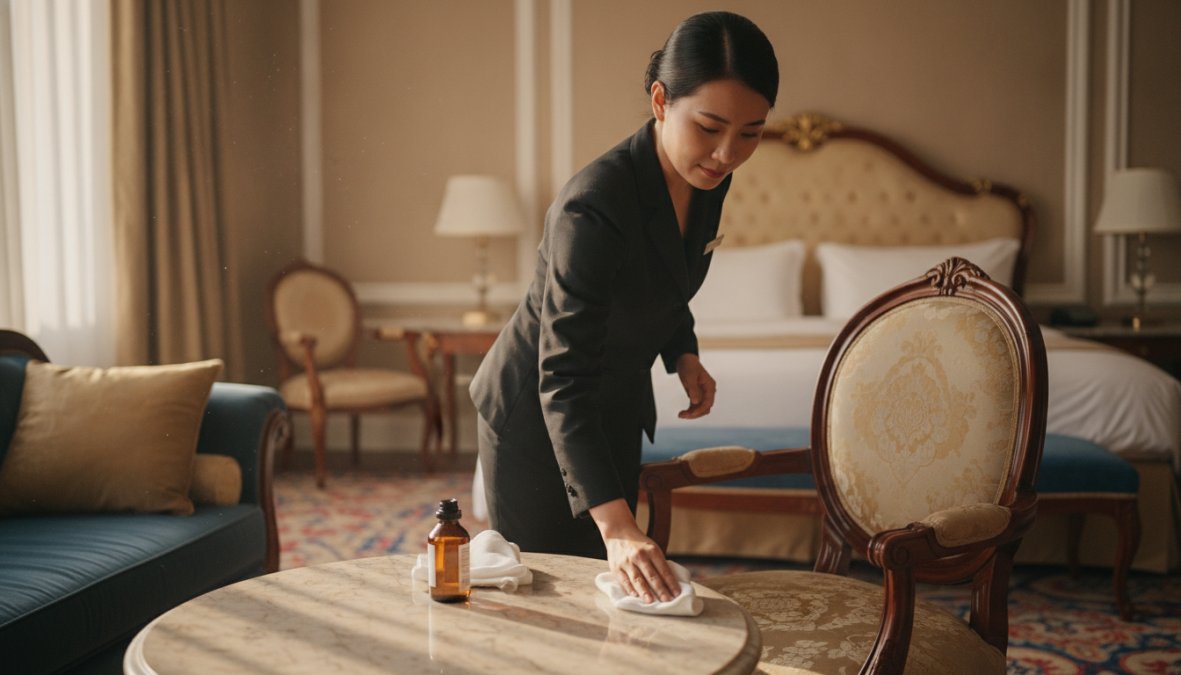
Hotel furniture cleaning tips require a structured, material-specific protocol. Without a systematic cleaning program, damage occurs that could have been avoided.
Material-Specific Cleaning Protocols and Frequencies
Solid wood furniture and veneered surfaces:
Daily surface cleaning with a soft, lint-free microfiber cloth and distilled water. Weekly deep cleaning with a pH-neutral wood cleaner (pH 5-7), applied in the direction of the wood grain. Monthly care with wood oil or beeswax polish renews the protective layer and prevents drying out. Quarterly inspection for scratches, cracks, or discoloration; minor scratches can be treated with wood repair markers. Maintain humidity control at 45-55% relative humidity to minimize swelling and shrinkage.
Leather upholstery and leather covers:
Daily cleaning with a soft, damp cloth removes dust and sweat. Weekly deep cleaning with pH-neutral leather soaps; never use water alone or aggressive chemicals. Monthly conditioning with leather care cream prevents dryness and cracking, especially important in dry climates. Treat fresh stains immediately using a dry method (blot with a paper towel, do not rub). Leather develops a natural patina that contributes to its luxury character.
Fabric upholstery and covers:
Daily surface cleaning with a soft brush or vacuum cleaner (low setting). Weekly stain treatment: treat fresh stains immediately using a dry method; use special cleaners for stubborn stains, always testing on an inconspicuous area first. Perform monthly deep cleaning with professional upholstery cleaning. Semi-annual inspection for wear, discoloration, or deformation. Fabrics with a higher thread count are more resistant to wear.
Marble, natural stone, and glass surfaces:
Daily cleaning with a soft cloth and distilled water; dry immediately to avoid water spots. Weekly deep cleaning with a pH-neutral natural stone cleaner (never acidic cleaners like vinegar). Monthly sealing with a special treatment prevents staining. Absorb oil or wine stains immediately with a paper towel.
Documentation and Training of Cleaning Staff
A cleaning log should contain the date, steps performed, cleaning agents used, identified issues, and the name of the staff member. Staff training is crucial: housekeeping employees should be trained in the correct application of cleaning agents, identification of material types, immediate measures for stains, and reporting procedures. Monthly refresher training prevents bad habits.
Troubleshooting and Emergency Repairs
Minor scratches on wood can be treated with wood repair markers. Deep scratches require sanding by professionals. Fresh stains on fabric are often reversible; dried stains require professional cleaning. Loose fittings should be adjusted immediately. Water damage is the most common cause of irreparable furniture damage – dry and ventilate immediately.
Water damage is the most common cause of irreparable furniture damage in hotels. Any leak near furniture should be fixed immediately.
Cost Budgeting for Cleaning and Maintenance
Daily cleaning requires 30-50 minutes per room. Weekly deep cleaning: 15-20 minutes per room. Monthly specialized cleaning: 30-60 minutes per room (rotating). Annual professional deep cleaning: 2-4 hours per room. Material costs (monthly per room): 5-15 EUR for specialized cleaning agents.
This investment is minimal compared to repair costs. A damaged piece of upholstered furniture costs 500-2,000 EUR to repair or 2,000-5,000 EUR to replace.
Invest in high-quality cleaning agents and training. A well-trained team with the right tools is the best insurance against wear and tear.
Protective Measures Against Daily Wear and Tear
Surface protection is important. Glass protective tops on tables protect the wood surface from scratches, stains, and water damage and can be easily replaced. Upholstery protection using slipcovers can be useful in high-traffic areas. Corners and edges are particularly vulnerable to damage; furniture should be placed so that it is not directly in the pathway. Coasters and felt pads protect wood surfaces from scratches.
Invest in high-quality protective measures that are not visible. Transparent glass protective tops or discreet felt pads are invisible but highly effective.
Preventing Wear on Luxury Hotel Furniture Through Strategic Placement
The placement of furniture directly influences its wear and tear. Sunlight causes fading, drying out, and warping. Use curtains or blinds to limit direct sunlight. Humidity control is also important; proximity to bathrooms can lead to swelling or mold growth. Good ventilation and humidity control are essential. Furniture in high-traffic areas wears out faster; the most valuable furniture pieces should be placed in less-used areas.
Casa Padrino offers room planning consulting for luxury hotels. The right layout can reduce wear and tear and improve aesthetics.
Guest Information and House Rules for Wear Prevention
A large part of wear and tear is caused by improper use by guests. Elegant house rules should be polite but clear: no feet on furniture, care when opening drawers, no heavy objects on tables, place liquids on coasters, no direct liquid splashes on wood or fabrics.
Communication should be friendly. An elegant sign in the room is more effective than aggressive signs. Staff should be trained to politely point out improper use to guests. Rapid response to problems prevents further damage.
Sustainable Procurement and Circular Design Principles
Preventing wear and tear on luxury hotel furniture is also a sustainability topic. Sustainable procurement means choosing furniture that is durable and can be repaired. A high-quality solid wood table can last for decades and be refurbished when needed.
Casa Padrino uses traditional European craftsmanship and high-quality materials to create furniture that is built to last. Circular design principles mean that furniture is designed to be easily repaired or refurbished. A hotel could introduce a refurbishment program where old furniture is restored and reused instead of being thrown away.
Sustainable procurement and refurbishment are not only good for the environment but also economically sensible. A piece of furniture that is refurbished often costs only a fraction of a new one.
Technology Integration for Monitoring and Maintenance
Modern luxury hotels increasingly use digital systems to monitor furniture condition, plan maintenance, and document compliance. A well-implemented technology strategy reduces manual errors and improves response times when issues arise.
Digital Maintenance Management Systems and PMS Integration
A maintenance management system (MMS) should be integrated with the hotel’s Property Management System (PMS). Core functions include automatic generation of maintenance tasks based on predefined schedules, mobile apps for housekeeping to report issues in real-time, automatic notifications for critical problems, a historical database of all maintenance work, and automatic report generation.
When selecting a system, ease of use, offline functionality, scalability, API integration, and data security should be considered.
Sensor-Based Environmental Monitoring
Environmental factors such as temperature, humidity, and light exposure significantly affect longevity. Sensors can continuously monitor these and trigger alerts.
Optimal Conditions:
- Temperature: 18-22°C (constant)
- Relative humidity: 45-55% (critical for wood furniture)
- Light exposure: UV protection through curtains
Sensors can be installed near windows, in bathrooms, and in storage areas. Automatic measures can be initiated when deviations are detected.
QR Codes and Digital Care Guides
Each piece of furniture can be labeled with a QR code that links to digital care instructions, maintenance logs, and repair history. The QR code is attached to the back or underside and links to a database containing material type, care requirements, recommended products, maintenance history, and photos of the furniture piece in its new condition.
Predictive Maintenance and Data Analysis
By analyzing historical data, patterns can be identified that point to future problems. A specific furniture model with recurring hinge issues indicates a design problem. Upholstered furniture in rooms with high humidity shows faster wear. Data analysis can also be used for budget planning: average lifespan, repair costs, and optimal replacement times.
Compliance and Documentation for Audits
A digital system creates a complete audit trail for compliance standards such as DIN EN 1021 (fire protection), DIN EN 1728 (safety), GDPR, and occupational health and safety.
Implementation Steps and Costs
Phase 1 (Month 1-2): Inventory and system selection. Costs: 5,000-15,000 EUR.
Phase 2 (Month 3-4): Pilot project in 10-20 rooms. Costs: 2,000-5,000 EUR.
Phase 3 (Month 5-6): Full rollout. Costs: 10,000-30,000 EUR.
Ongoing costs: Software licenses 500-2,000 EUR/month, sensor maintenance 200-500 EUR/month, training 500-1,000 EUR/month.
ROI: A well-implemented system can reduce maintenance costs by 20-30% and extend furniture lifespan by 15-25%. For a 100-room hotel, this means savings of 75,000-125,000 EUR over 10 years.
Technology is a tool for optimizing maintenance and cost management. A well-implemented system creates transparency and significantly reduces overall costs.
Budgeting and ROI for Durable Hotel Furniture
Investing in high-quality furniture and wear prevention has a clear ROI. A solid wood table with proper care can last 20-30 years, whereas a cheap table has to be replaced after 5-7 years. Over 30 years, this means multiple replacements of cheap tables versus a single purchase of a high-quality table.
Maintenance costs are minimal compared to replacement costs. A structured maintenance program also reduces emergency repairs, which are more expensive than planned maintenance.
Casa Padrino offers luxury hotel furnishing solutions designed for durability. A higher initial budget for high-quality furniture leads to lower overall costs over time.
| Aspect | High-Quality Furniture | Budget Furniture |
|---|---|---|
| Initial Investment | Higher | Lower |
| Expected Lifespan | 20-30 years | 5-7 years |
| Annual Maintenance Costs | Low | Medium |
| Repair Costs | Low (repairable) | High (often replacement) |
| Total Costs over 30 Years | Low | High |
| Aesthetic Appearance | Improves with patina | Deteriorates quickly |
Preventing wear and tear on luxury hotel furniture is not just a matter of aesthetics, but also of economic sense. A systematic approach to material selection, maintenance, cleaning, and protective measures significantly extends lifespan and reduces overall costs.
Casa Padrino offers not only high-quality luxury hotel furniture, but also the expertise to care for and protect it properly. With decades of experience in furnishing luxury hotels, the company understands the specific requirements of this industry.
Visit Casa Padrino to discover how exclusive Baroque furniture, Neoclassical furnishings, and custom bespoke furniture solutions can transform your hotel concept. Let our team advise you on how to create a timeless luxury ambiance that lasts for decades through the right selection and care.
Frequently Asked Questions
How often should luxury hotel furniture be maintained and inspected?
Professional hotels conduct daily visual checks and weekly detailed inspections. Deep cleaning and maintenance work should be carried out monthly, while seasonal inspections take place four times a year. This systematic hotel furniture care guide prevents minor damage before it turns into major problems and significantly extends the lifespan.
Which materials are most resistant to wear and tear?
Solid wood with high-quality surface treatments, natural stone such as marble and granite, and high-quality upholstery materials with special coatings offer optimal resistance to wear. Casa Padrino uses proven materials for its luxury hotel furniture, such as Italian solid wood, bronze, and gold leaf, which are known for their durability and elegance.
How do you protect upholstered hotel furniture from stains and wear?
Use hotel furniture cleaning tips such as regular vacuuming, immediate stain treatment, and professional dry cleaning. Protective covers and armrest protectors are effective preventive measures. High-quality upholstery materials with stain-resistant impregnation offer additional security. Good guest information also significantly reduces accidental damage.
What are the most common causes of wear and tear on hotel furniture?
Common causes include intensive use, improper cleaning, moisture and temperature fluctuations, and a lack of regular maintenance. Incorrect cleaning agents can damage fine materials. A structured hotel furniture care guide and professional maintenance by trained staff significantly minimize these risks and secure the investment in luxury furniture.