Table of Contents
- Definition and Historical Origin: Baroque and Rococo
- Stylistic Features of Baroque Furniture
- Rococo Style Features and Design Language
- Direct Comparison: Heaviness versus Lightness
- Materials and Woodworking
- Buying Baroque Furniture: What Collectors and Buyers Should Look For
- Integration into Modern Luxury Interiors
- Conclusion: The Right Choice for Your Interior
Last updated: August 27, 2026
Baroque vs. Rococo: Furniture Styles Compared
Distinguishing between Baroque and Rococo is one of the most fascinating chapters in the history of furniture design. While both styles emerged from the same European art history, they are worlds apart in their aesthetic philosophy. Baroque embodies power and prestige through grandeur and symmetry, while Rococo defines elegance through lightness and playful asymmetry. Casa Padrino, as a renowned manufacturer of exclusive luxury furniture, specializes in mastering both styles, offering bespoke solutions for collectors, interior designers, and luxury hotels wishing to integrate authentic Baroque and Rococo furniture styles into their spaces.
Anyone interested in these two eras faces a fundamental question: Which style fits my vision? The answer depends on more than just personal taste. It requires a deep understanding of the structural differences, craftsmanship techniques, and spatial impact of these two design styles.
The Baroque period (1600–1750) is the era of power and splendor, characterized by symmetrical, imposing forms. Rococo (1730–1780) is its more elegant continuation, featuring asymmetrical, playful ornamentation and a lighter design language.
Definition and Historical Origin: Baroque and Rococo
The Baroque Era (1600-1750)
Baroque emerged as an artistic movement of the Counter-Reformation and embodies the absolutist desire for representation of European princely courts. This stylistic era was characterized by dramatic staging, monumental architecture, and furniture designed to project power. The term “Baroque” itself originates from the Portuguese word “barroco” (an irregular pearl) and describes the opulent, sometimes ornate aesthetic of this period.
In furniture design, Baroque manifested through solid wood frames, elaborate carvings, and the use of precious materials such as solid wood, inlays, and veneers. The furniture pieces were not merely functional but served as status symbols in the castles and palaces of the European nobility. Every piece was a statement: grand, imposing, and unforgettable.
Art-historical documentation on the Baroque era
The Rococo Era (1730-1780)
Rococo developed as a reaction to the heaviness of the Baroque style. While Baroque ruled, Rococo played. This stylistic era, often understood as “Late Baroque,” originated in France and spread across Europe from there. The name is derived from the French word “rocaille” (shellwork), which was one of the defining decorative elements of this period.
Rococo furniture is characterized by curved legs (cabriole legs), asymmetrical shapes, and an abundance of delicate ornamentation. Where Baroque demonstrated power, Rococo demonstrated sophistication. The color palette was lighter, the shapes more fluid, and the ornamentation more playful. Mahogany, walnut, and oak were embellished with gilding and fine appliqués.
Rococo was the style of salons and private chambers, not throne rooms. Its elegance was more intimate, personal, and less formal than the monumental presentation of the Baroque style.
Stylistic Features of Baroque Furniture
Symmetry, Grandeur, and Prestige
Baroque furniture is the opposite of subtle. It is based on strict symmetry and architectural rigor. A Baroque armchair is not just a place to sit – er ist ein Thron im Miniaturformat. Die Symmetrie erstreckt sich über alle Achsen: von links nach rechts, von oben nach unten. Diese geometrische Ordnung vermittelt Stabilität, Macht und Kontrolle.
The grandeur of these furniture pieces was created through solid wood constructions, wide armrests, and high backrests. A Baroque dining table dominates the room not through understated elegance, but through pure presence. The legs are sturdy, often turned or carved, supporting the weight of this visual authority.
The desire for prestige was central. Baroque furniture pieces were instruments of power. They showcased wealth, taste, and access to the finest artisans. A guest entering a Baroque salon was meant to immediately understand: here sits someone who can afford to own magnificent things.
Ornamentation and Embellishments
Baroque ornamentation is opulent, structured, and narrative. Carvings tell stories – mythological scenes, hunting scenes, religious motifs. The decorations follow a clear hierarchical order: main motifs are larger and placed more centrally, while subordinate elements fill the gaps.
Gilding was not optional – sie war die Sprache des Barock. Gold auf dunklem Holz erzeugt einen dramatischen Kontrast, der Licht reflektiert und den Raum zum Glänzen bringt. Intarsien (Einlegearbeiten mit verschiedenen Holzarten) und Furniere (dünne Schichten kostbaren Holzes über günstigerem Untergrund) zeigten handwerkliche Meisterschaft und finanzielle Großzügigkeit.
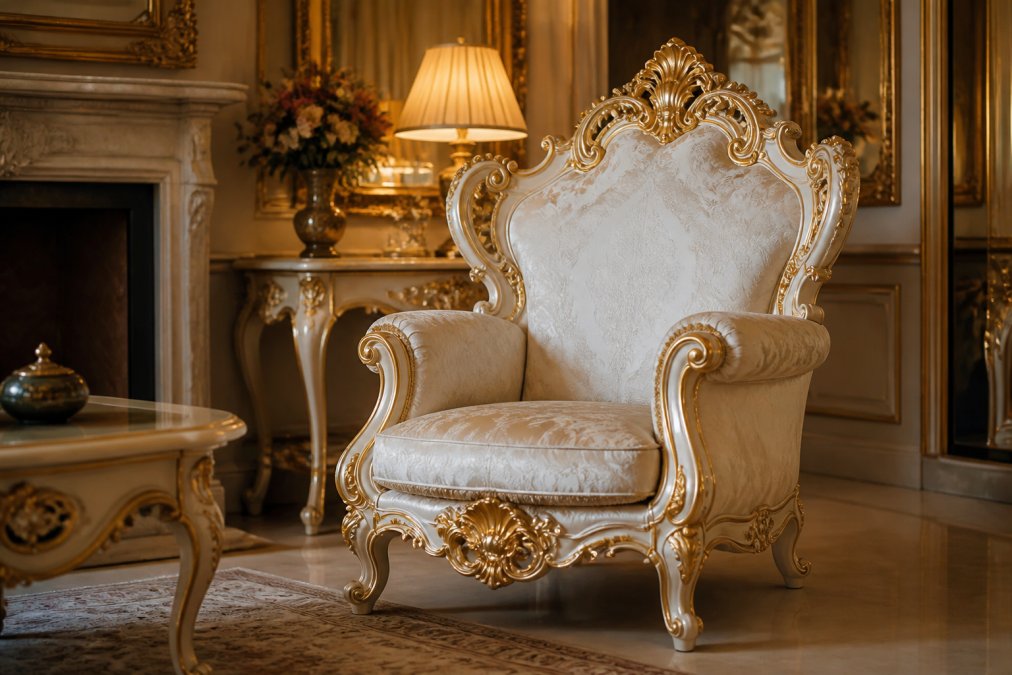
Casa Padrino specializes in these classic Baroque furniture pieces, offering armchairs, tables, and chests of drawers that keep this artisanal tradition alive. The use of solid wood, genuine gold leaf, and intricate carvings makes each piece an original.
Rococo Style Features and Design Language
Asymmetry, Lightness, and Elegance
While Baroque is symmetrical and monumental, Rococo is asymmetrical and playful. This asymmetry is not accidental – sie ist eine bewusste Abkehr von der geometrischen Strenge des Barock. Ein Rokoko-Sessel kann eine Armlehne haben, die anders verziert ist als die andere. Die Formensprache ist fließend, organisch, fast wie gefrorene Bewegung.
The lightness is an optical illusion created by craftsmanship. A Rococo chair with thin, curved legs supports just as much weight as a Baroque chair with solid legs – aber er wirkt, als könnte er jeden Moment davonfliegen. Diese Eleganz entsteht durch das Verhältnis von Masse zu Leerraum, durch die Reduktion von Schwere zugunsten von Schwung.
Rocaille, Shellwork, and Delicate Ornaments
Rocaille is the centerpiece of Rococo ornamentation. These shell-like, asymmetrical ornaments appear natural and spontaneous, but are in truth highly engineered. They originate from the imitation of shells, corals, and other natural forms, stylized into abstract, decorative motifs.
Shellwork (rocaille) appears everywhere: on mirrors, consoles, armchairs, and tables. It is the visual signature of Rococo. In contrast to the large-scale, symmetrical carvings of Baroque, Rococo ornaments are scattered, surprising, almost whimsical in their arrangement – und genau darin liegt ihre Eleganz.
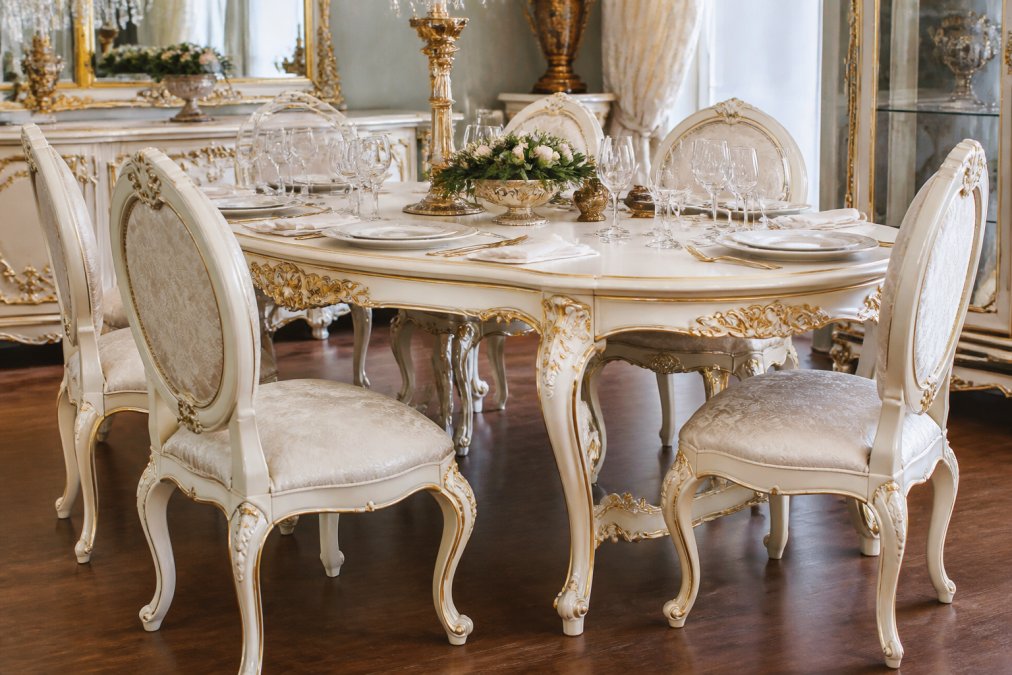
The delicate embellishments of Rococo require patience and precision. Every scroll, every curve is a decision made by the artisan. Casa Padrino’s Rococo collections showcase this mastery in every detail – von den geschwungenen Tischbeinen bis zu den feinen Applikationen auf Schubladen.
Direct Comparison: Heaviness versus Lightness
Structural Differences and Design Language
The most immediate difference between Baroque and Rococo lies in their design language. Baroque works with straight lines, right angles, and architectural principles. Even the carvings follow a clear structure. Rococo deliberately breaks these rules. Curved legs replace straight legs, and asymmetrical forms replace symmetrical arrangements.
A Baroque table has four identical legs that stand perpendicular to the floor. A Rococo table features cabriole legs – geschwungene Beine, die nach innen und dann nach außen schwingen. Diese strukturelle Differenz ist nicht ästhetisch, sondern konzeptionell. Der Barock sagt: „Ich bin stabil, ich bin stark." Das Rokoko sagt: „Ich bin elegant, ich bin bewegt."
The ornamentation follows this principle. Baroque carvings are large-scale, central, and symmetrical. Rococo carvings are scattered, surprising, and asymmetrical. Baroque fills surfaces; Rococo lets the space breathe.
Color Palette and Surface Treatment
Baroque favors dark, rich wood tones – Ebenholz, dunkles Mahagoni – mit kontrastierenden Vergoldungen. Rococo works with lighter tones: white-lacquered wood, light mahogany, walnut. The gilding is more subtle, often concentrated only on the ornaments rather than covering entire surfaces.
This choice of color has deep roots. Dark Baroque feels majestic, mysterious, and powerful. Light Rococo feels airy, playful, and intimate. A Baroque salon is a place of authority; a Rococo salon is a place of socializing and pleasure.
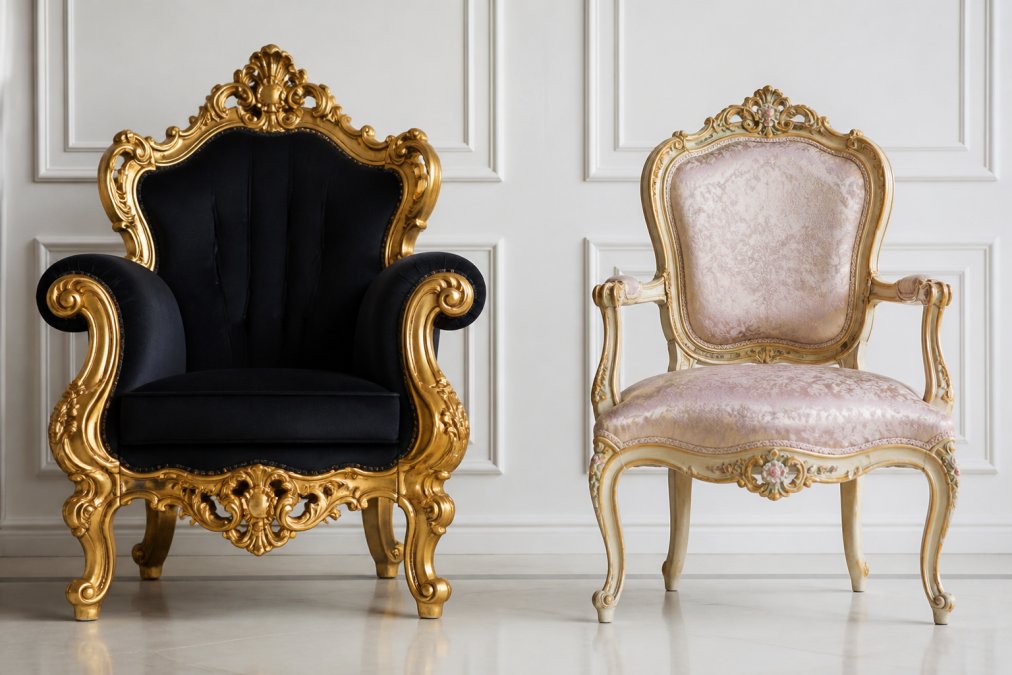
Baroque and Rococo should not be mixed. A Baroque armchair next to a Rococo chair looks dissonant because the two styles embody different spatial philosophies. Choose one style and remain consistent.
Materials and Woodworking
Solid Wood, Inlays, and Veneers
Both Baroque and Rococo are grounded in solid wood craftsmanship. The differences lie in the processing and application. Baroque utilizes solid blocks of wood for structures and carvings. Rococo works with thinner, more fluid forms, requiring highly precise woodworking.
Inlays (marquetry) are decorative techniques where different types of wood are combined to create patterns. This technique is used in both styles, but with different intentions. Baroque uses inlays for geometric, architectural patterns, while Rococo uses them for organic, flowing designs.
Veneers are thin layers of precious wood applied over a more affordable substrate. This technique allowed expensive woods to be used economically. Both Baroque and Rococo utilized veneers, but Rococo, with its lighter aesthetic, benefited particularly from this technique – sie ermöglichte die dünnen, eleganten Formen, die das Rokoko definieren.
Gilding and Exquisite Appliqués
Gold leaf is the language of luxury in both styles. Baroque uses gilding extensively – ganze Flächen glänzen golden. Rococo concentrates gilding on ornaments and details, creating a more subtle, refined effect.
Exquisite appliqués – Bronze, Marmor, Elfenbein, Perlmutt – wurden in beiden Epochen verwendet, aber wieder mit unterschiedlicher Intensität. Der Barock häuft diese Materialien an, um Reichtum zu demonstrieren. Das Rokoko setzt sie gezielt ein, um Akzente zu schaffen.
Art-historical analysis of materials in European furniture styles
Buying Baroque Furniture: What Collectors and Buyers Should Look For
Recognizing Authenticity and Craftsmanship Quality
Authentic Baroque furniture differs from reproductions in several ways. Genuine antique Baroque furniture shows signs of age and use – Kratzer, Unebenheiten, natürliche Verfärbungen des Holzes. The carvings are not uniformly precise because they were crafted by hand. Every piece is unique with individual characteristics.
The quality of craftsmanship can be recognized by the precision of the carvings, the stability of the construction, and the quality of the materials. Solid wood should be used throughout, not just as a superficial veneer. The joints between parts should be stable and expertly executed. Gilding should be genuine gold leaf, not cheap plastic.
Casa Padrino offers handcrafted Baroque furniture made using traditional methods. The use of solid wood, genuine gold leaf, and elaborate carvings guarantees that each piece is a true investment in quality. The Luxury Furniture Collection by Casa Padrino showcases this craftsmanship to its fullest extent.
Restoration and Value Retention
A Baroque furniture piece is a long-term investment that requires care. Restoration should be carried out by professionals who understand historical techniques. Improper restoration can destroy the value of a piece.
Value retention depends on several factors: rarity, condition, provenance (history of ownership), and quality. A rare Baroque furniture piece in excellent condition will appreciate in value over time. Regular care – Reinigung mit geeigneten Mitteln, Schutz vor direktem Sonnenlicht, Kontrolle der Raumfeuchte – erhält den Wert.
For modern Baroque furniture, such as that from Casa Padrino, value retention is less a matter of antiquity and more about the quality of craftsmanship. A well-crafted modern Baroque furniture piece retains its value because it is timeless and made with meticulous care.
Integration into Modern Luxury Interiors
Combination Possibilities with Contemporary Elements
Baroque and Rococo do not have to live in museum-like environments. Modern interior designers and collectors successfully integrate these styles into contemporary spaces. The key lies in balance and intentionality.
A Baroque armchair in an otherwise minimalist room becomes a statement piece – einem Kunstwerk, das Aufmerksamkeit auf sich zieht. A Rococo dining table in a modern loft with an open floor plan creates a focal point of elegance and history. The combination works when the contemporary elements are calm and neutral, so as not to overwhelm the classic furniture piece.
Materials can be combined: solid wood Baroque furniture alongside modern glass and steel, Rococo details next to minimalist walls. Colors should be coordinated – wenn das Barockmöbelstück dunkel ist, sollten die modernen Elemente neutral sein.
Casa Padrino’s Bespoke Furniture Service makes it possible to adapt classic styles to modern spaces. Tailored solutions can translate Baroque or Rococo into contemporary contexts without losing their essence.
Interior Design and Stylistic Coherence
The successful integration of classic furniture styles into modern spaces requires conceptual clarity. Every room needs a visual anchor. This can be a Baroque armchair, a Rococo table, or an ensemble of classic furniture pieces.
From this anchor point, the rest of the room should be coordinated. Wall colors should support the furniture, not compete with it. Lighting should highlight the details of the carvings and gilding. Modern artworks can work alongside classic furniture pieces if they are chosen deliberately.
Stylistic coherence does not mean everything must be identical. It means that all elements share a common understanding of elegance and sophistication. A Baroque salon with modern artworks works better than a Baroque salon with randomly thrown-together objects.
Modern approaches to integrating historical furniture styles
Casa Padrino’s Luxury Interior Design Service offers professional support for this integration. The experts understand how classic Baroque and Rococo furniture fit into contemporary spaces without losing their historical integrity.
Conclusion: The Right Choice for Your Interior
Ultimately, the comparison between Baroque and Rococo is a comparison between two philosophies: power versus elegance, symmetry versus asymmetry, grandeur versus lightness. Both are timeless, both are valuable, and both require an understanding of and respect for their artisanal heritage.
Choose Baroque if you want your space to project authority and prestige. Choose Rococo if you prefer elegance and sophistication. Or choose based on the spaces you live in and the materials you love.
The most important decision is not between Baroque and Rococo, but rather choosing authenticity and quality. A handcrafted Baroque furniture piece made of genuine solid wood with real gold leaf will accompany you for a lifetime. A poorly made reproduction piece will disappoint you after just a few years.
Guide to selecting classic furniture styles for private spaces
Casa Padrino does not just understand these differences theoretically; they live them in every creation. With over 20 years of experience in furnishing luxury hotels, villas, and private collections, Casa Padrino offers handcrafted Baroque and Rococo furniture that honors tradition and shapes the future. Whether you are looking for a single statement armchair or require a complete luxury hotel furniture solution for a major project, the experts at Casa Padrino understand the nuances of these styles and can turn your vision into reality.
Discover the Baroque Furniture Collection and the exclusive Rococo pieces at Casa Padrino. Every piece of furniture is a work of art, every detail a deliberate choice, and every investment a promise for the future. Visit Casa Padrino today and be inspired by the mastery of European craftsmanship.
Frequently Asked Questions
What is the main difference between Baroque and Rococo furniture?
Baroque furniture is characterized by grandeur, symmetry, and monumental ornamentation – embodying pomp and the desire for prestige. Rococo furniture is lighter, more asymmetrical, and playful, featuring delicate ornaments like rocaille and shellwork. While Baroque projects power, Rococo conveys elegance and lightness. Both styles utilize high-quality materials such as solid wood and gilding, but differ fundamentally in their design language.
What materials were typically used for Baroque and Rococo furniture?
Both eras favored exquisite materials: solid wood (mahogany, walnut, oak), inlays, and veneers for structure and decoration. Gilding and gold leaf were standard for appliqués and details. Upholstery featured high-quality fabrics and genuine leather. Casa Padrino works with these traditional materials and modern craftsmanship techniques to ensure authentic quality.
How do I recognize high-quality Baroque and Rococo furniture when purchasing?
Look for artisanal details: fine carvings, sturdy solid wood frames, and even gilding. Check the execution of inlays and veneers – they should be precisely crafted. Antique pieces show patina and natural signs of wear. For new furniture, the consistency of the ornamentation and the stability of the construction are crucial. Casa Padrino offers transparent craftsmanship quality.
Can Baroque and Rococo furniture work in modern luxury interiors?
Yes, absolutely. These styles create statement moments and contrasts in contemporary spaces. The key lies in balance: combine classic furniture pieces with minimalist elements, modern lighting, and neutral wall colors. A single Baroque armchair or Rococo dining table can act as an eye-catcher in an otherwise modern room. Casa Padrino supports you with bespoke solutions for your specific interior design.
How long does well-maintained Baroque and Rococo furniture last?
High-quality pieces made of solid wood with professional craftsmanship can last for generations if properly cared for. Regular cleaning, protection from direct sunlight, and occasional restoration preserve their value and beauty. Casa Padrino furniture is designed for longevity – both for private residences and professional hotel environments, where durability is essential.